
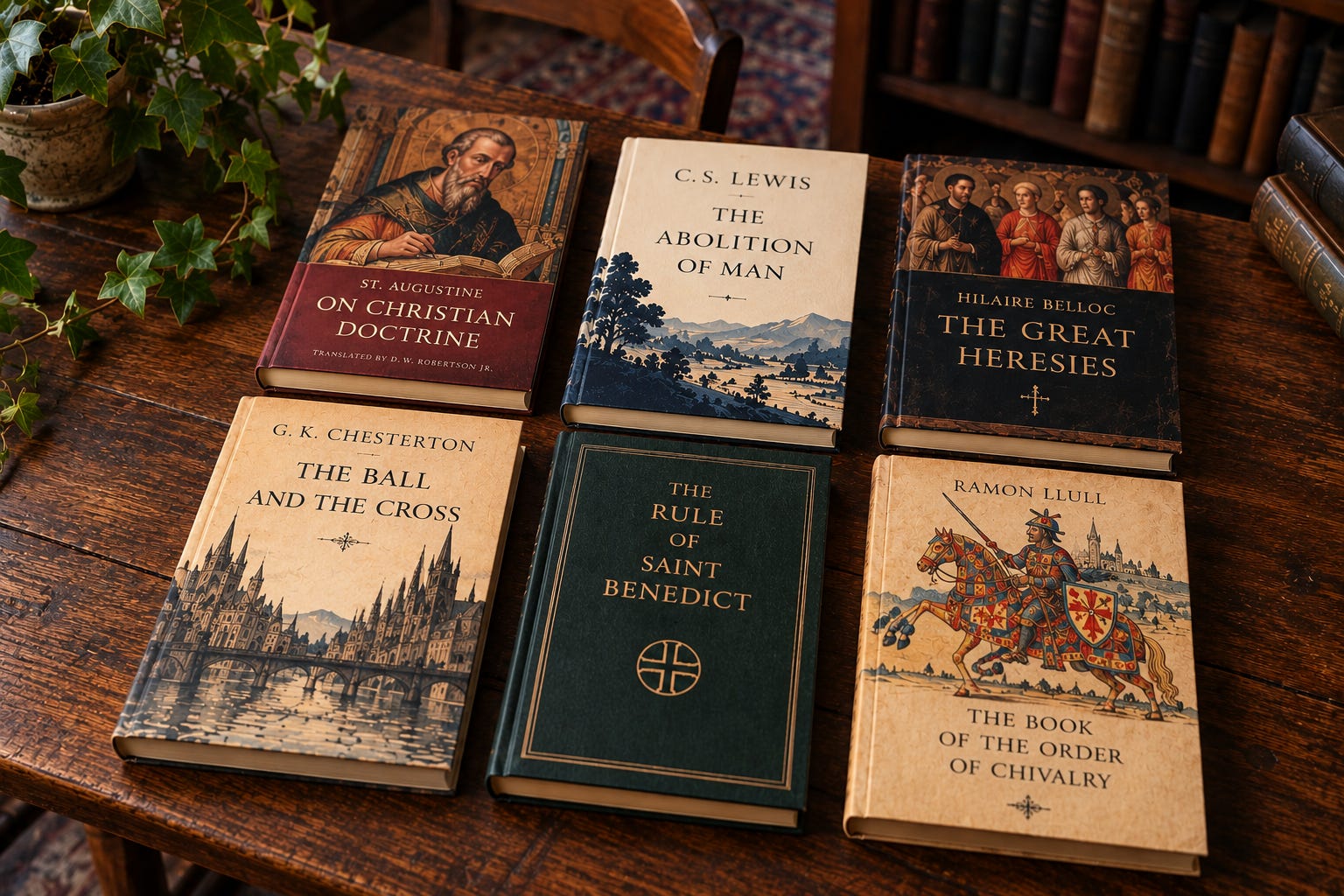
Six short books that you can (realistically) finish this month, from Augustine and C. S. Lewis to Chesterton and St. Benedict. Some are theology and philosophy, others history and fiction, but all six touch on the things we talk about here all the time: the ideas that shaped the West.
Now let’s get into the books…
1. On Christian Doctrine by St. Augustine (a. 160 pages)
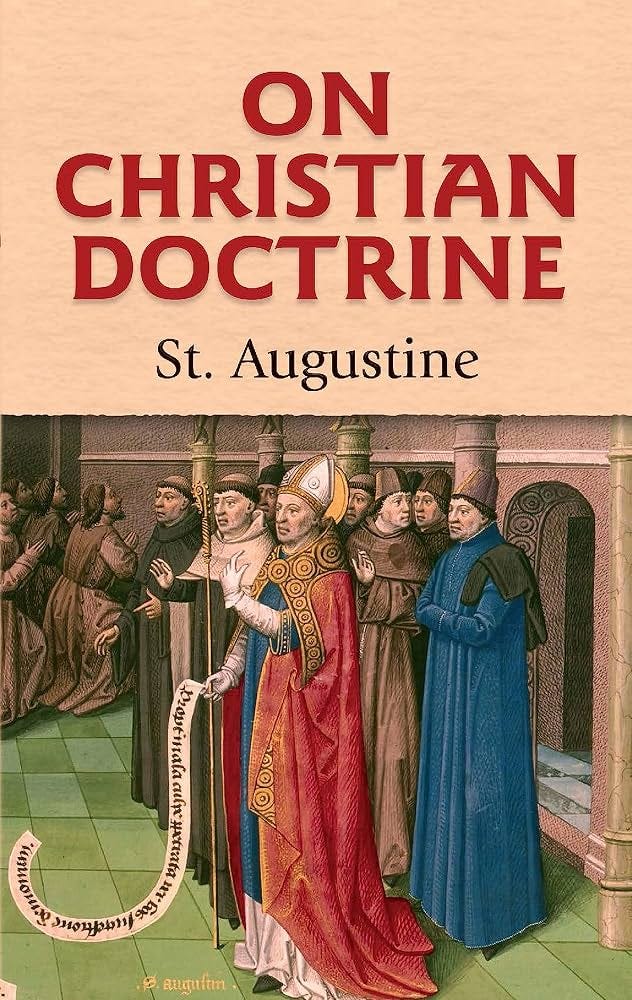
Written across the late fourth and early fifth centuries, On Christian Doctrine is Augustine’s guide to understanding and teaching Scripture, but it becomes a much broader discussion about knowledge, and the proper purpose of learning.
One of Augustine’s most interesting ideas is that Christians should not be afraid of learning simply because it comes from outside Christianity. Truth belongs to God wherever it is found, and Augustine famously compares this to the Israelites taking the gold of Egypt and putting it toward a better purpose:
Moreover, if those who are called philosophers, and especially the Platonists, have said aught that is true and in harmony with our faith, we are not only not to shrink from it, but to claim it for our own use from those who have unlawful possession of it. For, as the Egyptians had not only the idols and heavy burdens which the people of Israel hated and fled from, but also vessels and ornaments of gold and silver, and garments, which the same people when going out of Egypt appropriated to themselves, designing them for a better use, not doing this on their own authority, but by the command of God, the Egyptians themselves, in their ignorance, providing them with things which they themselves were not making a good use of; in the same way all branches of heathen learning have not only false and superstitious fancies and heavy burdens of unnecessary toil, which every one of us, when going out under the leadership of Christ from the fellowship of the heathen, ought to abhor and avoid; but they contain also liberal instruction which is better adapted to the use of the truth, and some most excellent precepts of morality; and some truths in regard even to the worship of the One God are found among them. Now these are, so to speak, their gold and silver, which they did not create themselves, but dug out of the mines of God’s providence which are everywhere scattered abroad, and are perversely and unlawfully prostituting to the worship of devils. These, therefore, the Christian, when he separates himself in spirit from the miserable fellowship of these men, ought to take away from them, and to devote to their proper use in preaching the gospel. Their garments, also—that is, human institutions such as are adapted to that intercourse with men which is indispensable in this life—we must take and turn to a Christian use.
Augustine refuses to make us choose between faith and learning. The intellect should be cultivated and knowledge should be pursued, but both ultimately have to be ordered toward something higher than themselves.
If you are interested in classical education, start here.
2. The Abolition of Man by C. S. Lewis (a. 100 pages)
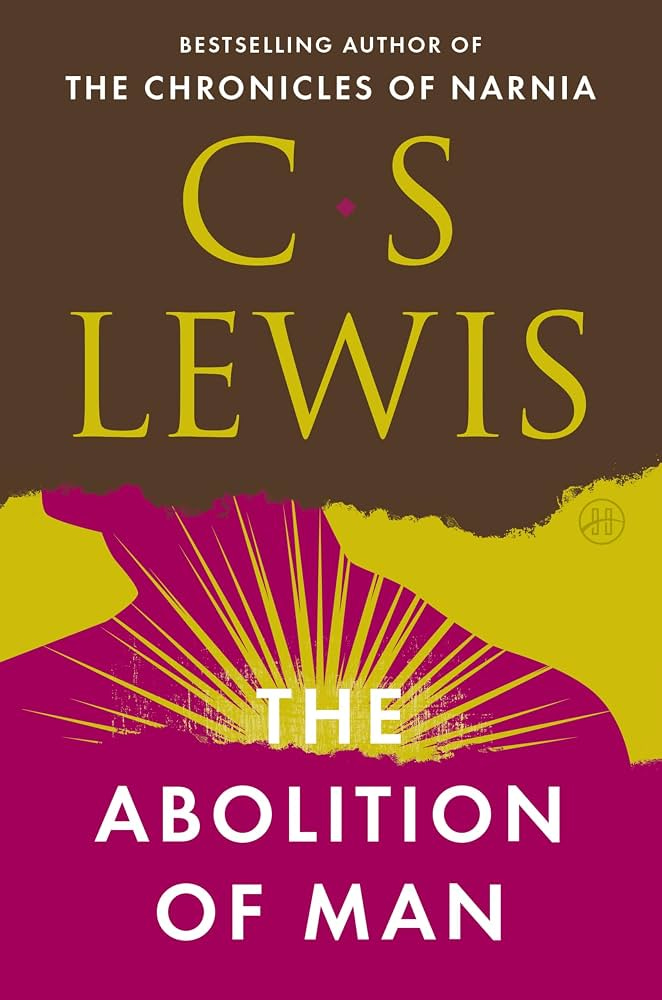
This might be the most important short book on the list.
Published in 1943, The Abolition of Man began as a series of three lectures in which C. S. Lewis examined education, morality, and what happens when a civilization stops believing that good and evil are objectively real.
Lewis saw something deeply wrong with an education that trained the intellect while weakening the moral imagination. His famous description of modern education producing “men without chests” refers to people whose reason and appetites remain, but whose character has never been properly formed:
The operation of The Green Book and its kind is to produce what may be called Men without Chests. It is an outrage that they should be commonly spoken of as Intellectuals. This gives them the chance to say that he who attacks them attacks Intelligence. It is not so. They are not distinguished from other men by any unusual skill in finding truth nor any virginal ardour to pursue her. Indeed it would be strange if they were: a persevering devotion to truth, a nice sense of intellectual honour, cannot be long maintained without the aid of a sentiment which Gaius and Titius could debunk as easily as any other. It is not excess of thought but defect of fertile and generous emotion that marks them out. Their heads are no bigger than the ordinary: it is the atrophy of the chest beneath that makes them seem so. And all the time—such is the tragi-comedy of our situation—we continue to clamour for those very qualities we are rendering impossible. You can hardly open a periodical without coming across the statement that what our civilization needs is more ‘drive’, or dynamism, or self-sacrifice, or ‘creativity’. In a sort of ghastly simplicity we remove the organ and demand the function. We make men without chests and expect of them virtue and enterprise. We laugh at honour and are shocked to find traitors in our midst. We castrate and bid the geldings be fruitful.
Lewis understood that education is never simply about transferring information. We are always teaching young people what deserves admiration and what deserves contempt, what is worth loving and what is worth rejecting.
It is barely a hundred pages, but there is enough in here to think about for years.
3. The Great Heresies by Hilaire Belloc (a. 160 pages)
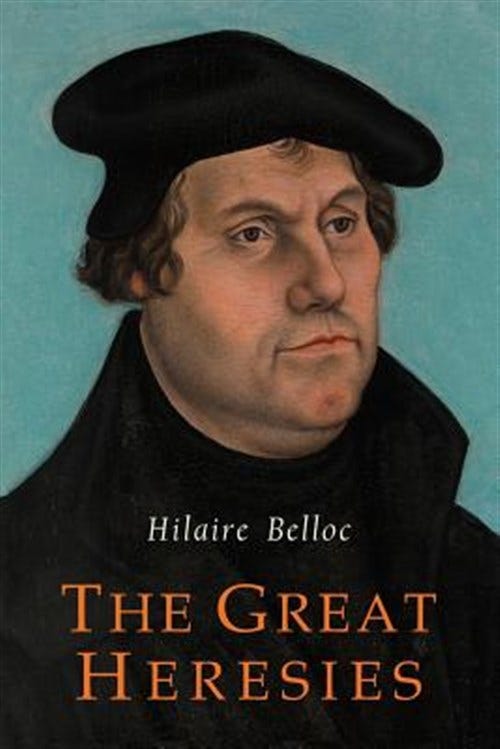
If you want a short introduction to some of the great religious conflicts that shaped Western history, Belloc is always entertaining.
In The Great Heresies, he looks at several movements that challenged Christianity across the centuries, including Arianism, Islam, the Albigensians, and the Protestant Reformation.
Hilaire Belloc warns that the West should not assume its centuries-long struggle with Islam is over simply because Islam appears politically weak in the present:
It has always seemed to me possible, and even probable, that there would be a resurrection of Islam and that our sons or our grandsons would see the renewal of that tremendous struggle between the Christian culture and what has been for more than a thousand years its greatest opponent. The recrudescence of Islam, the possibility of that terror under which we lived for centuries reappearing, and of our civilization again fighting for its life against what was its chief enemy for a thousand years, seems fantastic. Who in the Mohammedan world today can manufacture and maintain the complicated instruments of modern war? Where is the political machinery by which the religion of Islam can play an equal part in the modern world? I say the suggestion that Islam may re-arise sounds fantastic—but this is only because men are always powerfully affected by the immediate past:—one might say that they are blinded by it.
His larger point is that ideas have consequences, and theological disagreements can eventually transform entire civilizations. Change what people believe about God and man, and sooner or later you change their culture and understanding of society as well.
Belloc is opinionated, provocative, and certainly not neutral, which is part of what makes him so enjoyable to read. You do not have to agree with every conclusion to appreciate the larger question he is asking:
What happens to a civilization when its fundamental beliefs change?
4. The Ball and the Cross by G. K. Chesterton (a. 200 pages)
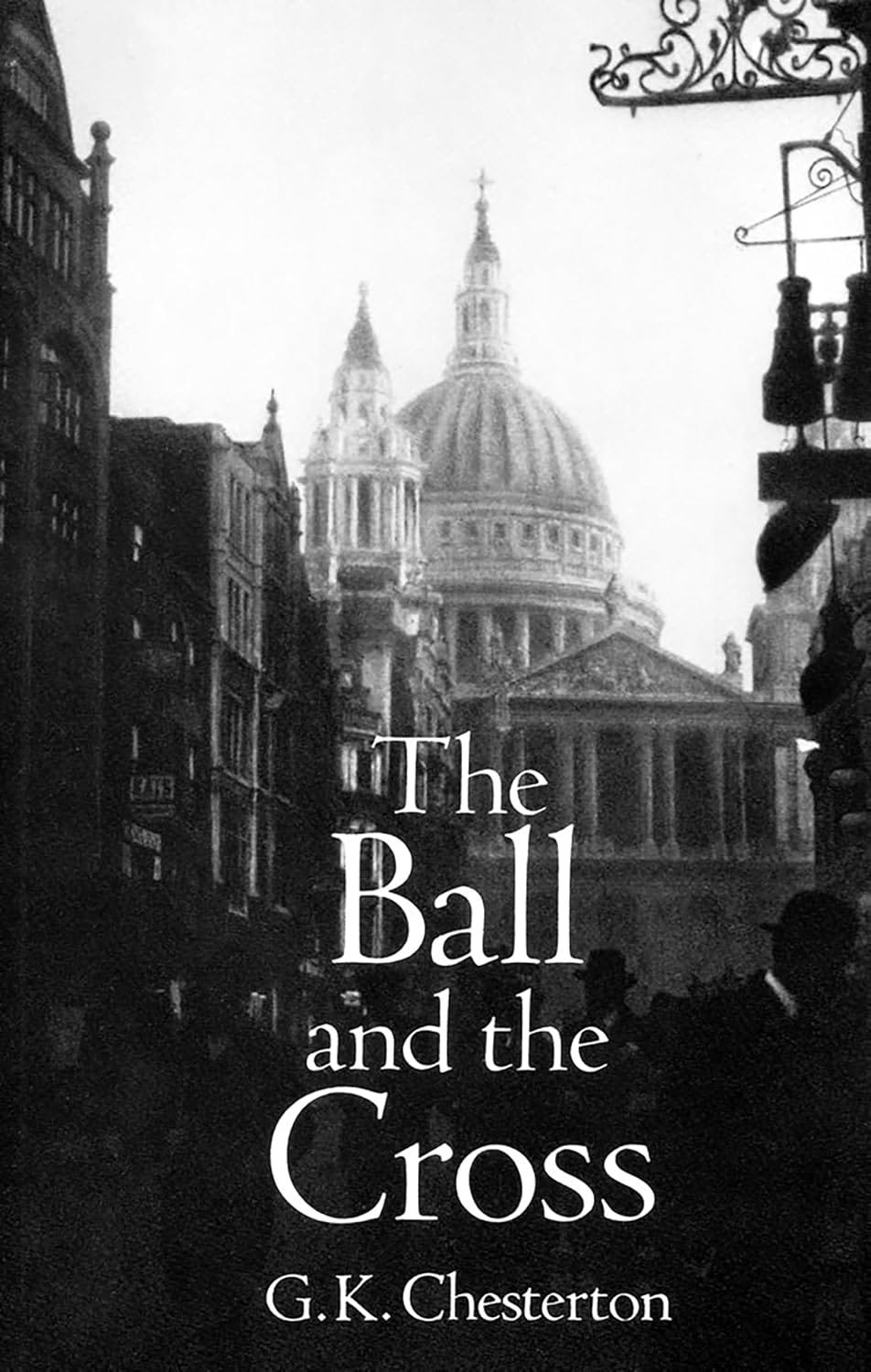
Now something completely different written by Belloc’s best friend, G. K. Chesterton.
The Ball and the Cross begins with two men who absolutely cannot stand each other.
One is a devout Catholic.
The other is a committed atheist.
After the atheist publishes an attack on Christianity, the Catholic becomes so outraged that he challenges him to a duel, and the two spend much of the novel desperately trying to fight each other while everyone around them desperately tries to stop them.
G. K. Chesterton argues that words are worth fighting over precisely because words carry meaning, and meaning ultimately determines what we believe to be true:
Why shouldn’t we quarrel about a word? What is the good of words if they aren’t important enough to quarrel over? Why do we choose one word more than another if there isn’t any difference between them? If you called a woman a chimpanzee instead of an angel, wouldn’t there be a quarrel about a word? If you’re not going to argue about words, what are you going to argue about? Are you going to convey your meaning to me by moving your ears? The Church and the heresies always used to fight about words, because they are the only things worth fighting about.
It sounds ridiculous because it is.
But underneath the comedy, Chesterton is making a good point about a society that has become so indifferent to questions of truth that it considers two men willing to fight over their beliefs more insane than the people who believe in nothing strongly enough to fight for it.
Like most Chesterton, it is funny and strange, but also serious when it needs to be.
If you want one work of fiction on this list, make it this one.
5. The Rule of Saint Benedict by St. Benedict (a. 100 pages)
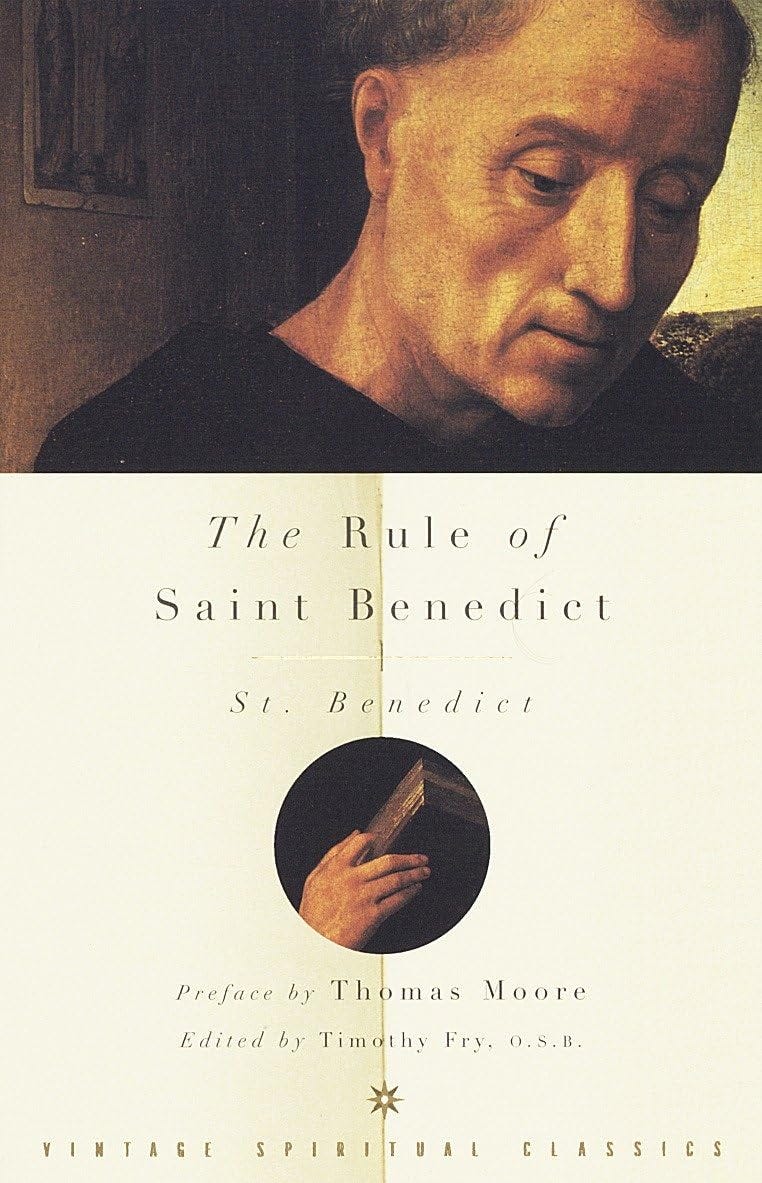
Written in the sixth century as a guide for monastic communities, The Rule of Saint Benedict lays out a way of life built around prayer and work.
There is nothing flashy about it (and that is precisely the point).
Benedict is concerned with how people actually live together: when they pray and work, how authority should be exercised, etc.
He presents the Christian life as a battle against our own will, fought through prayer and obedience in service of Christ the true King:
Listen, O my son, to the precepts of thy master, and incline the ear of thy heart, and cheerfully receive and faithfully execute the admonitions of thy loving Father, that by the toil of obedience thou mayest return to Him from whom by the sloth of disobedience thou hast gone away. To thee, therefore, my speech is now directed, who, giving up thine own will, takest up the strong and most excellent arms of obedience, to do battle for Christ the Lord, the true King. In the first place, beg of Him by most earnest prayer, that He perfect whatever good thou dost begin, in order that He who hath been pleased to count us in the number of His children, need never be grieved at our evil deeds. For we ought at all times so to serve Him with the good things which He hath given us, that He may not, like an angry father, disinherit his children, nor, like a dread lord, enraged at our evil deeds, hand us over to everlasting punishment as most wicked servants, who would not follow Him to glory.
The Rule went on to shape countless monasteries across medieval Europe, and those monasteries became important centers of worship and education.
You can read the whole thing in a day.
6. The Book of the Order of Chivalry by Ramon Llull (a. 100 pages)
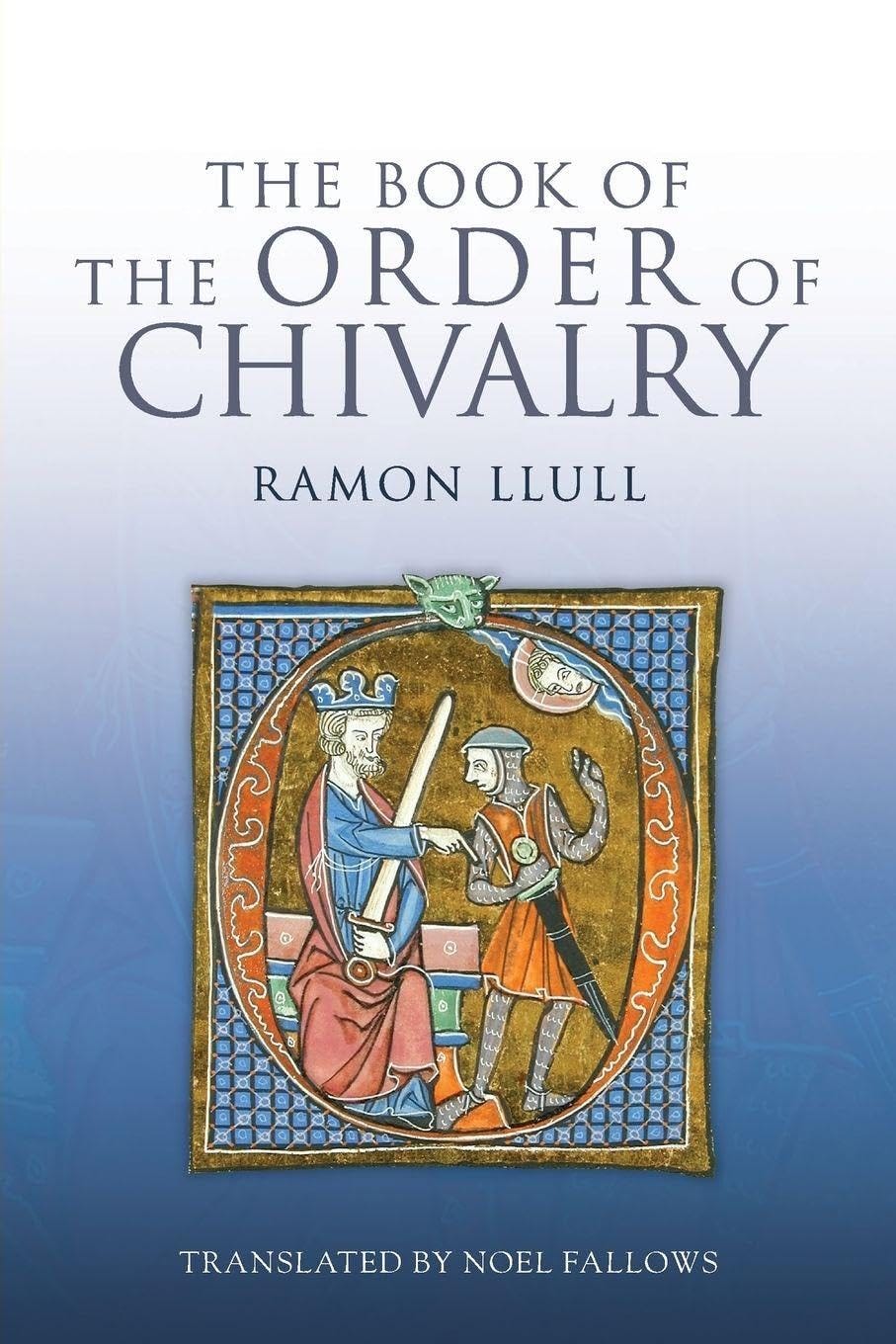
And finally, something for anyone interested in knights and medieval chivalry.
Written by the medieval philosopher Ramon Llull in the thirteenth century, The Book of the Order of Chivalry asks a simple question:
What is a knight actually supposed to be?
Ramon Llull argues that a true knight is defined not by his title, but by his duty to defend the faith, uphold justice, and protect the weak:
The office of the knight is the aim and purpose for which the Order of Chivalry was begun; thus, if the knight does not practise the office of knighthood he is contrary to his Order and to the aforesaid beginnings of Chivalry, and because of this contradiction he is not a true knight even though he may be called a knight, and such a knight is baser than the weaver or the trumpeter who does practise his office. The duty of a Knight is to support and defend the Holy Catholic Faith. The duty of a Knight is to support and defend his earthly lord, for neither a king nor any high baron has the power to uphold righteousness among his people without aid and help. The duty of a Knight is to support and defend women, widows and orphans, and sick or enfeebled men. Moreover, he ought to establish towns and cities in order to guarantee justice to the people. Since nobility of courage has chosen the knight over those who are beneath him in servitude, nobility of habits and good manners befit the knight, for nobility of courage could not achieve the high honour of Chivalry without appropriate virtues and good habits.
That makes the book super interesting because it shows us chivalry as medieval writers wanted it to be understood:
The knight is not simply a warrior.
He is supposed to be a certain kind of man.
Of course, real medieval knights did not always live up to that ideal, just as people rarely live perfectly according to the ideals of their own age.
Friendly reminder:
The Western Spirit exists because of readers like you. Join us and help keep this project alive and independent.
If you’ve been enjoying these essays, consider becoming a paid subscriber. For a few dollars a month, you’ll get:
Essays on brave men, and turning points in Western history
Reflections on faith, tradition, and culture
Full access to the growing archive - essays, book breakdowns, and deep dives
This project exists because readers like you make it possible.
As I mentioned in Friday’s email, today I’m finally announcing our next project.
For obvious reasons, the announcement is behind the paywall and exclusively for those who support our publication. This is something I’ve been working on for a while, and I’m incredibly excited to finally share it with you.
Join us (or miss out on what everyone else will be talking about)..