
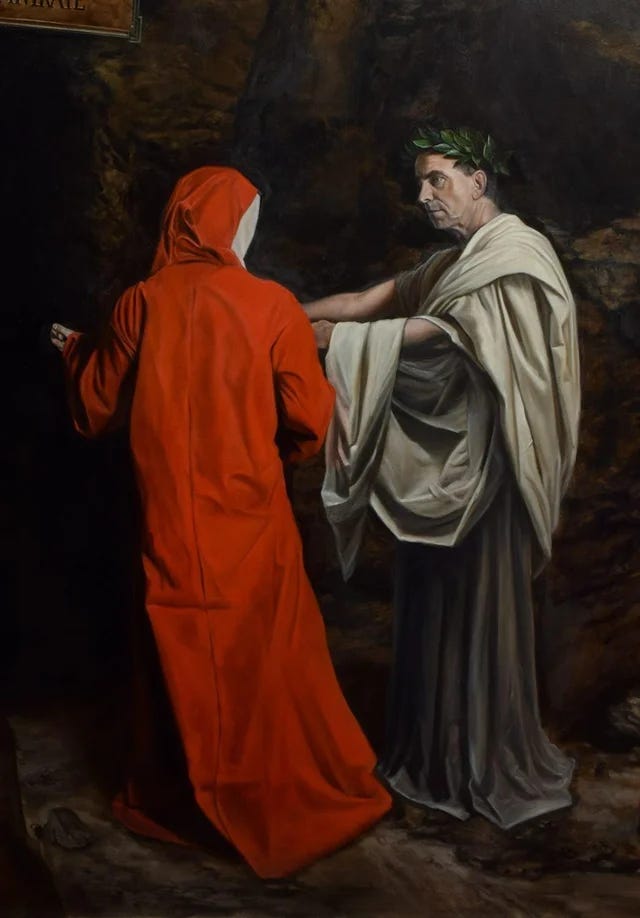
Everyone knows Dante’s Inferno as the poem about Hell… the circles of sinners, the flames, the grotesque punishments. It’s one of the most vivid depictions of damnation in all of literature. But if you read it closely, one of its most haunting lessons isn’t about fire or demons. It’s about something quieter, something easier to miss: who you choose to follow.
At the start of the Divine Comedy, Dante is lost in a dark wood. He doesn’t know how he got there. He just knows he’s surrounded by confusion, fear, and danger. Then three beasts appear… a leopard, a lion, and a she-wolf… blocking every path forward. Dante is stuck.
And that’s when someone arrives: Virgil, the great Roman poet. Virgil represents reason, wisdom, and art. He was Dante’s literary hero, the model he most admired. And now, in the poem, he appears as a guide. Virgil tells Dante he can’t get past the beasts alone. He’ll have to take another road… one that descends through Hell and climbs up through Purgatory. Only by going down into darkness can he rise into light.
It’s an extraordinary setup. Dante the poet writes himself into the story as Dante the character, being led by his favorite author through the underworld. But as the story unfolds, something becomes clear: even the best guides have limits. And following the wrong guide… even if they’re brilliant… can leave you stranded forever.
Reminder: The Western Spirit is a reader-supported publication. We are very close to 100 paid subscribers!
If you’ve been enjoying these essays, consider becoming a paid subscriber. For a few dollars a month, you’ll get:
In-depth pieces on forgotten battles, brave men, and turning points in Western history
Reflections on faith, order, tradition, and the deeper meaning behind culture
Full access to the growing archive — essays, book breakdowns, and historical deep dives
This project exists because readers like you make it possible.
The Power of a Guide
We don’t often think about it, but human beings are wired to follow guides. No one really navigates life alone. We imitate parents, mentors, writers, teachers, even people online. Sometimes we imitate them consciously, sometimes unconsciously, but it’s always happening.
Dante understood this. The Divine Comedy isn’t just a story of traveling through the afterlife. It’s a story of being led… first by one guide, then another. Virgil takes him through Hell and Purgatory. Later, Beatrice takes him through Heaven. Then finally, a figure named Bernard of Clairvaux (a medieval saint) helps him gaze at the ultimate vision of God.
Why not just one guide? Because different guides can only take you so far. Reason can bring you to the edge of faith, but not past it. Philosophy can teach you virtue, but it can’t open the gates of Heaven. Poetry can stir the soul, but it can’t redeem it. Dante shows this in the structure of the whole journey. Each guide is indispensable, but each is limited.
That’s the warning: admire your guides, but know their limits.
Why Virgil Matters
Virgil is one of the most fascinating choices Dante could have made. He wasn’t a Christian. He lived centuries before Christ. But Dante revered him as the poet of the Aeneid, the story of Rome’s founding. Virgil represented order, discipline, and the grandeur of civilization. He also, in Dante’s mind, represented the peak of human reason unaided by faith.
So why bring him into the story? Because Dante wants to show that reason and culture are good. They can guide you out of confusion. Virgil rescues Dante from despair in the dark wood. He explains the logic of Hell’s punishments. He urges Dante onward when he falters. Without Virgil, Dante wouldn’t survive the journey.
But there’s a catch. Virgil can’t save him. He can only guide him part of the way. When the time comes for Dante to ascend into Paradise, Virgil has to step aside. He literally disappears, leaving Dante in tears. It’s one of the most moving moments of the whole poem.
Why does Virgil vanish? Because no matter how wise or noble he is, he doesn’t know God. He represents natural wisdom, not supernatural grace. His vision stops short of Heaven.
That’s Dante’s warning in story form: you can admire philosophy, art, politics, and reason, but don’t mistake them for ultimate guides. They can’t take you all the way.
The Problem of False Guides
The deeper danger isn’t just limited guides. It’s false guides. Throughout the Inferno, Dante shows us what happens to those who followed the wrong leaders.
Take the heretics, trapped in flaming tombs. They followed teachers who denied the soul’s immortality. Or the flatterers, drowning in filth, who once misled others with sweet but empty words. Or the corrupt church leaders, buried headfirst in holes, who claimed to be spiritual shepherds but only sought wealth.
Each of these punishments is also about misguidance. People went astray because they trusted the wrong voices. Sometimes it was philosophers. Sometimes it was politicians. Sometimes it was priests. The result was always the same: ruin.
That’s why Dante spends so much time pointing out who these people were in real history. He wanted his readers to recognize the danger of following the wrong authority. Even a brilliant, charismatic, or holy-looking leader can be false. And if you follow them too far, you end up sharing their fate.
The Transition to Beatrice
The contrast to Virgil is Beatrice. She represents theology, revelation, and divine grace. Unlike Virgil, she isn’t just wise; she’s holy. In real life, Beatrice was a woman Dante loved from afar, who died young. In the poem, she becomes something more: the symbol of God’s love drawing him upward.
When Beatrice appears, Virgil vanishes. It’s painful, but necessary. Reason must yield to faith. Human greatness must bow before divine truth.
This moment is the hinge of the Comedy. Dante is saying: don’t cling to even your favorite teachers forever. At some point, you must choose a guide who can actually take you where you want to go. Virgil could explain Hell. He could even climb Purgatory. But Heaven required a new guide.
The Modern Parallel
What makes Dante’s warning timeless is that we’re still tempted by false guides today. We might not call them poets, but the principle is the same.
Think about intellectuals who promise to explain everything through psychology, or politics, or economics. Think about influencers who promise fulfillment through self-help hacks, or tech visionaries who promise salvation through progress. They might be brilliant. They might even help in real ways. But if you treat them as ultimate authorities, you’ll eventually hit the wall Dante hit with Virgil. They can’t take you all the way.
There’s always a moment where reason alone fails, where science doesn’t explain the meaning of suffering, where politics doesn’t heal the soul. And if you’ve staked everything on those guides, you’ll be left stranded at the edge of Paradise with no one to lead you further…