
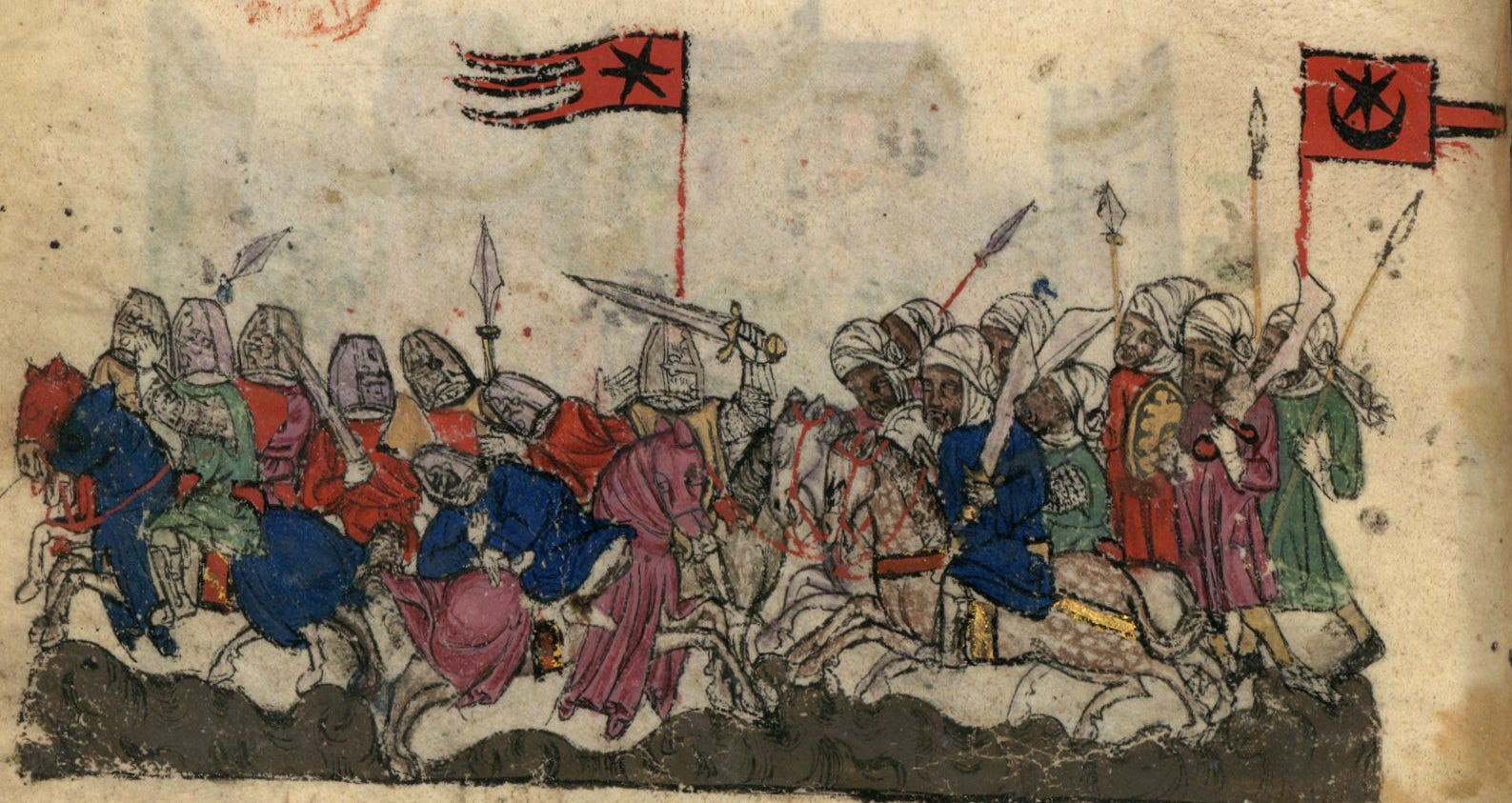
Muhammad died in 632. Four years later Muslim armies moved into Byzantine lands.
The first caliph (supreme religious and political leader who serves as the successor to the Prophet Muhammad) was Abu Bakr, Muhammad’s father-in-law and the father of Aisha (you know, the 6 year-old he married). In the last months of his rule he ordered the first Muslim armies into Byzantine Syria: “By Allah, I shall destroy the Romans and the friends of Satan with Khalid bin Al Walid.”
Abu Bakr died in August 634. By the time of Yarmouk the caliph was Umar.
Under these early caliphs, Muslim armies moved into both Byzantine and Persian lands.
The Sword of Allah - Khalid ibn al-Walid - won many victories and brought Syria under Muslim control. By 635 Damascus was under Muslim rule.
Heraclius (Emperor of Byzantine) saw the danger and gathered a Byzantine army to take Syria back.
Old sources said the Byzantine army numbered in the hundreds of thousands. Modern estimates put both sides in the tens of thousands. The Byzantine force included Byzantine troops, Armenians, and Christian Arab auxiliaries under the Armenian general Vahan.
They faced the Muslim army led by Khalid ibn al-Walid, with many of Muhammad’s companions in its ranks.
Before the armies finally clashed, there was one last meeting under a flag of truce. Vahan blamed the Arabs’ harsh desert life and poverty for their invasion and offered them food and clothing if they withdrew from Byzantine territory. The Sword of Allah couldn’t care less. He answered:
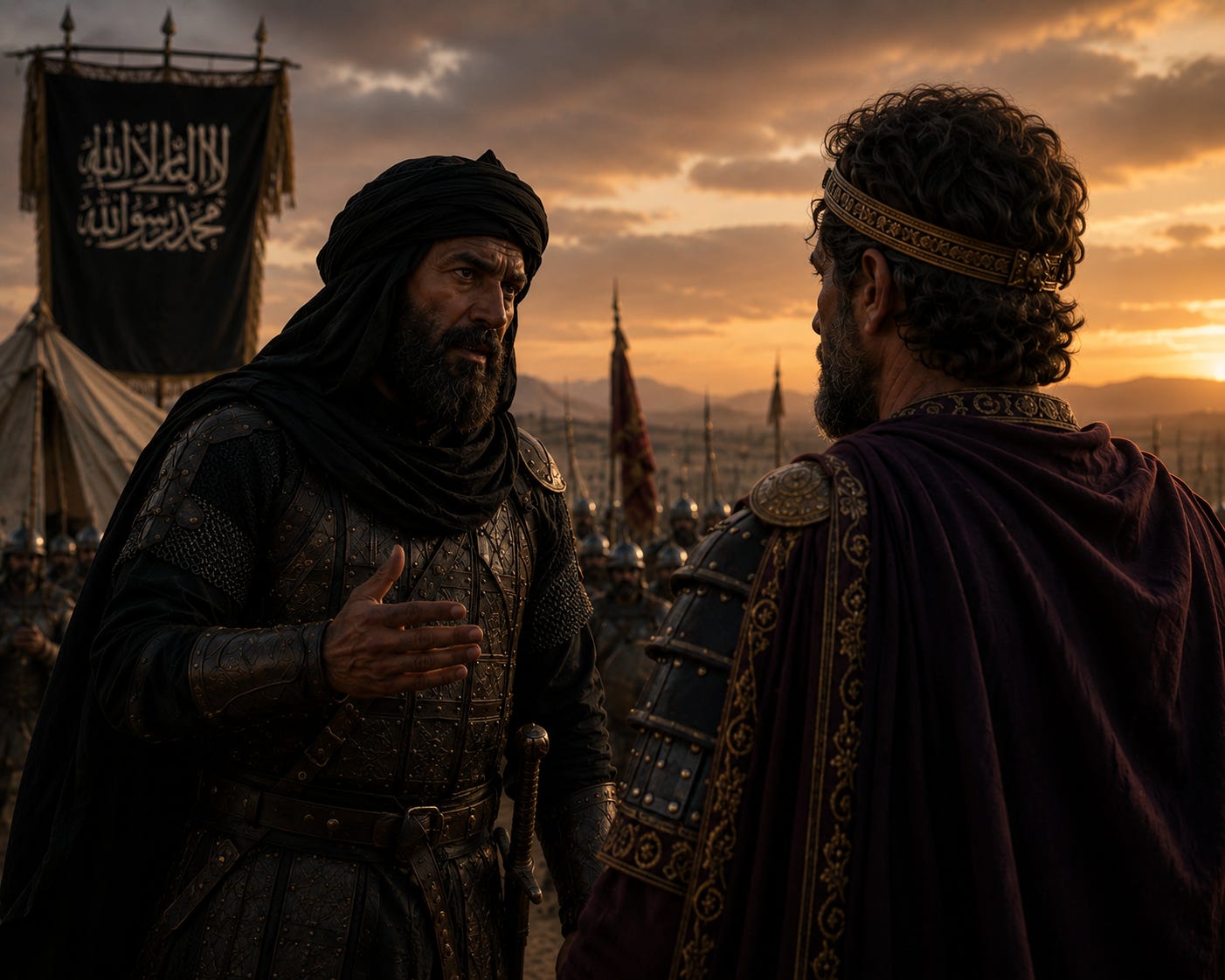
“It was not hunger that brought us here, but we Arabs are in the habit of drinking blood, and we are told the blood of the Romans is the sweetest of its kind, so we came to shed your blood and drink it.”
Vahan launched into a tirade:
“So, we thought you came seeking what your brethren always sought—plunder, extortion, or mercenary work. But, alas, we were wrong. You came killing men, enslaving women, plundering wealth, destroying buildings, and seeking to drive us from our own lands. Better people had tried to do the same but always ended up defeated. As for you, there is no lower and more despicable people—wretched, impoverished Bedouins. You commit injustices in your own nation and now ours. What havoc you have created! You ride horses not your own and wear clothes not your own. You pleasure yourselves with the young white girls of Rome and enslave them. You eat food not your own, and fill your hands with gold, silver, and valuable goods [not your own]. Now we find you with all our possessions and the plunder you took from our coreligionists—and we leave it all to you, neither asking for its return nor rebuking you. All we ask is that you leave our lands. But if you refuse, we will annihilate you!”
Khalid was unmoved. He began reciting the Quran and speaking of Muhammad. Then he called on Vahan to proclaim the shahada—“there is no god but Allah and Muhammad is his messenger”—and thereby embrace Islam. He added the further requirements: “You must also pray, pay zakat, perform hajj at the sacred house [in Mecca], wage jihad against those who refuse Allah, befriend those who befriend Allah and oppose those who oppose Allah. If you refuse, there can only be war between us… And you will face men who love death as you love life.”
Vahan’s reply was final: “Do what you like. We will never forsake our religion or pay you jizya.”
The talks, obviously, ended.
Friendly reminder: The Western Spirit exists because of readers like you. Join us and help keep this project alive and independent.
If you’ve been enjoying these essays, consider becoming a paid subscriber. For a few dollars a month, you’ll get:
Essays on brave men, and turning points in Western history
Reflections on faith, tradition, and culture
Full access to the growing archive - essays, book breakdowns, and deep dives
This project exists because readers like you make it possible.
When someone in the Muslim camp remarked on how many Romans there were and how few Muslims, Khalid answered:
“Do not say that! How few are the Romans and how numerous are we! An army’s strength lies not in numbers of men but in Allah’s help, and its weakness lies in being forsaken by Allah.”