
In 1793, France declared war on the Church.
The guillotine was already busy. King Louis XVI had been executed. The queen was in prison. Nobles were fleeing. But the revolution wasn’t satisfied. It wanted to remake the soul of the country — and that meant killing the Church.
At first, they tried legislation.
Then they sent armed men.
Priests were dragged from their parishes. Churches were stripped bare. Relics burned. Public worship banned. Even the calendar was changed — Sunday eliminated, saints replaced with “reason,” and the year reset to Year One.
But the Church didn’t disappear.
It went underground.
The De-Christianization of France
“There is no need for priests. Liberty is our only god.”
—Revolutionary slogan, Paris, 1794
The revolutionaries weren’t just attacking power. They were attacking presence. The Church had been part of French life for over a thousand years — in every village, at every birth and death, in every bell that rang.
So they targeted everything visible.
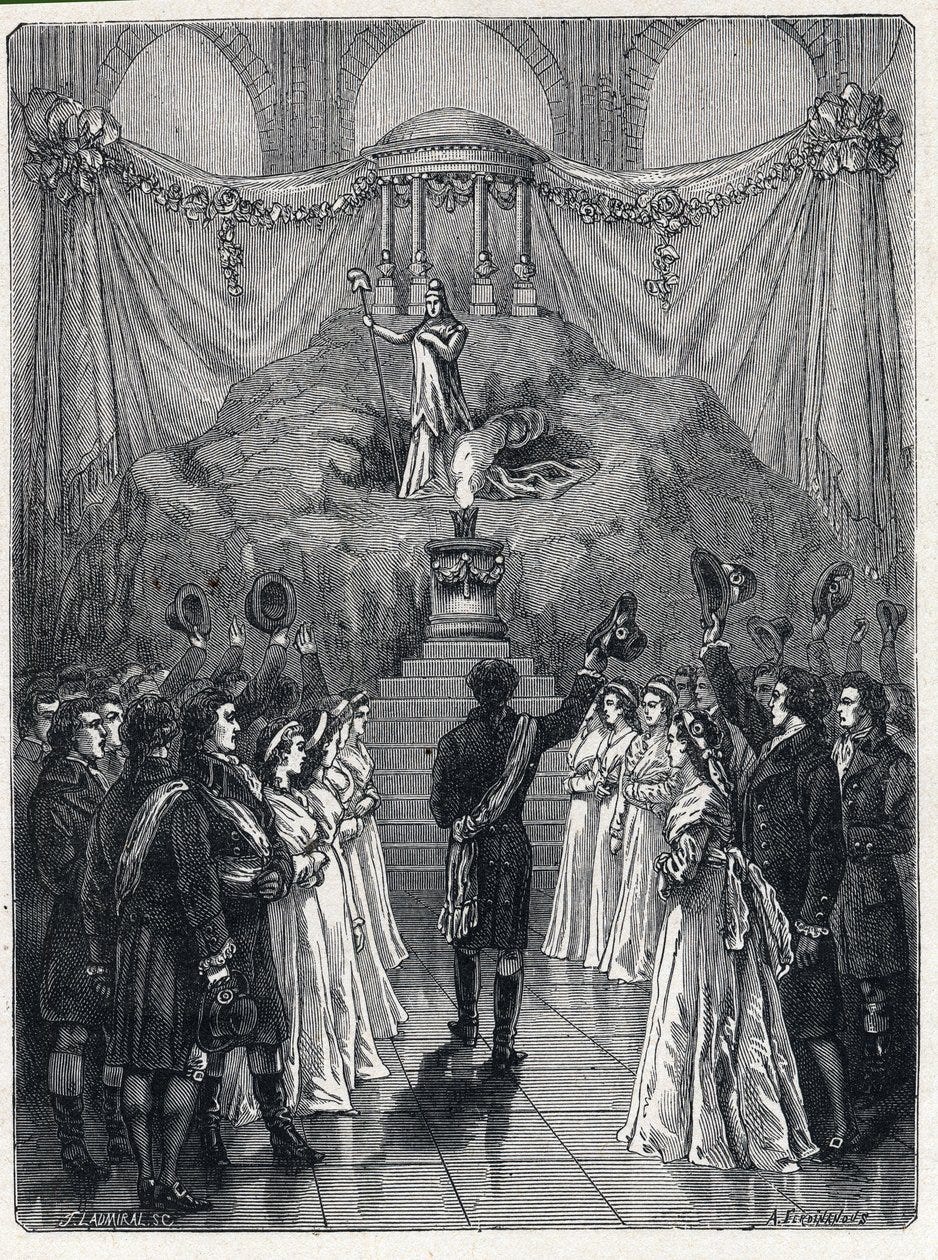
Churches were renamed “Temples of Reason.” Statues of saints were smashed. Crucifixes were pulled from walls. Monasteries were dissolved. Cemeteries were desecrated. And thousands of priests were forced to take an oath to the Republic — swearing loyalty to a regime that hated the Church.
Many refused.
They became known as refractory priests.
For that, they were hunted like criminals.
Those who didn’t flee faced prison, exile, or the guillotine.
Reminder: The Western Spirit is a reader-supported publication.
If you’ve been enjoying these essays, consider becoming a paid subscriber. For a few dollars a month, you’ll get:
In-depth pieces on forgotten battles, brave men, and turning points in Western history
Reflections on faith, order, tradition, and the deeper meaning behind culture
Full access to the growing archive — essays, book breakdowns, and historical deep dives
This project exists because readers like you make it possible.
The Underground Church
“We met in barns, in caves, in forests. Wherever the Mass could survive, we went.”
—Letter from a peasant in the Vendée
With public worship banned, the faithful had to improvise.
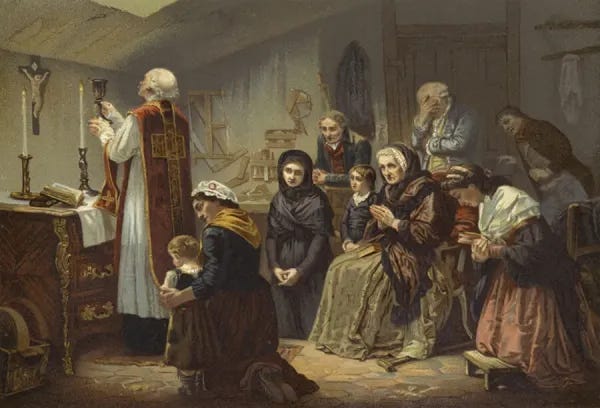
Masses were held in barns, in cellars, in fields at night. Children were baptized in kitchens. Confessions whispered in haylofts. Rosaries passed from hand to hand like contraband.
Refractory priests disguised themselves as farmers or laborers. Some moved from village to village, celebrating secret Masses by candlelight. Others went into permanent hiding, kept alive by the loyalty of poor families who risked everything to protect them.
These weren’t isolated cases.
In Brittany, Normandy, and the Vendée, whole regions rejected the revolution’s religious decrees. The Faith went silent — but never stopped.
It was the Church of the shadows.
It had no buildings, no schedules, no permission.
Only devotion.
The Vendée: Catholic Rebellion
“They have armies. We have God. And we know these fields better than they do.”
—Vendean rebel, 1793
The Vendée wasn’t just resistance — it was rebellion.
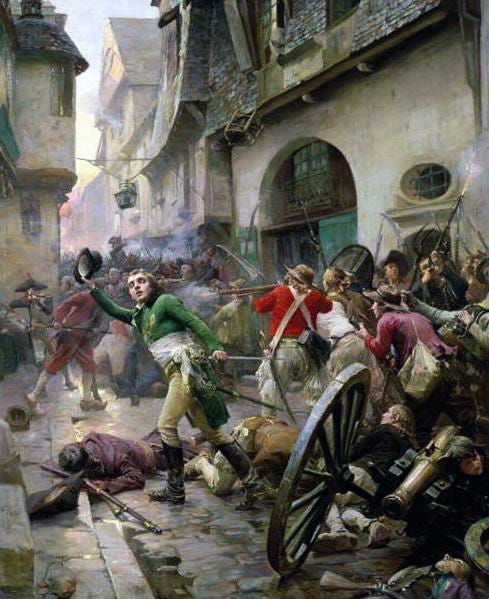
When the Republic began conscripting young men for war, the Catholic peasants of western France revolted. They carried icons instead of flags. Some rode into battle with scapulars on their chests and rosaries in their hands.
Their slogan: “For God and the King.”
The Republic responded with scorched-earth terror. Whole villages were burned. Men, women, and children were executed. Rivers were filled with corpses. Over 100,000 were killed — many for the crime of refusing to abandon the old faith.
But the spirit never broke.
Even as the Vendée was crushed militarily, the Catholic soul of the region survived — kept alive in stories, prayers, and underground Masses long after the smoke cleared.
Martyrs of the Revolution
“I am going to the altar of God.”
—Blessed Noël Pinot, on his way to execution
The revolution made martyrs — not just soldiers, but ordinary priests, nuns, and laity.
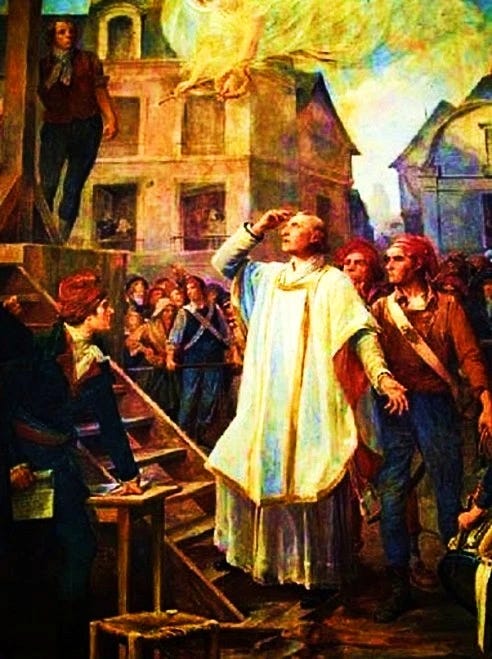
One of them was Noël Pinot, a parish priest who refused to take the revolutionary oath. He was arrested while secretly saying Mass, dressed in full vestments. The guards let him finish before taking him to the scaffold.
As he walked to the guillotine, still wearing his liturgical robes, he whispered the words of the Mass:
“Introibo ad altare Dei” — I will go to the altar of God.
He was 49.
Today, he is beatified — a symbol of fidelity under fire.
Hundreds like him were executed for saying Mass, hiding clergy, or refusing to deny the Church. Some were canonized. Most were never named.
But all shared the same quiet defiance:
They would not let the Faith die.
The Aftermath
“The Revolution tried to erase the Church. But the Church had deeper roots than they knew.”
—French historian Georges-Henri Soutou
By 1801, the war against the Church had failed.
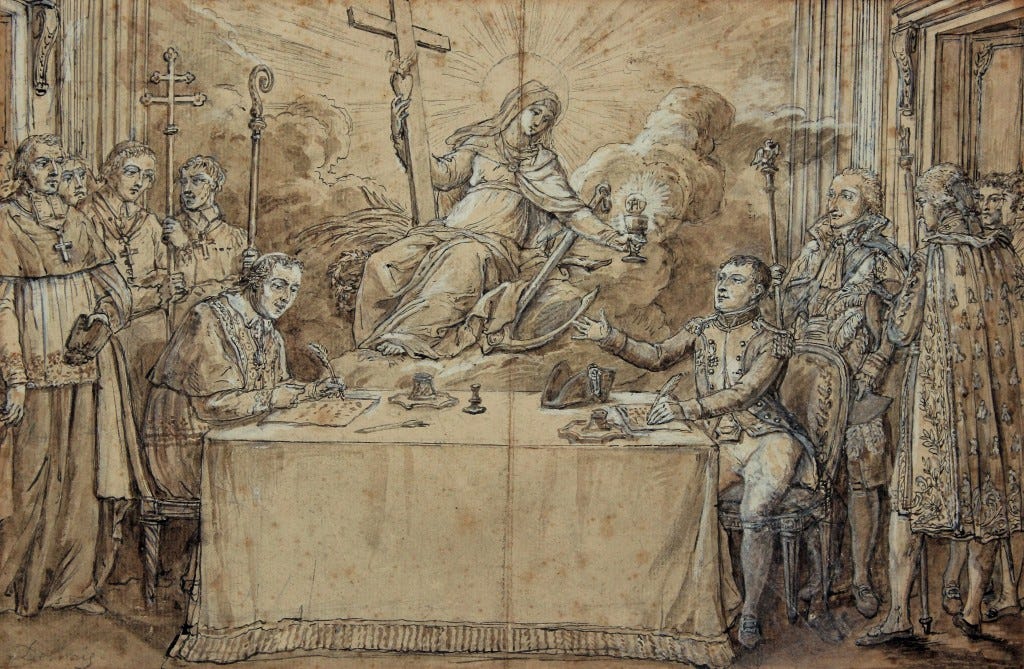
Napoleon, rising from the ruins of the Republic, made peace with the Vatican. The Concordat of 1801 restored public worship — partially. The Church remained under state control, but the persecution ended.
Many churches were reopened. Priests returned. Public Mass resumed.
But something had changed.
The Catholic Church in France was no longer just the religion of kings and cathedrals.
It was now the religion of the people.
Survival had reshaped it. Suffering had made it stronger. Faith had gone underground — and returned with scars, memories, and a fire that regimes could no longer touch.
Takeaways
1. You Can’t Outlaw Belief
The Revolution could close churches. But it couldn’t kill prayer. The sacraments survived because the people carried them.
2. The Faith Lives in the Margins
When the center collapses — the state, the institutions — the Faith retreats to the edge. Caves. Kitchens. Forests. But it never disappears.
3. The Church Doesn’t Need Permission
Rome wasn’t built with permits. The underground Church proved it doesn’t need official status to function — only the sacraments and courage.
4. Martyrs Make Memory
The names of Pinot, the nuns of Compiègne, and the peasant faithful still echo today. Martyrdom writes history in ink that doesn’t fade.
5. The Soul Endures
The French Revolution tried to replace the Cross with Reason. But the soul doesn’t obey ideology. It longs for something deeper. And in France, it never let go.
Want more?
Tomorrow’s deep dive: “The Massacre at Vassy: The Spark that Set France on Fire.”
We’ll uncover how a single church attack in 1562 triggered nearly 40 years of religious war—and why the Huguenots never forgot it.
Upgrade now to get full access:
The irrational, the unreasonable, the faithful.