
Let me say this plainly, because people dance around it and hide behind slogans instead of actually thinking through what they’re saying.
You’ve probably seen it a hundred times by now, especially online. Someone posts, “Islam is a peaceful religion,” or just as confidently claims that “the Crusades were offensive wars driven by blind aggression.”
It sounds clean and morally reassuring, and it gives the impression that the person saying it has a firm grasp on history, but in reality it’s the kind of statement that only works if you simplify things to the point of distortion.
The issue isn’t that everything about Islam is violent, and it’s not that everything about the Crusades was noble or pure either, because history is never that neat or one-sided. The real problem is that both of these claims depend on ignoring where the story actually begins and how it develops over time.
What people tend to do, whether consciously or not, is start right in the middle of the timeline and then present that moment as if it were the beginning of everything that matters.
If you actually rewind the story, even just a few centuries, you end up in the 7th century, which is where things become much harder to simplify or sanitize.
This is when Islam begins expanding, and it does so with remarkable speed and consistency, not through quiet cultural exchange but primarily through organized military conquest that reshapes entire regions.
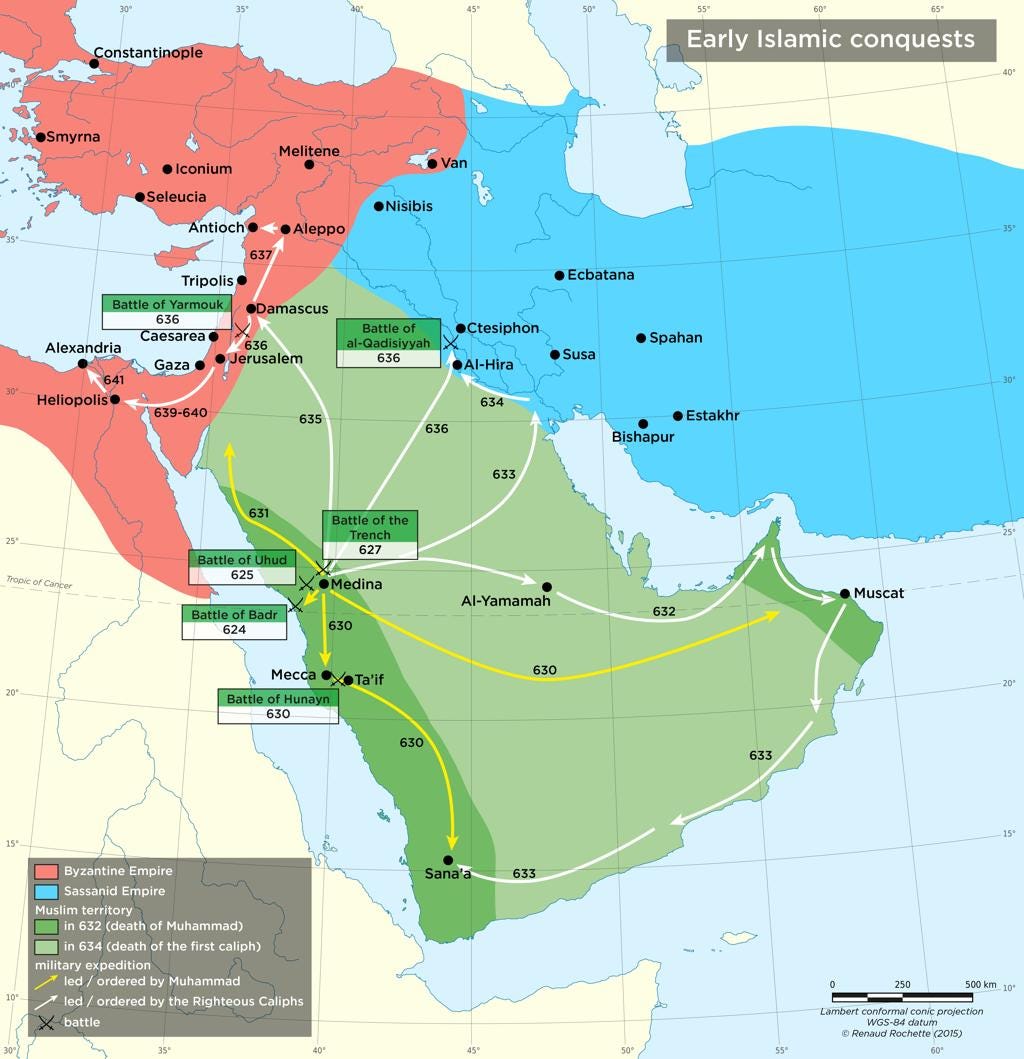
Syria falls, Egypt falls, North Africa falls, and Persia is effectively swept aside in a relatively short span of time, which is something people often gloss over because it complicates the modern narrative.
Friendly reminder: The Western Spirit exists because of readers like you. Join us and help keep this project alive and independent.
If you’ve been enjoying these essays, consider becoming a paid subscriber. For a few dollars a month, you’ll get:
In-depth pieces on forgotten battles, brave men, and turning points in Western history
Reflections on faith, order, tradition, and the deeper meaning behind culture
Full access to the growing archive — essays, book breakdowns, and historical deep dives
This project exists because readers like you make it possible.
These were not empty or marginal territories; they were deeply established civilizations, many of them overwhelmingly Christian, and in some cases they were central to the early development of Christianity itself.
We’re talking about places like Jerusalem and Alexandria, which were not peripheral outposts but major centers of theology, culture, and religious life for centuries before they were taken.
So one thing becomes very clear when you look at it honestly: what we now call the “Muslim world” was, in large part, previously part of the Christian world, and that transformation did not happen peacefully or accidentally.
It happened because one civilization conquered another and held that ground over time.
And importantly, the expansion did not stop once those initial territories were taken, as if it were a brief episode that then settled into stability.
Spain is invaded in 711 and remains under Muslim rule for centuries, while raids and incursions reach into France, Italy, and various parts of the Mediterranean, turning what had once been relatively secure regions into contested zones.
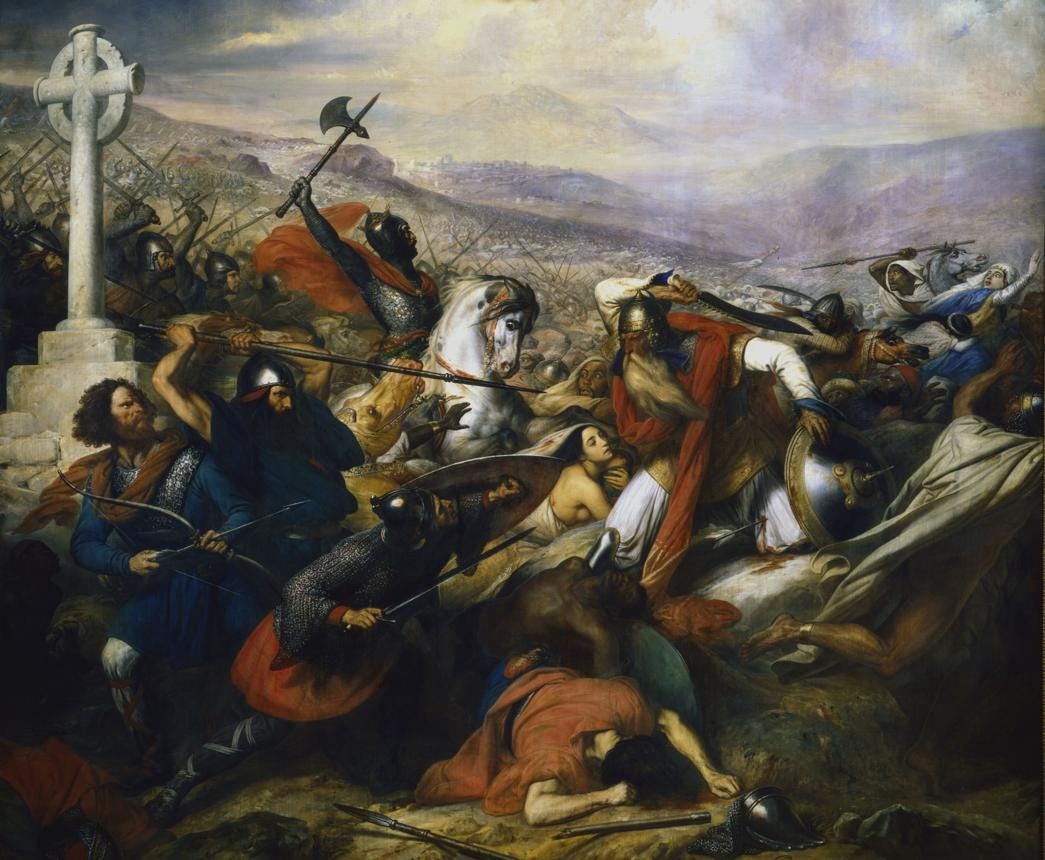
At the same time, the Byzantine Empire, which represents the continuation of the Christian Roman world in the East, is steadily weakened through ongoing military pressure, losing territory bit by bit over generations.
This situation persists for hundreds of years, which is the crucial detail that often gets skipped because it makes the later events much harder to frame in simplistic moral terms.
By the time we reach the late 11th century, Christians are not living in some untouched peace suddenly deciding to launch an attack; they are part of a civilization that has been under sustained pressure and has lost significant territory over a very long period.
That is the context in which things begin to shift.
The Byzantine Empire, facing serious military setbacks, appeals to the West for help..
In response to that appeal, Pope Urban II calls for what becomes the First Crusade, framing it as a mission to aid fellow Christians and recover lands that had once been part of Christendom:
“O race of the Franks, race from across the mountains, race chosen and beloved by God, distinguished from all nations by the situation of your country, as well as by your Catholic faith and the honor of the Holy Church—this message is for you, this exhortation is addressed to you.
From the borders of Jerusalem and the city of Constantinople a horrible tale has gone forth, and very frequently has been brought to our ears: that a people from the kingdom of the Persians, an accursed race, a race utterly alienated from God… has invaded the lands of those Christians and depopulated them by the sword, pillage, and fire.
They have led away a part of the captives into their own country, and a part they have destroyed by cruel tortures. They have either destroyed the churches of God or appropriated them for the rites of their own religion.
They destroy the altars, after having defiled them with their uncleanness. They circumcise Christians and the blood of the circumcision they either spread upon the altars or pour into the vases of the baptismal font.
When they wish to torture people by a base death, they perforate their navels, and dragging forth the extremity of the intestines, bind it to a stake; then, with flogging, they lead the victim around until the viscera fall out.
Others they bind to a post and pierce with arrows. Others they compel to extend their necks and, attacking them with naked swords, attempt to cut through the neck with a single blow.
What shall I say of the abominable rape of the women? To speak of it is worse than to be silent.
The kingdom of the Greeks is now dismembered and has been deprived of territory so vast in extent that it could not be traversed in two months’ time.
On whom, therefore, is the labor of avenging these wrongs and of recovering this territory incumbent, if not upon you—you upon whom, above all others, God has bestowed remarkable glory in arms, greatness of spirit, and bodily strength?
Let the deeds of your ancestors move you and incite your minds to manly achievements: the greatness of King Charlemagne and of his son Louis, and of your other kings, who destroyed the kingdoms of the Turks and extended the territory of the Holy Church.
Let the holy sepulcher of our Lord and Savior, which is possessed by unclean nations, especially arouse you, and the holy places which are now treated with ignominy and irreverently polluted by them.
O most valiant soldiers and descendants of invincible ancestors, be not degenerate, but recall the valor of your progenitors.
Let none of your possessions retain you, nor solicitude for your family affairs. For this land which you inhabit… is too narrow for your large population; nor does it abound in wealth.
Hence it is that you murder and devour one another, that you wage war, and that frequently you perish by mutual wounds.
Let hatred depart from among you, let your quarrels end, let wars cease, and let all dissensions and controversies slumber.
Enter upon the road to the Holy Sepulcher; wrest that land from the wicked race, and subject it to yourselves.
That land which, as the Scripture says, ‘flows with milk and honey,’ was given by God into the possession of the children of Israel.
Jerusalem is the navel of the world; the land is fruitful above all others, like another paradise of delights.
This royal city, therefore, situated at the center of the world, is now held captive by His enemies and is subjected by those who do not know God.
She seeks, therefore, and desires to be liberated and does not cease to implore you to come to her aid.
From you especially she asks succor, because, as I have already said, God has conferred upon you above all nations great glory in arms.
Accordingly undertake this journey for the remission of your sins, with the assurance of the imperishable glory of the kingdom of heaven.
When Pope Urban had said these and many similar things, all who were present were so inspired with one mind that they cried out:‘Deus vult! Deus vult!’ (God wills it! God wills it!)
When the venerable Roman pontiff heard that, with eyes uplifted to heaven, he gave thanks to God and, commanding silence with a wave of his hand, said:
‘Beloved brethren, today is manifest in you what the Lord says in the Gospel: “Where two or three are gathered together in My name, there am I in the midst of them.”
For unless the Lord God had been present in your spirits, all of you would not have uttered the same cry.
Let this, then, be your war cry in combats, because this word is given to you by God.
When an armed attack is made upon the enemy, let this one cry be raised by all the soldiers of God:
Deus vult! Deus vult!’”
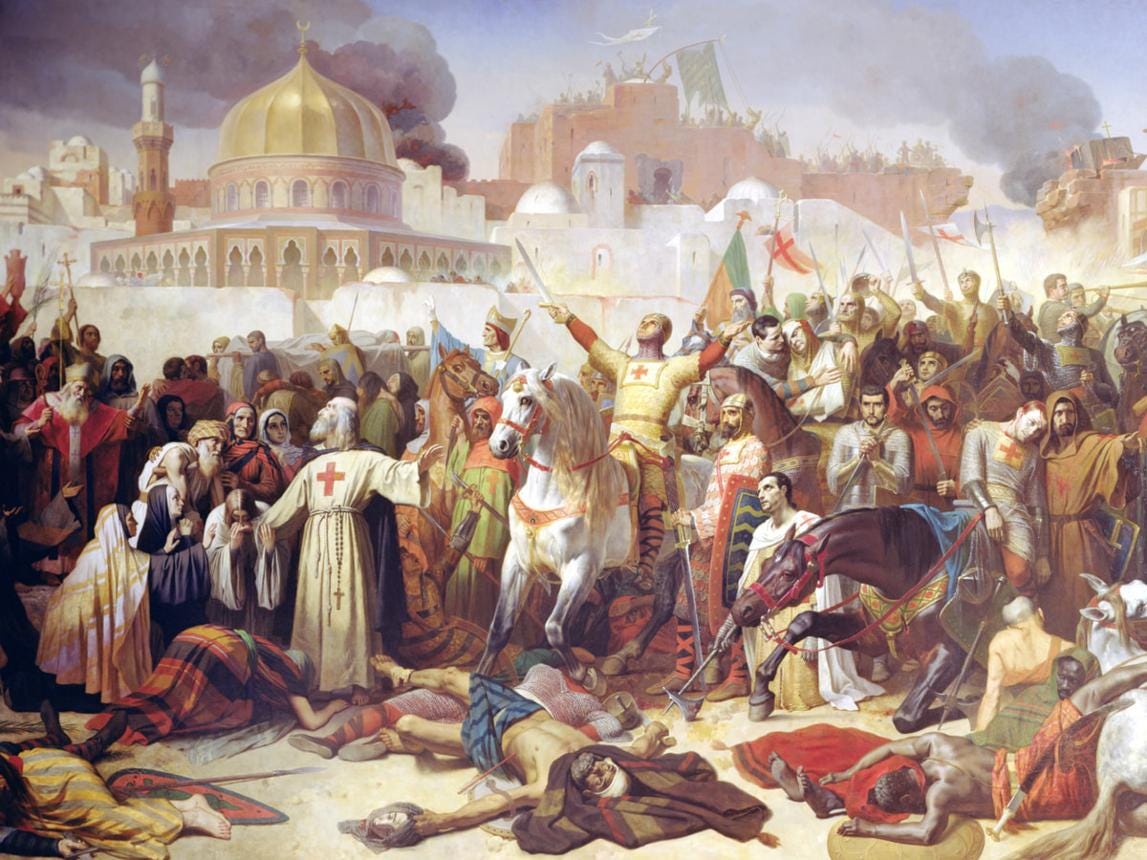
This is the point where modern interpretations tend to strip away all prior context and present the Crusades as if they appeared out of nowhere, driven by sheer aggression or religious fanaticism.
People will say that Christians invaded Muslim lands, which is technically true in a narrow sense, but it leaves out everything that led up to that moment and everything that shaped the decision.
To make that claim convincingly, you have to ignore centuries of prior conflict moving in the opposite direction, as well as the fact that many of these lands had originally been under Christian control before they were taken.
You also have to overlook the direct request for military assistance from the Byzantine Empire, which played a central role in triggering the response.
When you include all of that context, the picture changes in a significant way, and the Crusades begin to look less like an unprovoked invasion and more like a delayed and imperfect attempt to push back after long-term losses.
That doesn’t mean everything the Crusaders did was admirable, because war inevitably produces actions that are brutal, excessive, or morally questionable.
But acknowledging those realities is not the same as concluding that the entire cause was illegitimate, because those are two very different claims that often get blurred together.
In most other historical situations, we recognize that a group or nation can have a legitimate reason to fight while still committing wrongs in the process, and we are capable of holding both ideas at once.
If a society is invaded repeatedly over centuries, loses land, and eventually organizes a campaign to reclaim some of that territory, we do not usually describe that as pure aggression without context.
We might debate the methods, question the leadership, or criticize specific actions, but we still understand the underlying motive as a response to something real and ongoing.
For some reason, that same basic logic is often not applied when it comes to the Crusades, which suggests that something other than historical analysis is shaping the narrative.
Part of it is that modern Western audiences tend to be skeptical of their own past, often assuming that their ancestors were primarily driven by greed, ignorance, or intolerance, and this assumption influences how events are interpreted.
Another part is that simple narratives are easier to communicate and spread, especially in a culture that prefers short, emotionally satisfying conclusions over complex explanations.
So phrases like “Islam is peaceful” and “the Crusades were aggressive” continue to circulate because they are easy to remember and repeat.
The reality, as usual, is different.
Islam spread by the sword.
The Crusades, in turn, were not random acts of aggression detached from history, but completely justified events that arose out of centuries of prior conflict, territorial loss, and a specific call for assistance from an embattled ally.
Islam is Sharia law, and Sharia law is Islam. There is no Islam without Sharia law. Islam is a political legal system as much as a religion, it is not just one or the other. When you allow Islam, you allow both the religion and the laws. You cannot have one without the other. Muslims are committed to Sharia laws over any other, by definition, or they're not really Muslim. Sharia laws are different than Western laws and ethics and morals and norms. You cannot have two different sets of laws. You must pick one or the other. They are generally incompatible. Most Westerners likely support Western laws once they compare the two. It is a clear goal of Islam, with a proven track record, for over a thousand years, of conquering other areas and people and implementing Islam at the expense of the other people. If you import Muslims and people from Islamic based countries, who are not interested in assimilation, over time it will lead to conflict with Islam and Muslims, because they cannot coexist peacefully for the long run. There is no needle to thread or magical solution to make it work after 1400 years of oppression and conquest leading to some of the most barbaric humanity on earth today. People need to face reality.
One of the best, succinct summaries of the correct history & justifications for the Crusades, delivering a much-needed & timely clarification for today's largely historically ignorant populace.
Raymond Ibrahim has delved extensively into these historical records through primary sources in both his 3 main books and his youtube channel for anyone interested in learning more. Highly revommend