
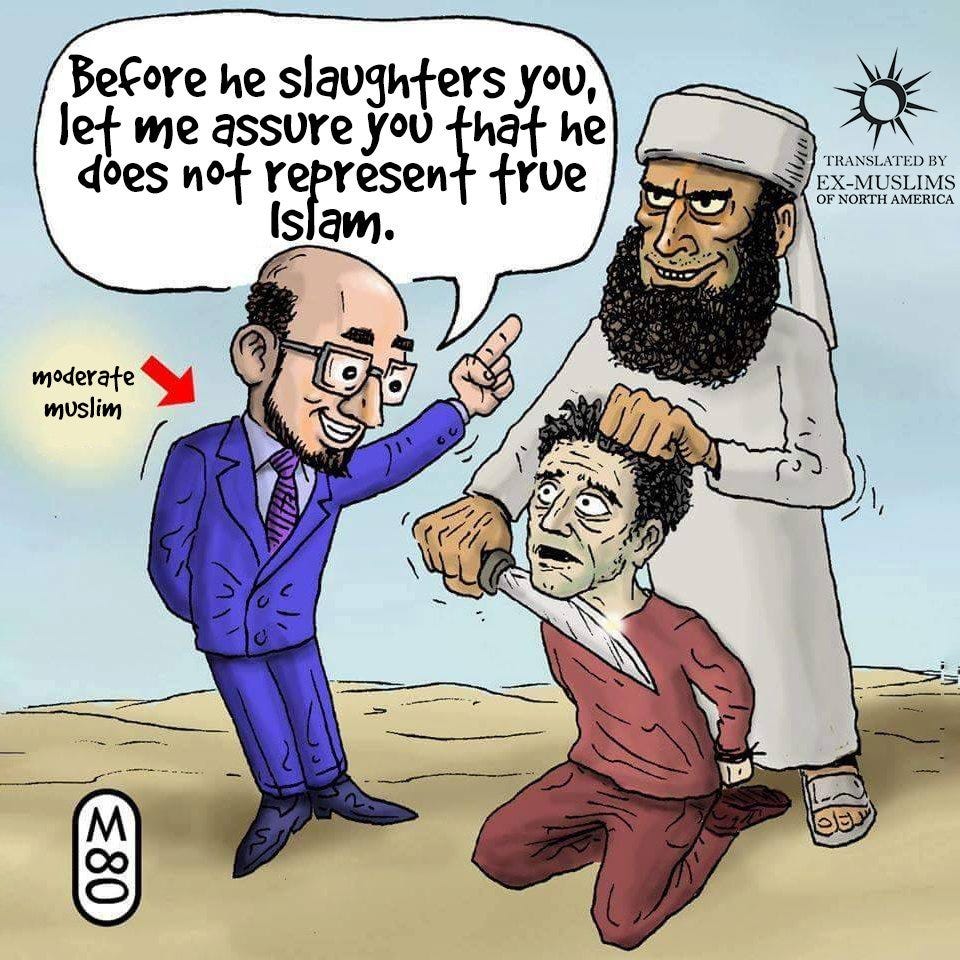
Islam vs. Islamism is the hot topic right now and everyone is debating it.
I have to say, I find it embarrassing - even disappointing - that some people on our side still make this distinction.
The usual line goes like this: praying, fasting, and paying zakat - that’s what the good Muslims do. That’s real Islam.
Jihad, subjugating non-Muslims, killing apostates, blasphemers, and Christians - that’s Islamism. That’s what the bad Muslims do.
Well, in reality, all of these things come from the exact same sources. They are in the Quran and the Hadith, and a Muslim (someone who submits to Allah) is required to follow what’s in there.
To quote Robert Spencer:
“Islamism” is a term that western non-Muslims invented in order to distance Islam from the crimes done in its name and in accord with its teachings. There is no such concept in Islamic theology or law.
Muhammad himself, in a canonical hadith, said: “Whoever leaves his religion - kill him.” Slavery and sex slavery are justified in the Quran. Muhammad did it. Jihad - expanding Islamic rule through force - is in both the Quran and the Hadith. So if a Muslim does the first set of things because they are commanded in those sources, why on earth would I assume he doesn’t do - or at least accept - the others?
Raymond Ibrahim was just at the Heritage Foundation conference and gave a speech on exactly this. Here he is explaining why the difference between Islam and Islamism is artificial:
“I would like to frame this brief talk on the question: is the problem Islam, or is it Islamism? I think relatively early on post-9/11, a lot of people were aware and cognizant there’s something going on with Islam. There are some issues. But we got that dichotomy very early on. Islam came to represent good Muslims who are compatible with the West, and Islamism was this weird thing that some Muslims do—politically engaging in terrorism, subversion, etc., etc. And that is, I submit to you, one of the most artificial distinctions that have ever been made. And I’m here to explain to you why.
Okay. So there’s this other thing. We’ve been kind of conditioned, and this is probably our fault. It’s because the Western mind has this sort of penchant for relativism. And so anything that we’re told we don’t take as concrete. It’s how you see it. How does a person understand it? This isn’t really the case in Islam. And I think this has been one of the problems, the shortcomings, is that when you meet a Muslim apologist, for example—who need not even be Muslim, he can be a Westerner—they’ll tell you, “Oh yeah, that’s one reading. This jihadist business is one interpretation, but most Muslims, you know, they reject that.” Well, the fact is knowing what is and is not Islamic is really not rocket science. It’s very easily ascertained. In fact, Islam is a very much legalistic religion in that it is concerned with what you do in the now. It’s not about my spiritual relationship with God, Allah in this case. And so the good news is we can tell what is and is not Islamic. How? There’s no time to get into the deep science of how this is ascertained, but the long and short of it is that the Quran is seen as the word of Allah and it’s taken literally. And then the other, second textual source is known as the hadith. And this records the words, deeds, behavioral habits of Muhammad the Prophet. And from this latter one, the Sunnah is ascertained. The Sunnah means the example, because the Quran says Muhammad is the perfect example for you to follow. So whatever Muhammad says or did, you’re supposed to implement in your life. So those two sources is what establishes what is and is not Islamic.
If you value well-researched stories about Western civilization that mainstream outlets ignore, consider becoming a paid subscriber.
Here’s what you get by upgrading:
In-depth essays on Christian men and great battles
Lessons from the past and what they can teach us today
Full access to the growing archive
Help keep The Western Spirit alive and independent by upgrading.
But it just so happens that the same exact mechanism and the same sources that have created those things—the prayer and the fasting—and have made them Islamic, have also made all those other problematic things actually Islamic. So the Quran, the words of Allah, and the hadith, the words of Muhammad—let’s look at a few examples that are problematic.”
Continue reading below.