
Hey friends,
I’ve been working on some new articles for you and went down a rabbit hole in medieval archives.
What I found is incredible: actual surviving correspondence from crusaders, kings, saints, emperors, and defenders of Christendom.
So I’m starting a new series: Letters That Built Christendom
I’ll be sharing some of the most fascinating primary sources in history. Below are the most important surviving accounts from the First Crusade..
Friendly reminder: The Western Spirit exists because of readers like you. Join us and help keep this project alive and independent.
If you’ve been enjoying these essays, consider becoming a paid subscriber. For a few dollars a month, you’ll get:
In-depth pieces on forgotten battles, brave men, and turning points in Western history
Reflections on faith, order, tradition, and the deeper meaning behind culture
Full access to the growing archive — essays, book breakdowns, and historical deep dives
This project exists because readers like you make it possible.
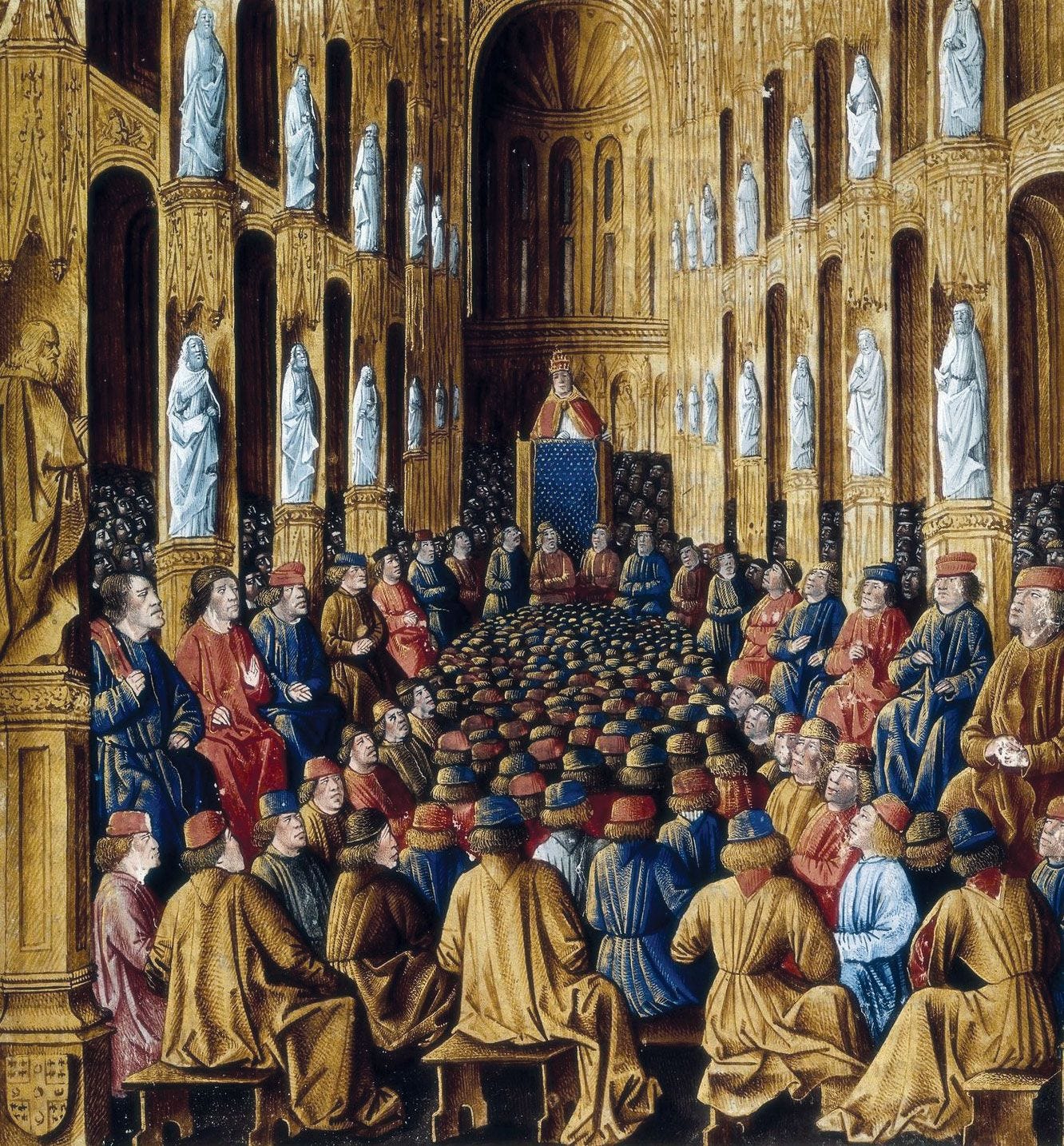
This is the letter that helped launch the First Crusade, as Pope Urban II called Christians in the West to take up arms for the liberation of the East (November 1095):
Most beloved brethren: Urged by necessity, I, Urban, by the permission of God chief bishop and prelate over the whole world, have come into these parts as an ambassador with a divine admonition to you, the servants of God. I hoped to find you as faithful and as zealous in the service of God as I had supposed you to be. But if there is in you any deformity or crookedness contrary to God’s law, with divine help I will do my best to remove it. For God has put you as stewards over his family to minister to it. Happy indeed will you be if he finds you faithful in your stewardship. You are called shepherds; see that you do not act as hirelings. But be true shepherds, with your crooks always in your hands. Do not go to sleep, but guard on all sides the flock committed to you. For if through your carelessness or negligence a wolf carries away one of your sheep, you will surely lose the reward laid up for you with God. And after you have been bitterly scourged with remorse for your faults-, you will be fiercely overwhelmed in hell, the abode of death. For according to the gospel you are the salt of the earth [Matt. 5:13]. But if you fall short in your duty, how, it may be asked, can it be salted? O how great the need of salting! It is indeed necessary for you to correct with the salt of wisdom this foolish people which is so devoted to the pleasures of this -world, lest the Lord, when He may wish to speak to them, find them putrefied by their sins unsalted and stinking. For if He, shall find worms, that is, sins, In them, because you have been negligent in your duty, He will command them as worthless to be thrown into the abyss of unclean things. And because you cannot restore to Him His great loss, He will surely condemn you and drive you from His loving presence. But the man who applies this salt should be prudent, provident, modest, learned, peaceable, watchful, pious, just, equitable, and pure. For how can the ignorant teach others? How can the licentious make others modest? And how can the impure make others pure? If anyone hates peace, how can he make others peaceable ? Or if anyone has soiled his hands with baseness, how can he cleanse the impurities of another? We read also that if the blind lead the blind, both will fall into the ditch [Matt. 15:14]. But first correct yourselves, in order that, free from blame , you may be able to correct those who are subject to you. If you wish to be the friends of God, gladly do the things which you know will please Him. You must especially let all matters that pertain to the church be controlled by the law of the church. And be careful that simony does not take root among you, lest both those who buy and those who sell [church offices] be beaten with the scourges of the Lord through narrow streets and driven into the place of destruction and confusion. Keep the church and the clergy in all its grades entirely free from the secular power. See that the tithes that belong to God are faithfully paid from all the produce of the land; let them not be sold or withheld. If anyone seizes a bishop let him be treated as an outlaw. If anyone seizes or robs monks, or clergymen, or nuns, or their servants, or pilgrims, or merchants, let him be anathema [that is, cursed]. Let robbers and incendiaries and all their accomplices be expelled from the church and anthematized. If a man who does not give a part of his goods as alms is punished with the damnation of hell, how should he be punished who robs another of his goods? For thus it happened to the rich man in the gospel [Luke 16:19]; he was not punished because he had stolen the goods of another, but because he had not used well the things which were his.
“You have seen for a long time the great disorder in the world caused by these crimes. It is so bad in some of your provinces, I am told, and you are so weak in the administration of justice, that one can hardly go along the road by day or night without being attacked by robbers; and whether at home or abroad one is in danger of being despoiled either by force or fraud. Therefore it is necessary to reenact the truce, as it is commonly called, which was proclaimed a long time ago by our holy fathers. I exhort and demand that you, each, try hard to have the truce kept in your diocese. And if anyone shall be led by his cupidity or arrogance to break this truce, by the authority of God and with the sanction of this council he shall be anathematized.”
After these and various other matters had been attended to, all who were present, clergy and people, gave thanks to God and agreed to the pope’s proposition. They all faithfully promised to keep the decrees. Then the pope said that in another part of the world Christianity was suffering from a state of affairs that was worse than the one just mentioned. He continued:
“Although, O sons of God, you have promised more firmly than ever to keep the peace among yourselves and to preserve the rights of the church, there remains still an important work for you to do. Freshly quickened by the divine correction, you must apply the strength of your righteousness to another matter which concerns you as well as God. For your brethren who live in the east are in urgent need of your help, and you must hasten to give them the aid which has often been promised them. For, as the most of you have heard, the Turks and Arabs have attacked them and have conquered the territory of Romania [the Greek empire] as far west as the shore of the Mediterranean and the Hellespont, which is called the Arm of St. George. They have occupied more and more of the lands of those Christians, and have overcome them in seven battles. They have killed and captured many, and have destroyed the churches and devastated the empire. If you permit them to continue thus for awhile with impurity, the faithful of God will be much more widely attacked by them. On this account I, or rather the Lord, beseech you as Christ’s heralds to publish this everywhere and to persuade all people of whatever rank, foot-soldiers and knights, poor and rich, to carry aid promptly to those Christians and to destroy that vile race from the lands of our friends. I say this to those who are present, it meant also for those who are absent. Moreover, Christ commands it.
“All who die by the way, whether by land or by sea, or in battle against the pagans, shall have immediate remission of sins. This I grant them through the power of God with which I am invested. O what a disgrace if such a despised and base race, which worships demons, should conquer a people which has the faith of omnipotent God and is made glorious with the name of Christ! With what reproaches will the Lord overwhelm us if you do not aid those who, with us, profess the Christian religion! Let those who have been accustomed unjustly to wage private warfare against the faithful now go against the infidels and end with victory this war which should have been begun long ago. Let those who for a long time, have been robbers, now become knights. Let those who have been fighting against their brothers and relatives now fight in a proper way against the barbarians. Let those who have been serving as mercenaries for small pay now obtain the eternal reward. Let those who have been wearing themselves out in both body and soul now work for a double honor. Behold! on this side will be the sorrowful and poor, on that, the rich; on this side, the enemies of the Lord, on that, his friends. Let those who go not put off the journey, but rent their lands and collect money for their expenses; and as soon as winter is over and spring comes, let hem eagerly set out on the way with God as their guide.”
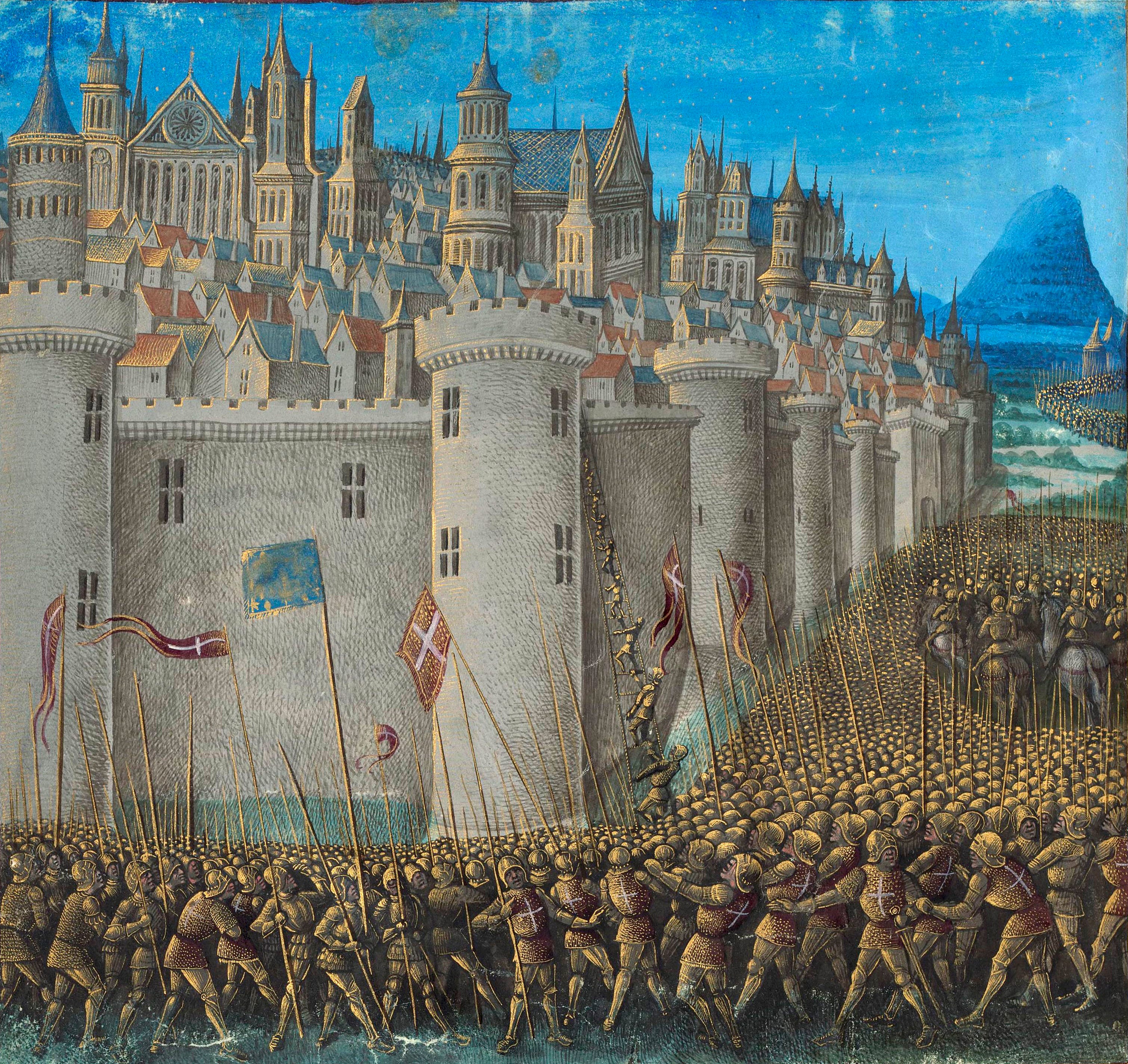
Stephen of Blois, one of the leaders of the First Crusade, writing to his wife Adele from Antioch as the brutal reality of the campaign set in (Antioch, March 29, 1098):
Count Stephen to Adele, his sweetest and most amiable wife, to his dear children, and to all his vassals of all ranks - his greeting and blessing,
You may be very sure, dearest, that the messenger whom I sent to give you pleasure, left me before Antioch safe and unharmed and through God’s grace in the greatest prosperity. And already at that time, together with all the chosen army of Christ, endowed with great valor by Him, we had been continuously advancing for twenty-three weeks toward the home of our Lord Jesus. You may know for certain, my beloved, that of gold, silver and many other kind of riches I now have twice as much as your love had assigned to me when I left you. For all our princes, with the common consent of the whole army, against my own wishes, have made me up to the present time the leader, chief and director of their whole expedition.
You have certainly heard that after the capture of the city of Nicaea we fought a great battle with the perfidious Turks and by God’s aid conquered them. Next we conquered for the Lord all Romania and afterwards Cappadocia. And we learned that there was a certain Turkish prince Assam, dwelling in Cappadocia; thither we directed our course. All his castles we conquered by force and compelled him to flee to a certain very strong castle situated on a high rock. We also gave the land of that Assam to one of our chiefs and in order that he might conquer the above-mentioned Assam, we left there with him many soldiers of Christ. Thence, continually following the wicked Turks, we drove them through the midst of Armenia, as far as the great river Euphrates. Having left all their baggage and beasts of burden on the bank, they fled across the river into Arabia.
The bolder of the Turkish soldiers, indeed, entering Syria, hastened by forced marches night and day, in order to be able to enter the royal city of Antioch before our approach. The whole army of God learning this gave due praise and thanks to the omnipotent Lord. Hastening with great joy to the aforesaid chief city of Antioch, we besieged it and very often had many conflicts there with the Turks; and seven times with the citizens of Antioch and with the innumerable troops coming to its aid, whom we rushed to meet, we fought with the fiercest courage, under the leadership of Christ. And in all these seven battles, by the aid of the Lord God, we conquered and most assuredly killed an innumerable host of them. In those battles, indeed, and in very many attacks made upon the city, many of our brethren and followers were killed and their souls were borne to the joys of paradise.
We found the city of Antioch very extensive, fortified with incredible strength and almost impregnable. In addition, more than 5,000 bold Turkish soldiers had entered the city, not counting the Saracens, Publicans, Arabs, Turcopolitans, Syrians, Armenians and other different races of whom an infinite multitude had gathered together there. In fighting against these enemies of God and of our own we have, by God’s grace, endured many sufferings and innumerable evils up to the present time. Many also have already exhausted all their resources in this very holy passion. Very many of our Franks, indeed, would have met a temporal death from starvation, if the clemency of God and our money had not succoured them. Before the abovementioned city of Antioch indeed, throughout the whole winter we suffered for our Lord Christ from excessive cold and enormous torrents of rain. What some say about the impossibility of bearing the beat of the sun throughout Syria is untrue, for the winter there is very similar to our winter in the West.
When truly Caspian [Bagi Seian], the emir of Antioch - that is, prince and lord - perceived that he was hard pressed by us, he sent his son Sensodolo [Chems Eddaulab] by name, to the prince who holds Jerusalem, and to the prince of Calep, Rodoarn [Rodoanus], and to Docap [Deccacus Ibn Toutousch], prince of Damascus. He also sent into Arabia to Bolianuth and to Carathania to Hamelnuth. These five emirs with 12,000 picked Turkish horsemen suddenly came to aid the inhabitants of Antioch. We, indeed, ignorant of all this, had sent many of our soldiers away to the cities and fortresses. For there are one hundred and sixty-five cities and fortresses throughout Syria which are in our power. But a little before they reached the city, we attacked them at three leagues’ distance with 700 soldiers, on a certain plain near the “Iron Bridge.” God, however, fought for us, His faithful, against them. For on that day, fighting in the strength that God gives, we conquered them and killed an innumerable multitude - God continually fighting for us - and we also carried back to the army more than two hundred of their heads, in order that the people might rejoice on that account. The emperor of Babylon also sent Saracen messengers to our army with letters, and through these he established peace and concord with us.
I love to tell you, dearest, what happened to us during Lent. Our princes had caused a fortress to be built which was between our camp and the sea. For the Turks daily issuing from this gate, killed some of our men on their way to the sea. The city of Antioch is about five leagues’ distance from the sea. For this reason they sent the excellent Bohemond and Raymond, count of St. Gilles, to the sea with only sixty horsemen, in order that they might bring mariners to aid in this work. When, however, they were returning to us with those mariners, the Turks collected an army, fell suddenly upon our two leaders and forced them to a perilous flight. In that unexpected flight we lost more than 500 of our foot soldiersto the glory of God. Of our horsemen, however, we lost only two, for certain.
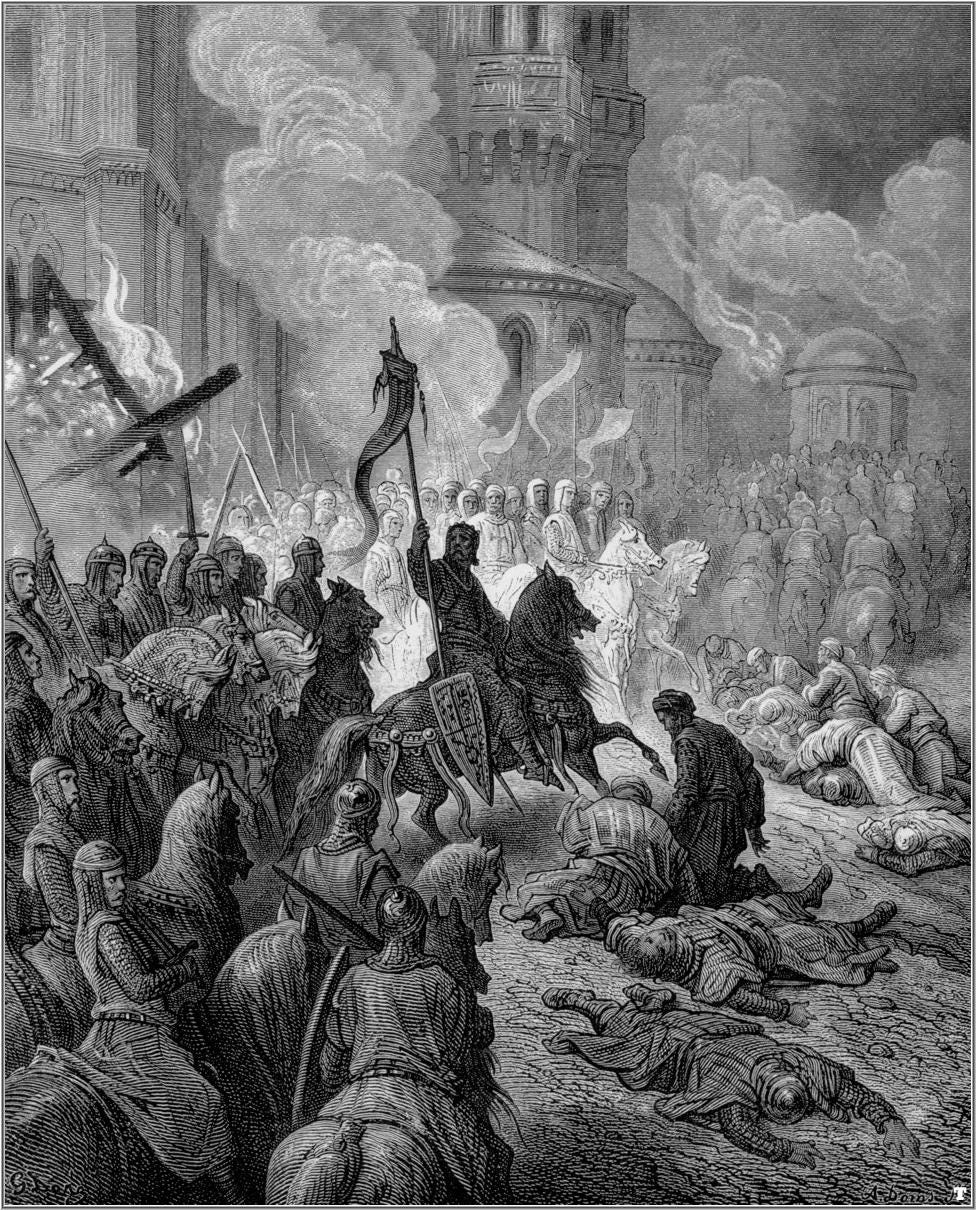
Eyewitness battlefield dispatch from Anselm of Ribemont, describing the chaos, bloodshed, and victories of the First Crusade at Antioch (Antioch, September 10, 1098):
In the name of the Lord!
To his lord and father, Manasses, by grace of God venerable Archbishop of Reims, Anselm of Ribemont, his loyal vass; and humble servant; greeting.
Let your Eminence, reverend father and lord, know that, even though absent and not present, we are daily asking aid . our hearts from you- not only from you, but, also, from all the sons of the Holy Mother Church of Reims, in whom we have the greatest faith. Likewise, inasmuch as you are our lord, and the counsel of the whole kingdom of France is especially dependent upon you, we are keeping you, father, informed of whatever happy and adverse events have happened to us. Let the others, moreover, be informed through you, that you may share equally in our sufferings, and rejoice with us in our success.
We have informed you how we fared in the siege and capture of Nicaea, in our departure thence and our journey through all Romania and Armenia. It now remains for us to tell you a little about the siege of Antioch, the many kinds of danger we there tasted, and the innumerable battles which we fought against the King of Aleppo, the King of Damascus, and against the adulterous King of Jerusalem.
Antioch has been besieged by the army of the Lord since the thirteenth day before the Kalends of November with exceeding valor and courage beyond words. What unheard of battles you might have perceived there at a certain gateway to the west! How marvelous it would seem to you, were you present, to see them daily rushing forth through six gates - both they and ourselves fighting for safety and life! At that time our princes, seeking to enclose the city more and more closely, first besieged the eastern gate, and Bohemund, having built a fort there, stationed a part of his army in it. However, since our princes then felt somewhat elated, God, who chasteneth every son whom he loveth, so chastened us that hardly seven hundred horses could be found in our army; and thus, not because we lacked proven and valiant men, but from lack of horses, or food, or through excessive cold, almost all were dying. The Turks, moreover, supplied with horses and all necessities in abundance, were wont daily to ride around our camp, a certain stream which lay between serving as a wall. There Was likewise a castle of the Turks almost eight miles away; and these Turks were daily killing many of our men, who were going back and forth from our army. Our princes went out against them and with God’s help put them to flight and killed many of them. Therefore the ruler of Antioch, seeing himself afflicted, called the King of Damascus to his aid. By God’s providence, this King met Bohemund and the Count of Flanders, who bad gone to find food with a part of our army, and, God’s help prevailing, he was defeated and routed by them. The ruler of Antioch, still concerned about his safety, sent to the King of Aleppo and aroused him with promises of very great wealth, to the end that be should come with all his forces. Upon his arrival, our princes went forth from camp, and that day, God being their helper, with seven hundred knights and a few foot soldiers they defeated twelve thousand Turks with their King, put them to flight, and killed many of them. Our men regained not a few horses from that battle, and returned rejoicing with victory. Growing stronger and stronger, therefore, from that day our men took counsel with renewed courage as to bow they might besiege the western gate which cut off access to the sea, wood, and fodder. By common agreement, therefore, Bohemund and the Count of St. Gilles went to the coast to fetch those who were staying there. Meanwhile , those who had remained to look after the possessions, seeking to acquire a name for themselves, went out incautiously one day after breakfast, near that western gate from which they were ingloriously repulsed and put to flight. On the third day after this, Bohemund and the Count of St. Gilles, on their way back, sent word to the princes of the army to meet them, (intending) together to besiege the gate. However, since the latter delayed for a short time, Bohemund and the Count of St. Gilles were beaten and put to flight. Therefore all our men, grieving and bewailing their disgrace, as well, for a thousand of our men fell that day, formed their lines and defeated and put to flight the Turks, who offered great resistance. On this day, moreover, almost fourteen hundred of the enemy perished both by weapons and in the river, which was swollen with winter rains.
And so, when this had been accomplished, our men began to build the fortress, which they strengthened, also, with a double moat and a very strong wall, as well as with two towers. In it they placed the Count of St. Gilles with machine men and bowmen. Oh, with what great labor we established the fortress! One part of our army served the eastern front, another looked after the camp, while all the rest worked on this fortress. Of the latter, the machine men and bowmen kept watch on the gate; the rest, including the princes themselves, did not stop in the work of carrying stones, and building the wall. Why recount the trials of many kinds, which, even if passed over in silence, are sufficiently evident in themselves - hunger, intemperate weather, and the desertion of fainthearted soldiers? The more bitter they were, the more ready our men were in enduring them. Yet, indeed, we think that we should by no means pass in silence the fact that on a certain day the Turks pretended that they would surrender the city and carried the deception so far as to receive some of our men among them, and several of their men came out to us. While this was going on in this manner, they, like the faithless people that they were, set a trap for us in which Walo, the Constable, and others of them as well as of us were destroyed. A few days after this, moreover, it was announced to us that Corbara, chief of the army of the king of the Persians, had sworn to our death, and had almoreover, it was announced to us that Corbana, chief of the army God, however, who does not desert those who place their trust in Him, did not abandon His people, but on the Nones of June compassionately gave to us the city of Antioch, which three of its citizens betrayed. We, however, devastated the city, and on that same day killed all the pagans in it, except some who were holding out in the castle of the city.
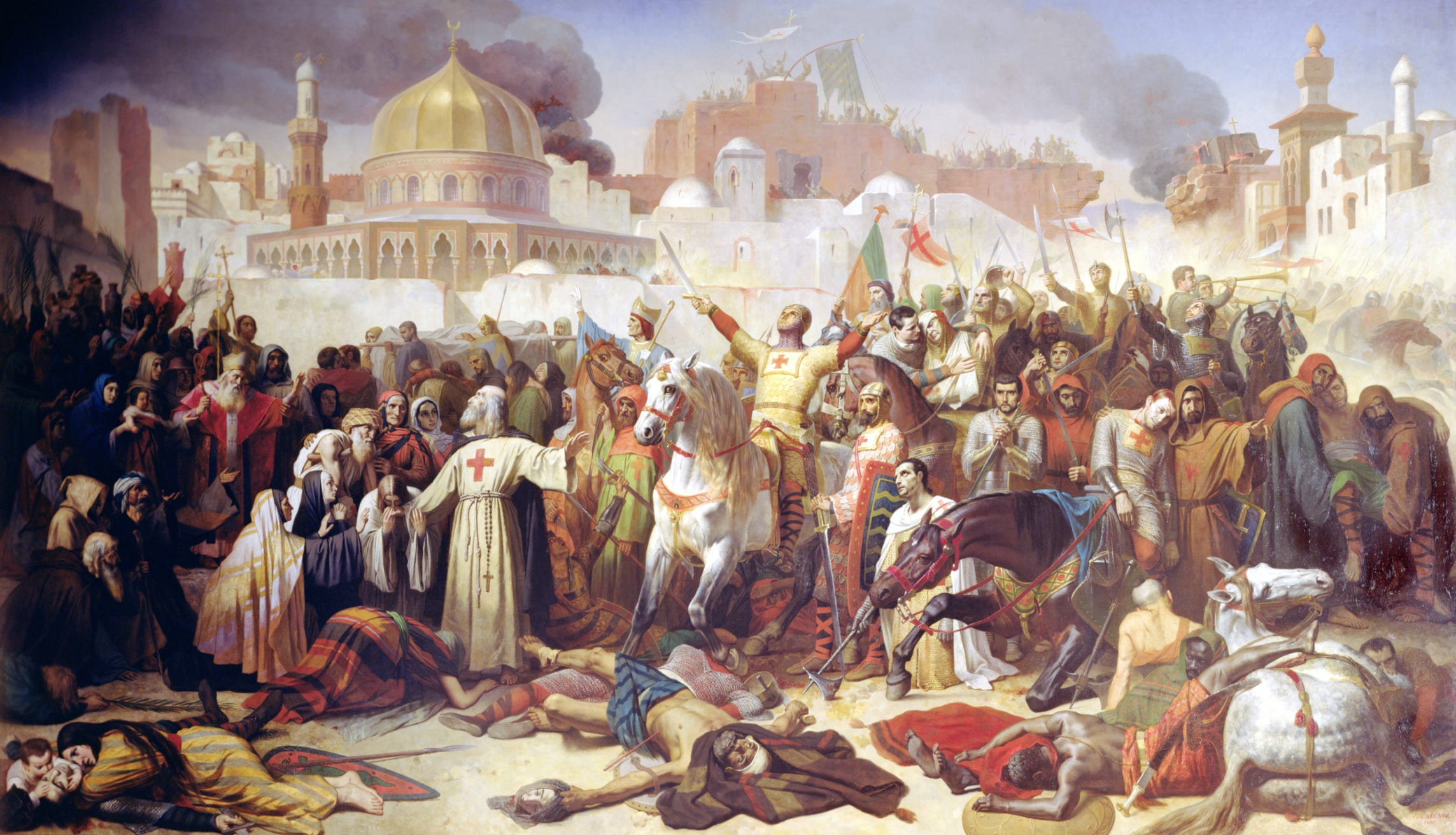
Rare surviving letter from ordinary crusaders, written as they marched east toward Jerusalem (Antioch, October 1098):
To the primates, archbishops, bishops, and other rectors, and to all the faithful of the lands of Christ anywhere; the clergy and people of Lucca (send) greeting full of peace and gladness in the Lord.
To the praise and glory of the Redeemer, our Lord Jesus Christ, we are truly and faithfully making known to all (the news) which we received truly and faithfully from participants in the affairs tbemselves - at what time, with what great triumph, the most mighty right band of Christ gave complete victory over the pagans to our brethren, His champions, after trial and perils. A certain citizen of ours, Bruno by name, known and very dear to all of us, in the year preceding this, went with the ships of the Angles even to Antioch itself. There, as a partner in work and danger, sharer of triumph and joy, be fought along with the fighters, starved with the starving and conquered, also, with the conquering; and when the complete victory had already been achieved, and he had rejoiced three weeks there with all, be returned to us, after a happy voyage. Placing him in our midst, we received from him the pure and simple truth of the matter - lo! in his own account, as follows:
“When we who were voyaging by sea bad come to Antioch, the army, which bad gathered together from everywhere by land, bad already surrounded the city in siege, though not very well. On the following day, our princes proceeded to the sea, for the sake of visiting us. They urged us to get together an abundant supply of wood for the construction of war engines, which we did at great expense. On the third day, moreover, before the Nones of March, that is the first Friday, our princes decided to erect a fortress at the western gate of the city. This fortress, a very short ballista-shot away (from the city), is now called by the name of the Blessed Mary. There, on that same day, in an attack of the Turks, in which they killed 2,055 of our men, we killed 800 of the enemy. From the third day, moreover, when the fortress had been erected, until the third day before the Nones of June, our men endured many hardships, and, weakened by hunger and the sword, they toiled there at great cost. However, on this day the city was captured in the following manner: Four brothers, noble men of Antioch, on the second day of June promise to surrender the city to Bohemund, Robert Curtose, and Robert, Count of Flanders. These, however, with the common assent of all our princes, at nightfall conduct the whole army to the wall of the city, without the knowledge of the Turks. And in the morning, when the citizens of Antioclio open the gates to receive the three named princes alone, according to promise, all of our men suddenly rush in together. There is the greatest clamor: our men obtain all the fortified places, except the very high citadel; the Turksthese they kill, those they hurl to destruction over the precipice.”
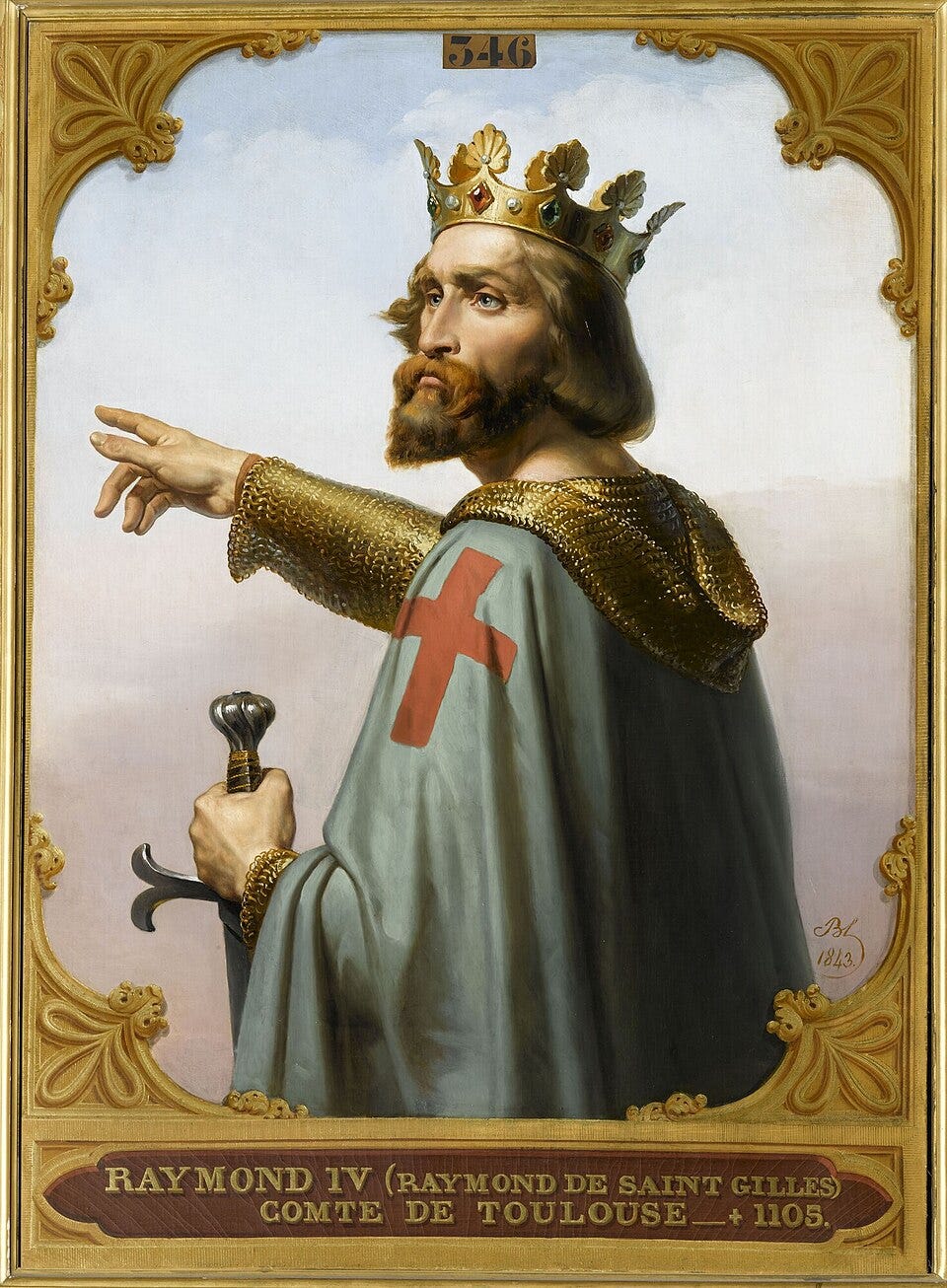
This is the official letter sent after the First Crusade, announcing to the Pope that Jerusalem had fallen into Christian hands (Laodicea, September 1099):
To Lord Paschal, pope of the Roman church, to all the bishops and to the whole Christian people, from the archbishop of Pisa, duke Godfrey, now, by the grace of God, defender of of the Holy Se ulchre, Raymond, count of St. Gilles, and the whole army of God, which is in the land of Israel, greeting.
Multiply your supplications and prayers in the sight of God with joy and thanksgiving, since God has manifested His mercy in fulfilling by our bands what He bad promised in ancient times. For after the capture of Nicaea, the whole army, made up of more than three hundred thousand soldiers, departed thence. And, although this army was so great that it could have in a single day covered all Romania and drunk up all the rivers and eaten up all the growing things, yet the Lord conducted them amid so great abundance that a ram was sold for a penny and an ox for twelve pennies or less. Moreover, although the princes and kings of the Saracens rose up against us, yet, by God’s will, they were easily conquered and overcome. Because, indeed, some were, puffed up by these successes, God opposed to us Antioch, impregnable to human strength. And there He detained us for nine months and so humbled us in the siege that there were scarcely a hundred good horses in our whole army. God opened to us the abundance of His blessing and mercy and led us into the city, and delivered the Turks and all of their possessions into our power.
Inasmuch as we thought that these had been acquired by our own strength and did not worthily magnify God who bad done this, we were beset by so great a multitude of Turks that no one dared to venture forth at any point from the city. Moreover, hunger so weakened us that some could scarcely refrain from eating human flesh. It would be tedious to narrate all the miseries which we suffered in that city. But God looked down upon His people whom He had so long chastised and mercifully consoled them. Therefore, He at first revealed to us, as a recompense for our tribulation and as a pledge of victory, His lance which had laid hidden since the days of the apostles. Next, He so fortified the hearts of the men, that they who from sickness or hunger had been unable to walk, now were enbued with strength to seize their weapons and manfully to fight against the enemy.
After we had triumphed over the enemy, as our army was wasting away at Antioch from sickness and weariness and was especially hindered by the dissensions among the leaders, we proceeded into Syria, stormed Barra and Marra, cities of the Saracens, and captured the fortresses in that country. And while we were delaying there, there was so great a famine in the army that the Christian people now ate the putrid bodies of the Saracens. Finally, by the divine admonition, we entered into the interior of Hispania, and the most bountiful, merciful and victorious hand of the omnipotent Father was with us. For the cities and fortresses of the country through which we were proceeding sent ambassadors to us with many gifts and offered to aid us and to surrender their walled places. But because our army was not large and it was the unanimous wish to hasten to Jerusalem, we accepted their pledges and made them tributaries. One of the cities forsooth, which was on the seacoast, bad more men than there were in our whole army. And when those at Antioch and Laodicea and Archas heard bow the hand of the Lord was with us, many from the army who had remained in those cities followed us to Tyre. Therefore, with the Lord’s companionship and aid, we proceeded thus as far as Jerusalem.
And after the army had suffered greatly in the siege, especially on account of the lack of water, a council was held and the bishops and princes ordered that all with bare feet should march around the walls of the city, in order that He who entered it humbly in our behalf might be moved by our humility to open it to us and to exercise judgment upon His enemies. God was appeased by this humility and on the eighth day after the humiliation He delivered the city and His enemies to us. It was the day indeed on which the primitive church was driven thence, and on which the festival of the dispersion of the apostles is celebrated. And if you desire to know what was done with the enemy who were found there, know that in Solomon’s Porch and in his temple our men rode in the blood of the Saracens up to the knees of their horses.
Then, when we were considering who ought to hold the city, and some moved by love for their country and kinsmen wished to return home, it was announced to us that the king of Babylon bad come to Ascalon with an innumerable multitude of soldiers. His purpose was, as be said, to lead the Franks, who were in Jerusalem, into captivity, and to take Antioch by storm. But God had determined otherwise in regard to us.
Therefore, when we learned that the army of the Babylonians was at Ascalon, we went down to meet them, leaving our baggage and the sick in Jerusalem with a garrison. When our army was in sight of the enemy, upon our knees we invoked the aid of the Lord, that He who in our other adversities had strengthened the Christian faith, might in the present battle break the strength of the Saracens and of the devil and extend the kingdom of the church of Christ from sea to sea, over the whole world. There was no delay; God was present when we cried for His aid, and furnished us with so great boldness, that one who saw us rush upon the enemy would have taken us for a herd of deer hastening to quench their thirst in running water. It was wonderful, indeed, since there were in our army not more than 5,000 horsemen: j and 15,000 foot soldiers, and there were probably in the enemy’s army 100,000 horsemen and 400,000 foot soldiers. Then God appeared wonderful to His servants. For before we engaged in fighting, by our very onset alone, He turned this multitude in flight and scattered all their weapons, so that if they wished afterwards to attack us, they did not have the weapons in which they trusted. There can be no question how great the spoils were, since the treasures of the king of Babylon were captured. More than 100,000 Moors perished there by the sword. Moreover, their panic was so great that about 2,000 were suffocated at the gate of the city. Those who perished in the sea were innumerable. Many were entangled in the thickets. The whole world was certainly fighting for us, and if many of ours had not been detained in plundering the camp, few of the great multitude of the enemy would have been able to escape from the battle. And although it may be tedious, the following must not be omitted: On the day preceding the battle the army captured many thousands of camels, oxen and sheep. By the command of the princes these were divided among the people. When we advanced to battle, wonderful to relate, the camels formed in many squadrons and the sheep and oxen did the same. Moreover, these animals accompanied us, halting when we halted, advancing when we advanced, and charging when we charged. The clouds protected us from the beat of the sun and cooled us.
Accordingly, after celebrating the victory, the army returned to Jerusalem. Duke Godfrey remained there; the count of St. Gilles, Robert, count of Normandy, and Robert, count of Flanders, returned to Laodicea. There they found the fleet belonging to the Pisans and to Bohemond. After the archbishop of Pisa had established peace between Bohemond and our leaders, Raymond prepared to return to Jerusalem for the sake of God and his brethren.
Therefore, we call upon you of the catholic church of Christ and of the whole Latin church to exult in the so admirable bravery and devotion of your brethren, in the so glorious and very desirable retribution of the omnipotent God, and in the so devoutedly hoped - for remission of all our sins through the grace of God. And we pray that He may make you - namely, all bishops, clerks and monks who are leading devout lives, and all the laity - to sit down at the right hand of God, who liveth and reigneth God for ever and ever. And we ask and beseech you in the name of our Lord Jesus, who has ever been with us and aided us and freed us from all our tribulations, to be mindful of your brethren who return to you, by doing them kindnesses and by paying their debts, in order that God may recompense you and absolve you from all your sins and grant you a share in all the blessings which either we or they have deserved in the sight of the Lord. Amen.
Source 1: Bongars, Gesta Dei per Francos, 1, pp. 382 f., trans in Oliver J. Thatcher, and Edgar Holmes McNeal, eds., A Source Book for Medieval History, (New York: Scribners, 1905), 513-17
Source 2: Dana C. Munro, "Letters of the Crusaders", Translations and Reprints from the Original Sources of European History, Vol 1:4, (Philadelphia: University of Pennsylvania, 1896), 5-8
Source 3: August. C. Krey, The First Crusade: The Accounts of Eyewitnesses and Participants, (Princeton: 1921), 157-60
Source 4: August. C. Krey, The First Crusade: The Accounts of Eyewitnesses and Participants, (Princeton: 1921), 161-67
Source 5: Dana C. Munro, "Letters of the Crusaders", Translations and Reprints from the Original Sources of European History, Vol 1:4, (Philadelphia: University of Pennsylvania, 1896), 8-11
Extraordinary work! Congratulations!
Excellent! Fascinating! Thank you.