

This article was written by Stéphanie Kay, independent writer and editor, French Canadian native and British citizen based in Oxfordshire and the USA.
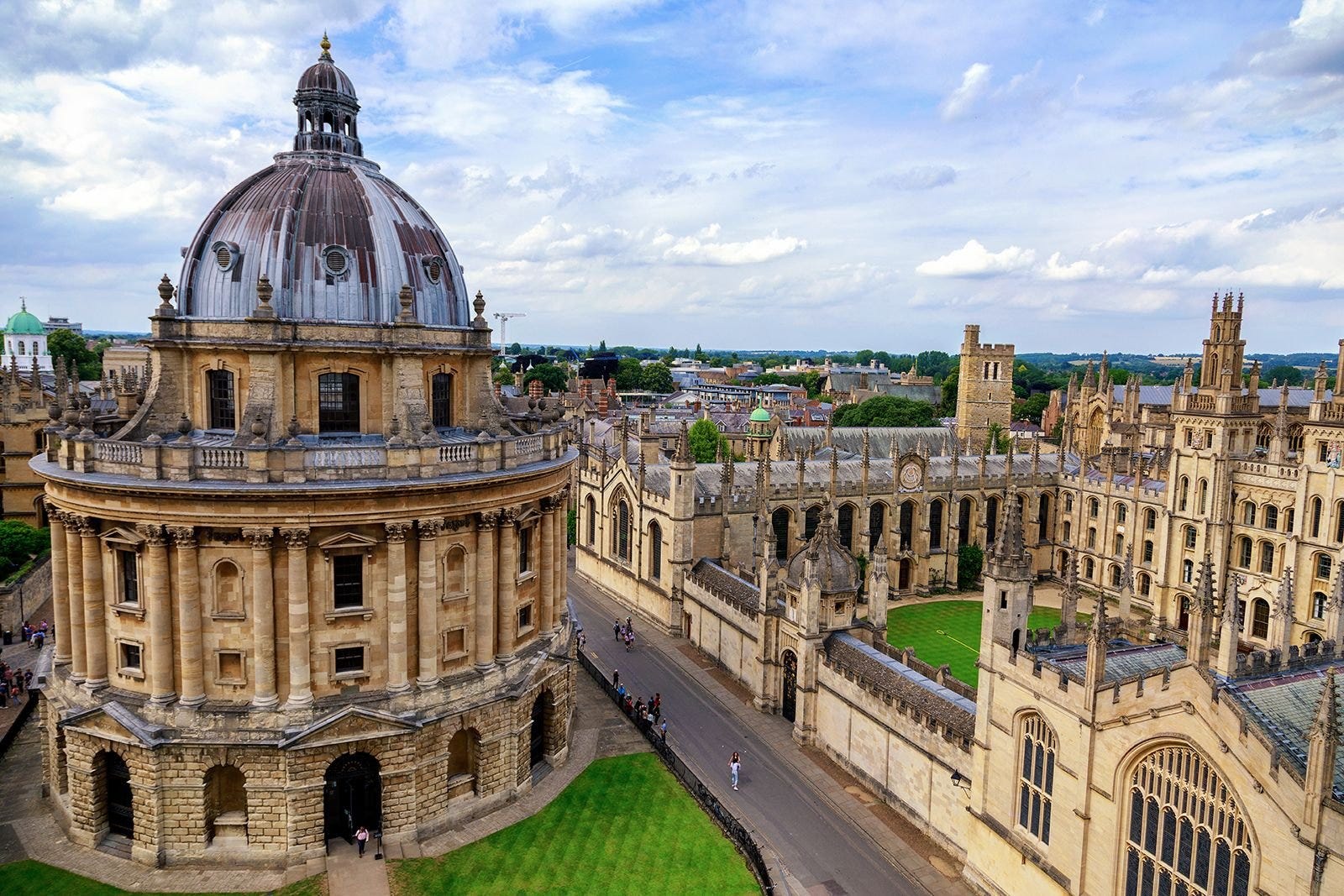
Centuries before it emerged as a place of learning, Oxford was a small Anglo-Saxon settlement at the edge of the kingdom of Mercia. It was established where a conveniently shallow stretch of the river Thames allowed oxen and other animals to ford this natural barrier, hence the name.
There are a few contenders for the location of this pivotal crossing; the most probable being near the confluence of the Thames and its Cherwell tributary, on land now belonging to the college of Christ Church. It was likely at this location, in the late 7th - early 8th centuries, that a pious young woman called Frideswide (circa 680 to 727 or 735) was impelled to found a priory church – or, in a different version, to develop the one founded by her father.
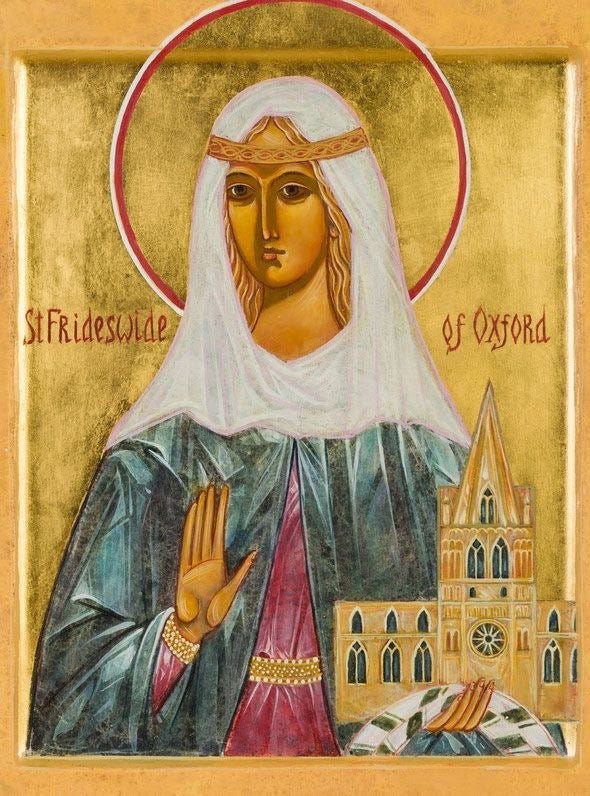
Mercia had only become Christian in 655, so Frideswide was an early stalwart of the faith in what later became England. As the daughter of a local king, she had the privilege of being able to devote herself to her calling. Conversely, as a princess and reputed to be beautiful and kind, she faced pressure to marry. Her most aggressive suitor was said to be Algar, prince of a neighbouring sub-kingdom. He wanted to make her his wife, notwithstanding her vocation to celibacy. His stated aim of marital conquest led her to flee Oxford, the church unfinished. She sought refuge a few miles northwest of the settlement, in a notoriously dense and thorny wood near what is now the hamlet of Binsey.
Algar eventually found her nonetheless, but he was stricken blind before he could claim her as his bride. Out of compassion for his affliction, and his subsequent repentance, Frideswide prayed to Margaret of Antioch, a 3rd century saint who had similarly been pursued against her will. As the story goes, in answer to Frideswide’s prayer, a well opened up at her feet. With the ‘triacle’ or ‘treacle’ (‘healing balm’) water of the well, Frideswide restored Algar’s sight. Her name, combining ‘peace’ and ‘strength’, had proven to be prophetic. Algar, a changed man, went on his way.
Frideswide stayed in the Binsey area to build a chapel near the healing well, in honour of St Margaret (rebuilt in the 13th Century). Pilgrims began to journey to Frideswide and to the Treacle Well and, when she had returned to Oxford, to the renowned well itself. It thrived as a place of pilgrimage throughout the Middle Ages and into the 17th century. Before the Reformation, and before their marriage was annulled in 1533, Catherine of Aragon and Henry VIII are said to have prayed there for a son and heir. Alas, poor Catherine! We can only begin to speculate on how history would have unfolded had this request been granted.
In another version, the well springs up not in connection with the Algar crisis but simply to provide water for Frideswide and her lady companions in their temporary exile in the thorny woods. The water proves to be miraculous, in addition to salubrious, and soon becomes a focus for pilgrimage. In this variant, Algar pursues Frideswide from Binsey back to Oxford. It is at Oxford that he is stricken blind, and where Frideswide heals him, without need of well or water.
If these origin stories of the cult of Frideswide sound rather like legends that’s because we have no contemporary written records, as is often the case for pre-Norman Conquest history. The documents which provide the stories above date from the 12th century: from William of Malmesbury’s Gesta Pontificum Anglorum, “and two saints’ Lives known as Life A and Life B.” (Sally Welch, A Pilgrims’ Companion to Saint Frideswide’s Way, Christ Church Cathedral, p. 12.)
Long before the Catholic Church formulated its Congregation for the Causes of Saints in 1588 (initially, the Sacred Congregation of Rites), validation of sainthood relied mainly on local testimonies and episcopal approval, and so we must assume it was for Frideswide. The survival of the well at St Margaret’s church, past the worst ravages of the Reformation, testifies to the strength of her cult. It was only in 1639, when Puritanical fervour had turned its keen gaze on the well, that its protective stone structure was broken down and its cult banished. It would lay dormant for over two hundred years.
Going back to Frideswide’s time, undoubtedly her connection with the future site of Christ Church vouchsafed her legitimacy in a more formal manner. For to Oxford she did indeed return, after the Binsey interlude. She established not only a church there, but a monastery (or priory/convent/nunnery, terms vary) where she was able to live out her vocation to prayer and to the poor and the sick.
Her church was burned down in 1002, in a grisly event of the St Brices’s Day Massacre. Any potential records would also have been lost in the conflagration. King Aethelred ‘the Unready’, who had ordered the massacre (of Danes in England), then ordered the church to be re-built.
As approved by Henry I, in 1122, it became an Augustinian Priory dedicated to St Frideswide. Her relics were recovered from their burial place and moved (‘translated’) by the Augustinians to a proper shrine in 1108, then moved again to a more elaborately-built one in 1289. The Priory thus became a second, major focus of Frideswide pilgrimages. According to some accounts, it is here that Catherine of Aragon prayed for a son, rather than at St Margaret’s well.
In 1440, Frideswide was made Patron Saint of Oxford and its University by the then Archbishop of Canterbury, Henry Chichele: feast day on 19th October.
In 1524, Cardinal Wolsey dissolved the Priory as part of his plans to found Cardinal College. With the Reformation in full swing by 1538, the shrine was destroyed, and the saint’s bones buried elsewhere to prevent further pilgrimages. In 1546 (Wolsey having died in 1530) the King re-founded the college in his own name (King Henry VIII College) which then became the Christ Church we know today (always Christ Church; ‘Christ Church College’ is not approved usage), wherein the new church served as both college chapel and diocesan Cathedral. Also from 1546, the college acquired the land encompassing Binsey and St Margaret’s church and well.
In the 19th century, the intense changes brought about by the Industrial Revolution inspired a Gothic Revival movement, harking back to the architecture and values of the High and Late Middle Ages. For Christ Church Cathedral that meant an interest in recovering its historical roots, therefore highlighting the foundational role of St Frideswide. Explorations and renovations connected to the movement yielded the exciting discovery - in an old well, as it happened – of fragments of the 1289 shrine and what appears to be a grave slab dating from an even earlier time (as displayed in the Museum of Oxford, on loan from Christ Church, below).
Friendly reminder:
The Western Spirit exists because of readers like you. Join us and help keep this project alive and independent.
If you’ve been enjoying these essays, consider becoming a paid subscriber. For a few dollars a month, you’ll get:
Essays on brave men, and turning points in Western history
Reflections on faith, tradition, and culture
Full access to the growing archive - essays, book breakdowns, and deep dives
This project exists because readers like you make it possible.


The artists of the Pre-Raphaelite Brotherhood, founded in 1848, similarly looked to the Middle Ages for inspiration, further contributing to the cultural wave of interest in the past. In 1859, as part of the renovations taking place at the Cathedral, Edward Burne-Jones was commissioned to paint a new, St Frideswide Window for the Latin Chapel where her shrine rests. It would take a long time, and a ladder, to be able to properly appreciate the visual and narrative elements of the project, individually and as they form the spectacular window in its entirety.

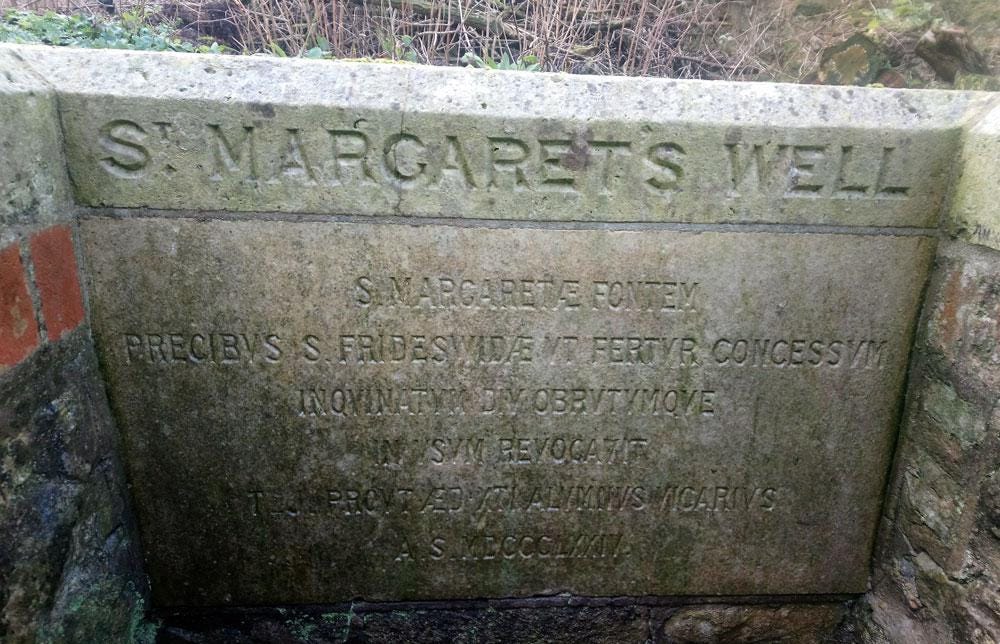
One Charles Dodgson, AKA Lewis Carroll, a Fellow at Christ Church from the 1850s, witnessed these developments. Dodgson often took boat trips to Binsey and Godstow with Alice Liddell and her sisters, the daughters of the Dean of the college. Borrowing from St Frideswide, he included mention of the Treacle Well in the stories he told the sisters, which were published as Alice in Wonderland in 1865. This ‘nonsense’ iteration of the well features in Chapter VII: “A Mad Tea-Party”, as told by the Dormouse. Whether because of this or coincidentally, in 1874, the Reverend T.J Prout, “alumnus of Christ Church”, took it upon himself to restore and re-open the well, for his time and for posterity.
A visitor to Oxford today may come across a St Frideswide parish church on Botley Road, a Frideswide Square near the main railway station, a St Frideswide Primary School in the suburb of Cowley and, in October, a yearly marking of her patronage on her feast day. Christ Church Cathedral remains the pre-eminently rewarding destination for Frideswide and other historical interests, with the caveat that the space must be shared with ever-present groups of tourists. Laudably, in the coming year, the Cathedral will be celebrating “Frideswide at 1300”, an anniversary based on 19th October, 727, as the day and year of her death. The Cathedral will host a series of events from February to October 2027. Some of the celebrations are in conjunction with a wide-ranging, revived pilgrimage called St Frideswide’s Way, segments of which can count towards completion of the Santiago de Compostela pilgrimage in Spain
For those of a more retiring or less energetic disposition, the quiet counterparts to the Cathedral, tucked away in the countryside, are worth bearing in mind. St Maragret’s church and well are a gentle, ten-minute walk from Binsey, in peaceful surroundings. The well looks a bit the worse for wear but it continues to be recognised and visited as a place of prayer and supplication. On a practical note, the water is too low to reach unaided, and there is no drawing vessel supplied, so visitors should come prepared with one. On a spiritual note, though the water appears murky – ‘treacly’ in the current sense – it is in fact clear and fresh, one might almost say miraculously so. St Margaret’s continues as a small place of worship, with Holy Communion one Sunday a month and Evening Prayer in the summer months, which may be preceded by official sprinklings from the well.
The whole of Binsey consists only of a few picturesque houses and an upscale pub called The Perch. Nearby is a lovely Thames-side path leading northward to the ruins of Godstow Abbey. To the south, by crossing the Thames on a Victorian iron footbridge, there is access to Port Meadow, a late-Saxon common land of over 300 acres for the grazing of cattle and horses. It is used for that purpose and as a popular recreational area to this day.
We cannot leave this bucolic patch of Oxfordshire, however, without highlighting the Binsey signpost.
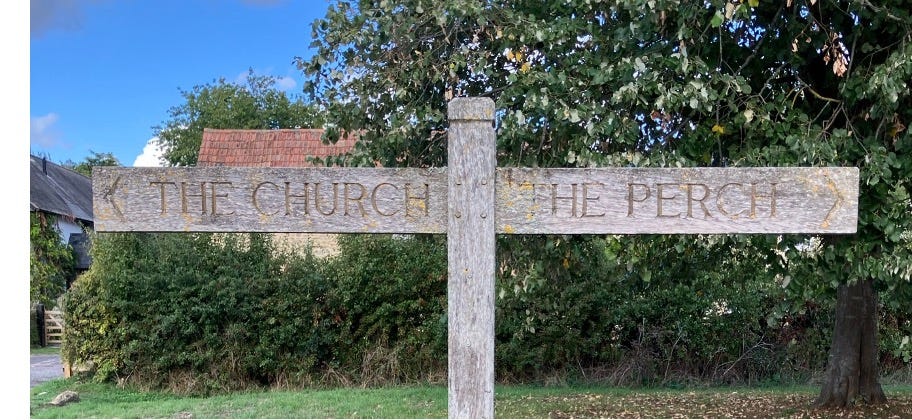
The weathered wood marks an opposition between the direction of St Margaret’s and the direction of the pub: ‘The Church’ one way, ‘The Perch’ the other. The easy rhyme makes it sound like a light-hearted dilemma. In truth, though, the spiritual basis of British culture on the one hand, and the social, cultural core of that culture on the other, are now under various forms of serious or even civilisational threat. Efforts to support and revitalise both may become needed pilgrimages of a kind unforeseen by ancient saints. Where the fate of the Church is concerned, in particular, smothered as it is by neo-paganism, politicisation or indifference, and an imported, hostile religion, we may all be required to stand, like Frideswide in her day, as stalwarts of the faith.
Thank you so much, Sandro! Indeed I do cover those points, in the full article.
Very interesting. Thanks for sharing!