

“Will no one rid me of this meddlesome priest?” These words are commonly attributed to King Henry II (reigned 1154-1189), who would have uttered them in a paroxysm of frustration with Thomas Becket, his Archbishop of Canterbury. The baronial knights to whom the King posed the momentous question took it as their cue for action. They duly travelled to Canterbury Cathedral, where they brutally murdered Becket on December 29th, 1170.
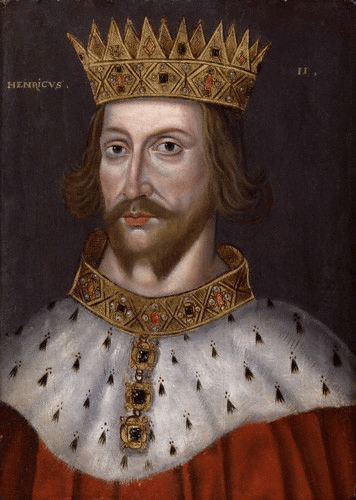
Famously ‘medieval’ though it is, however, the ‘meddlesome priest’ line comes from the 1964 film “Becket” (based on the 1959 French play of the same name, by Jean Anouilh). While these scripted words are not historically accurate, it’s almost certain that Henry did say something very much to that effect.
Edward Grim, a suitably named eyewitness to Becket’s murder, recorded Henry’s fulmination as:
“What miserable drones and traitors have I nurtured and promoted in my household who let their lord be treated with such shameful contempt by a low-born cleric!”
In Grim’s record of the outburst, Henry implies that the knights should already have leapt to defend his honour from Becket’s ‘shameful contempt’.
Manoeuvred by Henry into the Archbishopric of Canterbury, Thomas Becket had taken to his role so conscientiously that he had chosen to prioritise his duty to God before duty to his King - whereas Henry had counted on Becket’s headship of the Church to ensure it would defer to the Crown by default. His good friend, Thomas Becket, had thus become his enemy. The tension roiled the Kingdom from 1164 until the day of the murder, which itself had lasting consequences.
Another account derived from a contemporary source cites the King as saying:
A man… who has eaten my bread, who came to my court poor, and I have raised him high – now he draws up his heel to kick me in the teeth! He has shamed my kin, shamed my realm; the grief goes to my heart, and no one has avenged me!
In the 7th century, far away in Arabia, Muhammad the prophet of Islam had said something similar, in his case about a troublesome Jewish poet.
Thus, after a Jewish poet, Ka‘b ibn al-Ashraf, had offended Muhammad with his verse, the latter exclaimed, “Who will kill this man who has hurt Allah and his prophet?”
(Raymond Ibrahim, The Two Swords of Christ, p.87)
When I learned of this saying, it immediately reminded me of the “Becket” line, not because I’d seen the film (though I have now) but because it has passed into common language. In 2017, for example, former FBI director James Comey used it to misrepresent words of President Trump and exonerate himself.
Whatever the exact wording of Henry’s grievance, it struck me that its import is the same as Muhammad’s: not about a crime, as such, but about the ‘hurt’ of insult. Both overlords were bristling at lèse-majesté: a subject’s refusal to bow to authority.
The insult for Henry came from the ‘low-born’ Becket, mere son of a merchant, whom he had elevated to highest office (Lord Chancellor) before the Archbishopric. The insult for the leader of Islam came from a Jew who ought to have known his suppliant place as a mere infidel.
The tenor of both complaints being so similar, one may ask if Henry was echoing Muhammad. The answer is perhaps surprising: he could have been.
Historical facts and reports indicate that Henry II was well versed in the ways and the literature of Islam. Around the time of Henry’s great-grandfather William’s conquest of England in 1066, which took about twenty, often violent, years to secure, the Normans were also in the process of conquering Sicily (1061-1091).
If you value well-researched stories about Western civilization that mainstream outlets ignore, consider becoming a paid subscriber.
Here’s what you get by upgrading:
In-depth essays on Christian men and great battles
Lessons from the past and what they can teach us today
Full access to the growing archive
Help keep The Western Spirit alive and independent by upgrading.
Whereas the Anglo-Saxon culture of early England came under intense pressure from the newly imported Norman rulers and systems, the legacy of the 250-year old Muslim occupation of Sicily was treated more leniently, with some of its practices even incorporated into the island’s governance.
By the time Henry was born, in 1133, the Norman Kingdom of Sicily has been consolidated (1130). A fusion of Islamic and Norman architectural styles developed, and the books and culture of Islam featured in the education of Norman scions, notably that of Henry. According to Claudia Gold, author of King of the North Wind: The Life of Henry II in Five Acts (William Collins, 2018):
Alongside Islam, Henry also developed an admiration for Arabic learning from an early age. He had received an outstanding education from scholars versed in the ‘new’ knowledge that was exploding out of Sicily, Spain and the Middle East. […]
Henry’s parents – heeding the lesson from the monk William of Malmesbury that “a king without letters is [just] an ass with a crown” – had hired the best tutors in Europe. Among them was the renowned Arabist, linguist and scientist Adelard of Bath, who had a profound impact on Henry’s education. Adelard had travelled for seven years in Italy, Sicily, Antioch and the southern coast of what would become Turkey, dedicating himself to the ‘studies of the Arabs’.
Henry’s interest continued into adulthood. He welcomed travelling scholars, not least Arab ones, to his courts. He knew enough about Arabic learning to request specific texts from diplomats travelling to Sicily and the kingdom of Jerusalem.
It is therefore plausible that he would know, or been told about, specific Koranic verses and specific hadiths, like the story of the doomed Jewish poet.
Islamic influence filtered through to Henry’s aesthetic sense as well. During his reign, though he spent much of his time in France (as Duke of Normandy and Aquitaine, and Count of Anjou) Henry often repaired to a hunting lodge a few miles north of Oxford called Woodstock Palace (near Blenheim Palace today). Henry had a residence built close by, in the Islamic style, for his long-time mistress Rosamund Clifford.
[Henry] mimicked the palaces of the Norman kingdom in Sicily, with fountains and courtyards. The palace was later destroyed but its style, abounding in Arabic motifs, was unique in northern Europe.
And these are only a sample of the links between England and formerly Islamic Sicily in the 12th century.
More importantly for our purpose here is the gauntlet Henry threw down in 1168. At that point Becket was four years into a Continental exile he had resorted to because of over-reaching legal charges brought against him by Henry in 1164.
By 1168, the situation had become so intolerable to Henry that it came to a head with his links to Islam, culminating in the most shocking card a Christian King could play: he threatened to convert.
Continue reading below.