
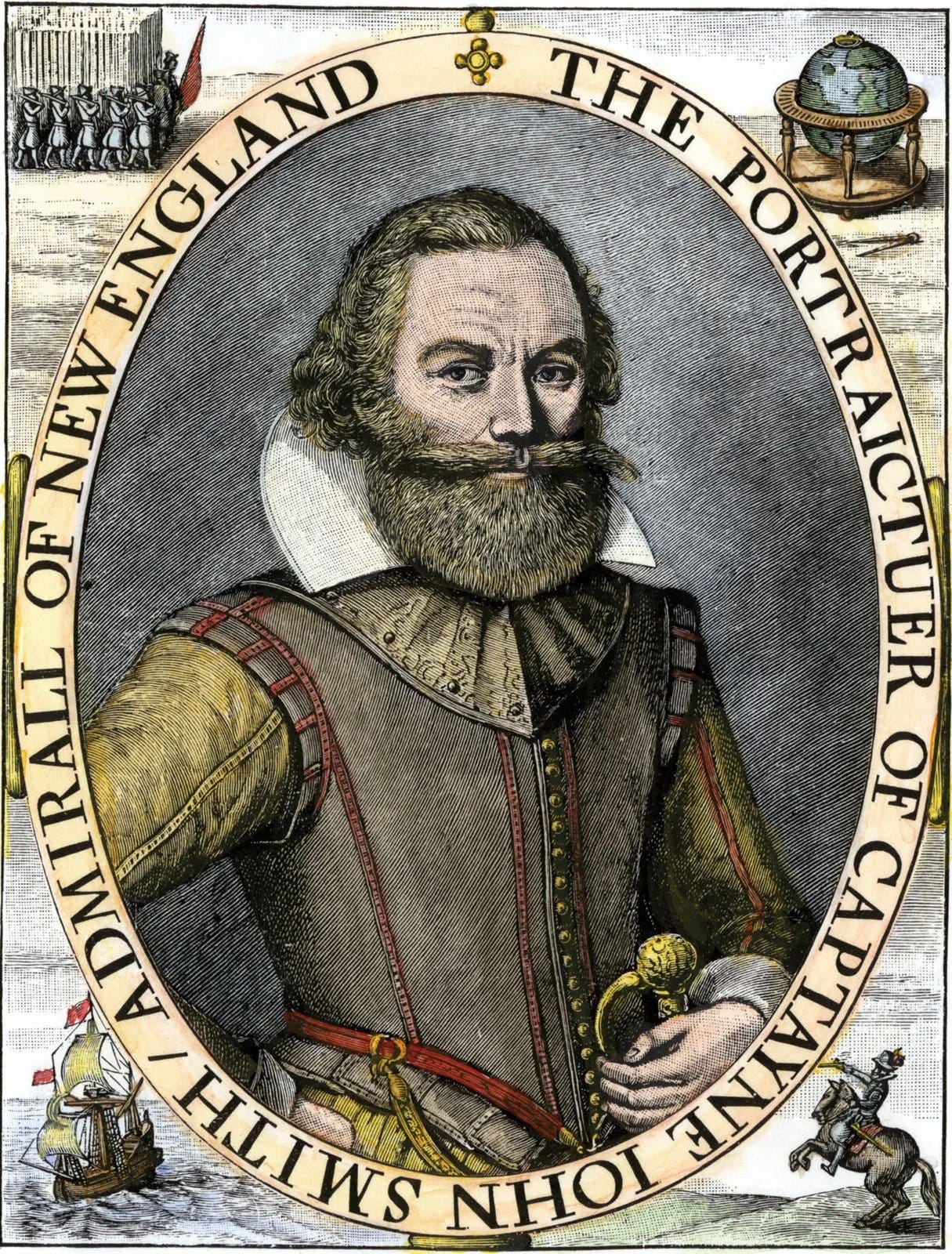
In either late 1579 or the very first days of 1580, one of Albion’s greatest sons was born in Willoughby, a small village in Lincolnshire. While we know not the day of his birth, we do know the date of his baptism: on January 6, 1580, John Smith was baptized.
There was little reason to suspect that this crying baby boy had a great deal of greatness in him. His parents weren’t particularly poor or rich; they farmed land rented from Lord Willoughby, and made enough to send him to a grammar school in Lincolnshire. They had aspirations for the boy–perhaps he could be apprenticed to a Hanseatic merchant after he learned his letters–but nothing so bold as what he envisioned. To John, neither the plow nor the ledger would do. He would learn his letters, and later use them to great effect, but his daily bread would not come from the sweat of his brow nor any talent at trade. He was to be a knight.
Or so he dreamt as he was raised on the farm, educated for a few years, and then sent off as a merchant’s apprentice. This was a step up for the family, and no small thing in those days. But the bold boy was no spirit that could be confined to a counting house. To the open seas and adventures of a great spice merchant, perhaps, but not to the stool on which he sat as he tracked the little details of trade in his ledger and thought of rising about the station of his yeoman parents or the dismal life of money he was staring in the face.
Then, with the death of his father–who he could not dishonor by departing from the prestigious, if dull, apprenticeship that had been arranged for him–Smith’s chance came. The Spanish sought to hold onto the Low Countries, and the Protestant Dutch who lived in those lands had no intention of letting them. England, by now a fiercely Protestant nation under the reign of Queen Elizabeth, was not directly involved in this war against his Most Catholic Majesty Phillip II. But Albion’s sons could win their spurs as soldiers of fortune, and that’s what a 16-year-old Smith decided he’d do.
Racing across the Channel, Smith joined the army of Henry IV of France as a mercenary, fighting on the side of Dutch Independence and facing a renewed apprenticeship, this time in the art of war. Here, in the mud and blood of Flanders, he learned the practical mechanics of early modern war. These were the days of plate armor and firearms, of pike and shot, of the Medieval and the modern. He saw the discipline it took for men to stand under fire, the damage cannons could do to fortifications, and the cruelty of bitter religious conflict. This was to prove the perfect training ground, for all the wars in which he fought in the future were to be similarly cruel wars between alien groups seeking to dominate each other not for king and country, but for God.
Winning his spurs and earning his salt in Henry’s service, Smith made a name for himself. He was not yet famous, but he was known, and his mettle had been tested and found perfectly stern rather than wanting. He could fight, and his fellows knew it. Driven by the sense of restless adventure that was to so define his life, he travelled Europe and lost a small fortune to French con men, was thrown overboard and left on a deserted island by Catholic travelers, and wared with Mediterranean pirates before eventually tromping off to grander battlefields in the East, where Christian fought Muslim in a merciless battle for the bloodlands between Orient and Occident. Here, on the tattered edge of the Holy Roman Empire, he served first in Hungary, then in Transylvania as Hapsburg and Wallachian battled Ottoman and Moldovan in a slugging match over strategic land.
It was in these bloody campaigns that Smith rose to fame. Serving alongside Count Meldritch at the Siege of Regall, Smith and the Christian army found themselves locked in a demoralizing stalemate with the Turks, who were holed up in a heavily fortified stronghold. During the monotony of the siege, the Turkish commander–a fellow named Turbashaw–sent out an offer of single combat. He would fight any Christian champion in full view of both armies. Smith, eager for glory, accepted the challenge. As both sides watched, the two champions rode out onto the field, then raced towards each other, lances levelled. Smith’s lance smashed into the Turk, crashing against his armor and unhorsing him. Wheeling about, Smith raced back to unhorsed Turbashaw, hopped off his own horse, and used his falchion to cleanly decapitate the Turk. The army of Christ roared with applause at the gory trophy as the Muhammedans sat outraged.
It didn’t end there. Infuriated by Smith humiliating Muhammed’s army with such a display, a second Turk challenged him to single combat, again in full view of both armies: give back Turbashaw’s head, or lose your own, a warrior named Grualgo roared. Smith accepted, and it was back to battle. Again lances shivered, but this time Grualgo–though wounded in the arm–remained atop his horse. The champions wheeled about and raced at each other again, firing their pistols at point blank range. Smith was smacked in the breastplate, but it held firm. Grualgo was seriously wounded, and toppled from his steed. Smith once again brought his falchion to bear upon the wounded Turk; a second head was taken.
This the Turks could not abide, and when Smith issued a boastful challenge, it was accepted by Bonny Mulgro. When the charge came, lances proved ineffective for both men, and so they resorted to the battle-axe. Though Smith initially had the worst of it, losing his axe in the slugfest that followed, he managed a daring blow that left Mulgro seriously injured and unhorsed, and soon a third Turk’s head had been taken.
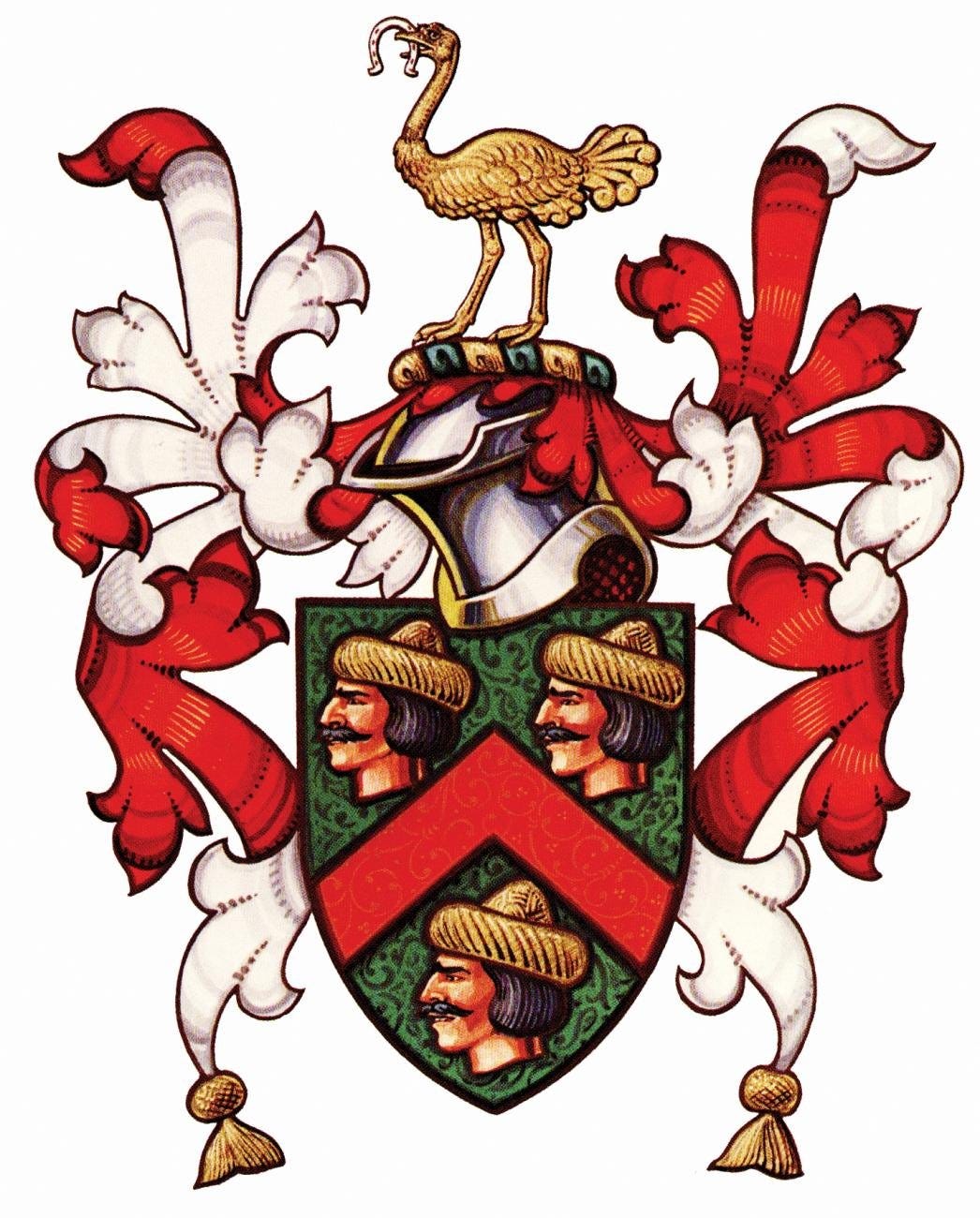
This was a tremendous string of victories that were as enlivening to the Christians as they were disconcerting and demoralizing to the Muslims. Further, they were enough to win Smith entry into the ranks of the elite: the mercenary was knighted, and his coat of arms emblazoned with three Turks’ heads to commemorate his victory. This noble crest was granted to him by Prince Sigismund Báthory of Transylvania.
But “pride goeth before destruction, and an haughty spirit before a fall,” and such was the case for Smith as for all men. The next year, Smith was ambushed and defeated by the Tatars in the bloody Battle of Rotenturm. His force annihilated, Smith was seriously wounded and captured on the field. Soon sold as a slave to a wealthy family in Constantinople, at that point called Istanbul, he became the property of a nobleman’s mistress. Her name was Charatza Trabigzanda, and she fell into a trance-like infatuation with this English knight and his tales of chivalric combat, happier days in England, and all the rest he had seen.
This affection appears to have been discerned by Charatza’s suspicious mother, and so Smith was sent north to her brother, Bashaw Bogall. As he governed a remote estate near the Sea of Azov, it was thought that there Smith might be kept safe and made to convert. Neither was true. Ignoring his sister’s wishes, Bogall treated Smith with the utmost brutality. The enslaved English mercenary-turned-knight was beaten, whipped, and driven into the fields to work the estates of this frontier tyrant. But though beaten and enslaved, Smith was still strong in spirit, and he sat waiting for an opportunity to make his way to freedom.
It came when Bashaw Bogall set about beating Smith during the threshing season. They were alone, and Smith sensed it was time to act. Taking up his threshing bat, he battered his tormenter with it until yet another noble Turk had fallen to his blows. Pausing barely a moment to hide the body and gather up some food, Smith raced off and headed for freedom in Muscovy. For days he travelled, the iron collar of thralldom still about his neck as he sought desperately to reach Christian lands. After more than two weeks of flight, the iron-collared and exhausted Englishman reached a Muscovite garrison at Ecopolis, upon the river Don. He was questioned and found honest by the governor, who struck off his badge of slavery and aided him, and so the knighted hero made his way back to England by way of the Easternmost Christian kingdom, seeing a land entirely alien to all but a few of his kinsmen in those days.
He arrived back in England in 1604, just in time for a new adventure.
Queen Elizabeth had died just a year before he returned, and before she died, the Queen had decided to plant the Protestant flag in the new world to combat the grasping global power of Spain. The Roanoke colony had failed in confusion and disaster during the days of Drake, and a new attempt at colonization was called for: the Virginia Company.
This band of “gentlemen adventurers,” as the subscribers of its stock were called, had determined that they would plant the flag of England upon the shores of Virginia, named for the virgin queen, Elizabeth. The Spaniards had tried and failed to settle a Chesapeake colony, and the Britons thought they could do better. Gradually, an expedition was pieced together despite the new king, James, being hesitant to risk the recent peace with Spain.
Amongst those men involved in the risky, patriotic enterprise was Captain Bartholomew Gosnold. A navigator and privateer, in many ways a maritime version of Smith, Gosnold was one of the few Englishmen who had seen the New World. Indeed, he had travelled along the coast of what was to become New England in 1602, and was part of the inner circle of investors and planners of the attempt to built a plantation–or colony–in North America.
The company formed was the Virginia Company. Backed by lords, it was to carry Protestantism to the New World and serve as a center of profit in addition to being a base of English power across the mighty Atlantic. It was to ship back such materials as could currently only be gotten from Muscovy and the Baltics–particularly timber–to reduce English reliance on them, and find the same incredible wealth in gold the Spanish had discovered in and extracted from their colonies. Such, at least, were the hopes.
Smith, with his sense of adventure and proven record as a fighter of pagans, was one of the military men chosen to serve on the mission. A logistician as well, he proved invaluable as the Virginia company bumbled through preparing an expedition over the course of 1605 and 1606. Finally, it was ready. Respected by imperial promoters like Halkuyt and Hudson, close with Gosnold, a knight in his own right, Smith was chosen to be one of seven members of the governing council in Virginia, when the expedition arrived at the colonists’ new Chesapeake home. A secret until the party arrived in what was to become the Old Dominion, this was to prove most useful to Smtih. In fact, it’s probably the reason he wasn’t executed.
All this and much more having been arranged over years of painstaking work, Captain John Smith boarded the Susan Constant in December 1606, and sailed off to a painful debacle.
The trouble began before the party left England’s territorial waters. Poor winds meant they were stranded offshore before even having made it to Ireland, and sitting in a crammed ship boded well for no one’s humors. The provisions were eaten down, the men made sick, the ships battered for days, then weeks, as the captain waited for the weather to improve. Finally, it did, and the three-ship force set off again in search of what they hoped would be riches and glory.
Friendly reminder:
The Western Spirit exists because of readers like you. Join us and help keep this project alive and independent.
If you’ve been enjoying these essays, consider becoming a paid subscriber. For a few dollars a month, you’ll get:
Essays on brave men, and turning points in Western history
Reflections on faith, tradition, and culture
Full access to the growing archive - essays, book breakdowns, and deep dives
This project exists because readers like you make it possible.
Instead, they got sea-sickness and internal conflict, the latter problem of which grew worse when they arrived in the West Indies. Smith, a proud man with much to be proud about, clashed with the gentlemen’s sons on board with him. Men like Edward Maria Wingfield were not the sorts who he thought could earn their keep in the world to which they were headed, and he clashed with them as the leaking, poorly provisioned ship found its way to the island of Nevis, in the Caribbean. There the conflict grew out of control, and the proud captain faced execution. For some reason that has been lost to history, Smith was spared though the gallows was constructed. He was, however, arrested, and the party set off from Nevis to the Chesapeake in a foul humor.
The conflict continued, Smith raging as he sweltered in the hold. And then his fortunes changed in an instant: on the night of April 26, 1607, Cape Henry was spotted. The sealed tin box with the expedition’s leaders could now be opened, and to the surprise of all, the ornery mercenary was one of the seven rulers of the colony. Begrudgingly, his fellow rulers let him out of the hold.
This deliverance was less than it seemed. The colony that was soon planted was an utter debacle from the start. It faced an Indian attack the moment it went ashore for the first time, and after regrouping settled on a pestiferous and febriferous peninsula thought to be more defensible. This muddy spit of unwholesome land was to be called Jamestown.
Though chosen for its defensibility rather than its healthfulness, Jamestown was initially not even defended. The London Directors, safe in secure in their civilized home, had commanded that the Virginia adventurers were to make peace rather than war with the heathens they encountered so that they could be led to Jesus. Smith found this absurd, knowing as he did from years of experience that difference between men meant war between them as well. Was Protestant England not planting its flag in this sweltering and mosquito-ridden land so that Catholic Spain could be countered? Why would the savages who had fired upon the English from the first be any different?
Nevertheless, orders were orders and the colonists tried to make peace with those Indians they encountered, something that soon led to conflict, and the Indians sensed weakness. Smith had forced the colony to accept partially barricading the neck of the peninsula, and this proved the salvation of the settlers: the Indians crept up to it and attacked, letting fly with a cloud of arrows at the unarmored and largely unarmed English; they had left their cannon and most of their muskets aboard the ships so as to show their peaceful intentions. Those who could fought with all their might, and managed to delay the Indian attack long enough for a naval cannon to be fired. The ball cracked a tree and this frightened the attacking Indians, who scattered. At this point, the lesson of war’s unavoidability was at least somewhat learned, and the Jamestown settlement was fortified, with weaponry brought ashore. Orders or not, the English would not consent to die like sheep.
In all this, the party largely worked as one unit. Some were less accustomed to work than others, but were willing to share in fighting and fortification. Gentlemen and artificers both desired to live, after all, and martial glory was universally respectable.
But they were not all willing to farm. In fact, nearly none of them knew how. So once a tenuous peace had been struck, the gentlemen’s sons largely stopped working. They went off to search for gold, or similar riches, and left the others to do the work of scratching out a crop…one that was desperately needed, as the weeks of laying at anchor and riding out storms off England had left the expedition even more painfully short of provisions than it would otherwise have been.
Only fool’s gold was ever found, and the refusal of much of the party to work – with those who did work generally having no idea how to farm, as they were urban poor from London rather than stolid country farmers (the expedition lacked even a plow, apparently) – meant the English were soon starving.
Smith had no intention of starving, though he also wasn’t going to return to the farming life he had left behind as a 16 year old lad, so set about trying to get some food from the Indians. Always one to recommend war rather than peace with the newly discovered pagans, he spent December of 1607 on an armed foraging expedition, and was soon ambushed by a formidable hunting party led by Opechancanough, relative of the powerful Werowocomoco, or Great Powhatan, as he is better known. Though his men were killed in the attack, Smith managed to put up a stern fight while using his native guide as a human shield. He was nevertheless taken captive, once his pistols were no longer usable, and taken to Powhatan’s court. There he was fed a lavish feast before two large, dark boulders were pulled into the smoky circle.
Suddenly, a gang of towering and painted warriors seized Smith and dragged him to a rock, forcing his head upon it while raising their clubs above his head. Into the scene darted an adventurous little girl, Matoaka, better known by her playful moniker, Pocahontas. This 11 year old daughter of Powhatan broke from her attendants and flung herself across the English captive, her face upon his, between his brains and the clubs that would bash it out. All froze, and looked to Powhatan for guidance. He chose what his daughter wanted–and perhaps had wanted this from the start, and set her upon this task to give him and excuse for mercy–and Smith was allowed to live. Not only that, but he received some food to take back to Jamestown.
Starting in the spring of 1608, Smith set about mapping the new Chesapeake home he was sharing with his fellow colonists. Perhaps to escape the other Council members with whom he was feuding over their refusal to force the men to farm rather than dig for ever-absent gold, perhaps to avoid the difficult duty of securing the ever-dwindling storehouse over which he was supposed to be in charge, or maybe because he simply had an unquenchable thirst for exploration, he set out on two long voyages with a dozen men rowing him, producing maps of such remarkable accuracy that they were used seriously until the mid-19th century, and continue being used for archeological purposes into the present day.
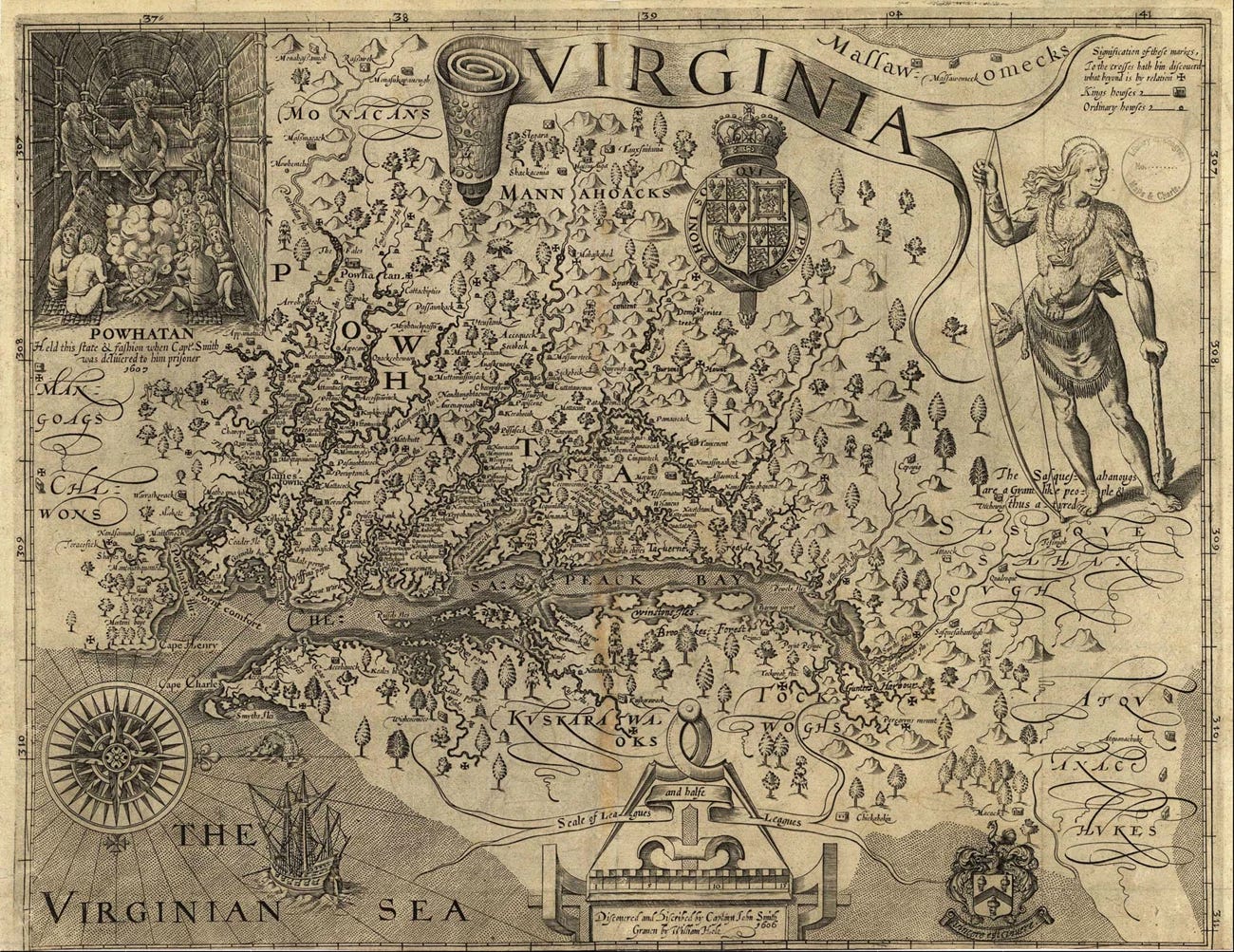
The first expedition involved the charting of the James and York rivers, along with some Indian diplomacy involving the other tribes in the region. The second expedition involved mapping the massive, winding systems of the Potomac and Patapsco rivers where no Englishman had ever set foot. It was during this northern push that Smith met and negotiated with the formidable Susquehannock tribe, known for its prowess. Smith managed to extract something of an agreement with the natives, who were apparently impressed by his courage and the military technology the English possessed. Smith, awed by their towering statures and intimidating dress of wolf pelts, was similarly desirous of a treaty with them. Nothing much ever came of this other than something of a pelt trade, but the English at least escaped the meeting with their lives.
By the time the battered, open barge in which Smith and his motley, hungry crew of a dozen had sailed for months as he mapped the rivers of their new home finally rattled back to Jamestown, these two expeditions had allowed him to chart three thousand miles of shoreline, and the English had a better sense of their water-centric home. Smith also showed the English, through his negotiations with the Indians while on these journeys, how the threat of force and provision of trade goods made for a better strategy than questing hopelessly after a Christian peace. The corn he got for beads kept the colony alive, if only barely.
Smith’s fellow council members were unimpressed, however, and when he was made President of the Council in September 1608, shortly after returning, he inherited governance of a colony that was near-completely broken. It was running low on food, producing nowhere near enough, and was the scene of frivolous gentlemen bowling in the weed-choked streets or digging up barrels of pyrite, which they hoped was real goad, while it raced towards starvation.
Feuding with figures like Gabriel Archer and John Ratcliffe who desired a more passive approach to colonial governance, Smith managed to pull the colony through 1608 by requiring that every man who wished to be fed from the meagre supplies available work to feed the colony. “He who does not work, neither does he eat,” was the Biblical passage on which Smith based this dictatorial rule
This turned the colony away from the gold-hunting and Indian proselytizing the colony’s directors wanted, but his demands for a fortified storehouse, sturdy houses, and agricultural plots at least meant some of the men survived. So too did he carry the sword and torch to Indian settlements, refusing to make peace with those who acted aggressively toward English settlements. Out of this skirmishing and raiding he got enough corn and security to keep the colony from flatlining, but little more.
His dictatorial authority lasted until the summer of 1609, when an influx of new settlers sent by the Virginia Company and new letters of authority for Archer and Ratcliffe weakened his grip on the still-struggling colony. Smith was doubly annoyed with the situation, as the company had sent over far too few supplies and far too many more useless colonists who didn’t know how to farm. Starvation in the hopelessly overcrowded and semi-besieged fort was thus once again on the horizon, and Smith sought to prevent it with the usual mix of trade and raiding.
During one such voyage, this one in October of 1609, disaster struck. Somehow, the gunpowder pouch strapped to his hip caught fire as he slept in an open boat, and the resultant explosion ripped a large chunk of flesh from his thigh and burned him severely. He threw himself into the freezing water and sizzled, barely alive.
Somehow, he survived the dire wound and schemes of his enemies, and made it back to England. Stripped of his authority by Archer and Ratcliffe, he arrived in chains, inches from death.
This was not the end of Smith, nor of Virginia. It was to muddle through the starving time as he explored the coast of New England–he discovered both Cape Cod and Plymouth while mapping what became America’s northern coast, and then turned his pen to castigating his enemies in the colony and Virginia Company. Those letters he had learnt so many years before came in useful as he wrote narratives of his expeditions that left few of his contemporaries unscathed, and most of them slandered.
The end of his association with Virginia came not with his maps nor his pen, but when a young man named John Rolfe brought his bride back to England. Her name was Lady Rebecca, which she adopted after being baptized. Originally, she had been known as Pocahontas. Coldly, she rebuked Smith for leaving her–she had presumed him dead–and it does not appear that the two ever reconciled. She soon died of disease, and Smith passed away in June 1631 in London, at the relatively young age of 51. He died quietly in his bed, a stark contrast to his life of violence and exploration.
Smith: The Perfect American Model
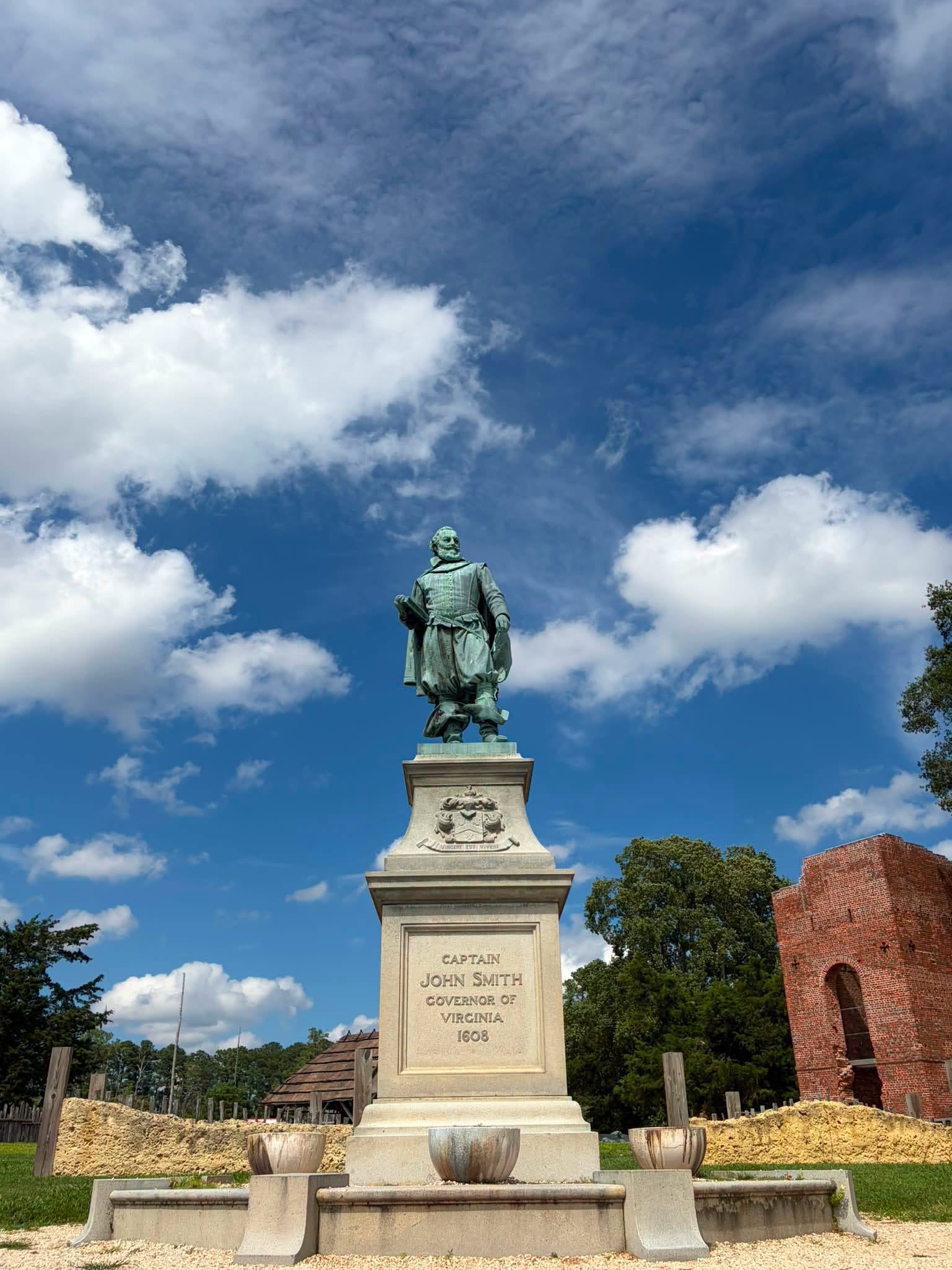
Though America did not yet exist when he was born in Lincolnshire in 1580, there are few great men of history who feel so distinctly American as John Smith, for he broke many of the molds of the old world and built many of the tendencies that were to define a certain sort of American as we began our great ascent as a nation.
For what was John Smith but a man who straddled old and new? Raised on a farm, he set out to do something bolder. He fought as a mercenary in a war of religion in the Low Countries, and after winning his spurs served in what he thought to be a crusade against the Ottomans in Transylvania. He was a slave of the Turks, and carved out the plantation colony that would bring slavery to America. He discarded the mewling and detached religiosity of those English who demanded the Indians be preached to rather than fought, and raised his well-honed blade to fight them. He spent his life in quest of a great fortune, yet he loved and desired gentility. He was an explorer, and cherished Merry Old England.
Smith was thus a composite of what classic Americans became.
While a Christian, he was much more interested in fighting the Indians to take their territory than in converting them and living with them. This was American policy after the horrific and underhanded 1622 Massacre that almost destroyed Virginia; he was just ahead of the curve in recognizing the need to fight and relative desirability of taking rather than asking. Whereas Canada was to make peace with and protect the “First Nations” as its settler population grew, America nearly exterminated the Indians before allowing a few to live on reservations, as degraded curiosities. Such is much closer to what Smith would have thought necessary, and done.
Like the frontiersmen, explorers, and settlers that were to define America for centuries to come, Smith could never quite settle down. He always wanted to explore, to discover, to chart new places and bring new territory under his dominion. With the map and the sword he set out, and those who followed were to do the same with the musket.
Smith also had much less tolerance for charity than the settled Europeans, and his approach to starvation and poverty was one that became what America was known for until the New Deal: in this land of plenty, a land where anything grew and game abounded, every man was expected to figure out eating for himself. There would be no grand charity, no public storehouse to feed all in need, no food for impoverished worker or distressed gentleman. While England had its poor laws and workhouses, America was to have no such thing, and no such relief. Only those who worked or had enough money to avoid working ate in America until the 20th century; the land of plenty was a much unkinder place for the indolent than settled Europe, as Smith would have wanted.
Finally, Smith represents the same conflicted view of European nobility that long characterized America and Americans. On one hand, he desperately wanted to be part of the genteel society he saw but was not part of as a young man. Chivalry, wealth, prominence, it all appealed to him, and he set off to become such a man. This is why he was an adventurous mercenary: it was the way to obtain such status, not trade, and it somewhat worked. He got his coat of arms, and became well-respected, in certain corners, at least. But he could never quite make himself amenable to the lax, indolent nature of the gentlemen and their sons. His hostility to their gaming and bowling in Jamestown’s muddy streets, his forcing them to set to work farming, his constant feuding with his superiors by birth all showed his inner will and desire that his merit would trump their birth. The Virginia gentry that followed him was little different. Men such as Byrd, Lee, Fitzhugh, Corbin, Custis, and all the rest came to America because such an adventure was the way they could escape lives of dull middle class merchantdom and become part of a respected landed elite. Byrd would have been a goldsmith if not for his uncle Stegge inviting him to Virginia, and Lee would have been a London merchant or clothier had not he set out for the change of glory in the New World. Such men and their sons sought to be a gentry, but also found themselves annoyed with the haughtiness of their British superiors, something that eventually led to Revolution. The gentry of the Carolinas, patroons of New York, and even Gilded Age elite were little different: they loved the culture of the British landed elite to a certain extent, but always had a bit of the striver in them, and a different sense of where merit and talent fit in the order of things. Smith, in his feuding with such men as Wingfield, began that proud American tradition.
So, when you think of Smith and his courage, raise a toast to him. He’s from whom we’re descended, if spirit and tradition if not in blood.
This article was written by Will Tanner. He writes about history and what we should learn from it at The American Tribune, and tells the stories of the lives of great men on his YouTube channel, The Old World Show. Please follow him to hear more such stories as these!
We truly need more of our true history told. Men & woman like Smith & Pocahontas helped to make the world.
Wonderfully interesting read. Thank you very much.