

Remember, remember, today is the fifth of November. That means Guy Fawkes is trending on social media. As is V for Vendetta, since many public school products think that the Gunpowder Plot was an anarchist-liberation movement.
Nothing could be further from the truth, as we used to discuss in the college history of terrorism class which I taught for years. And probably the best recent source on this topic is Marc Nicholls, “Strategy and Motivation in the Gunpowder Plot” from The Historical Journal, 50, 4 (2007), pp. 787–807.
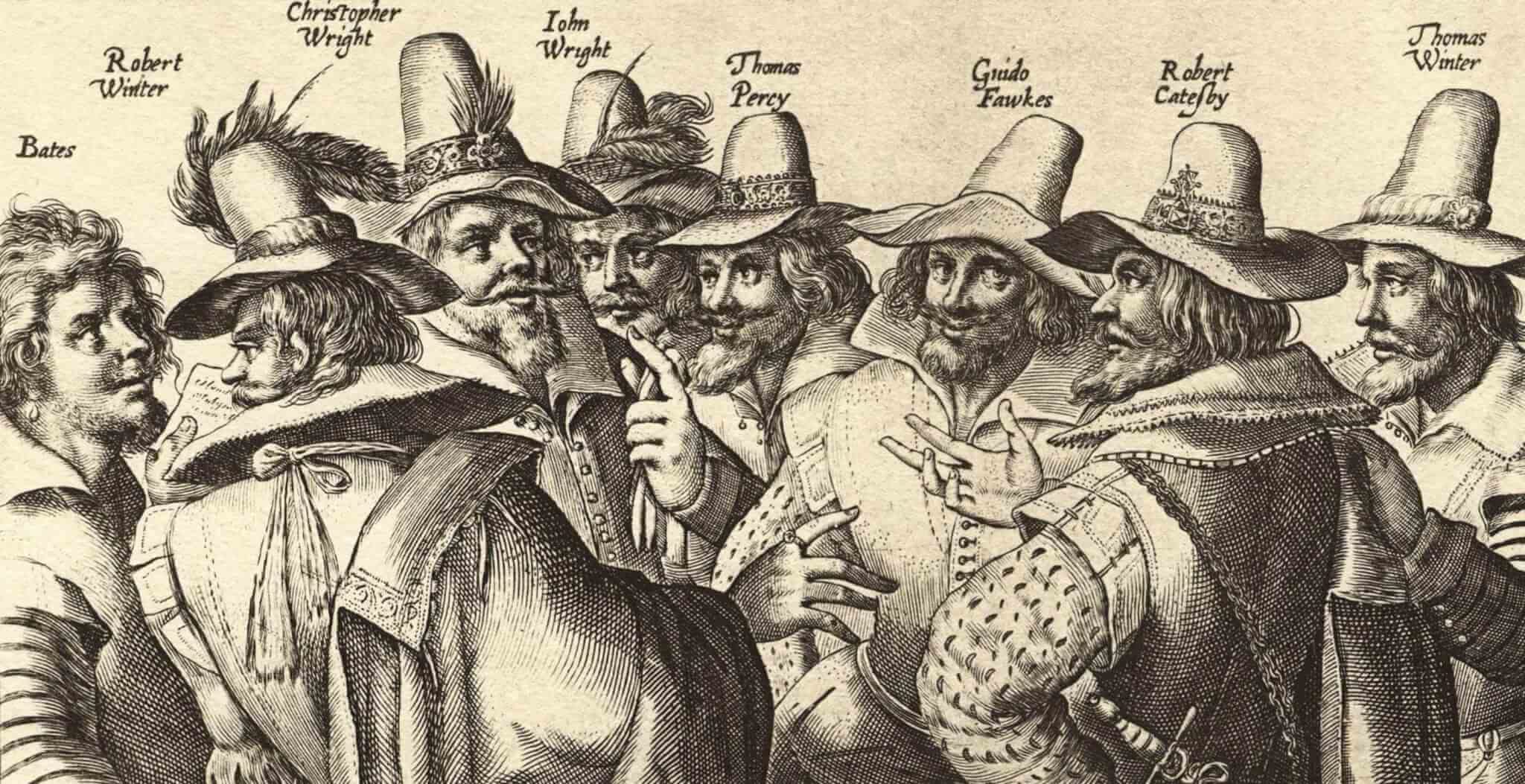
One of the first things Nicholls makes clear is that we should probably be remembering it as “Robert Catesby Day,” as he was the mastermind of the plot. Fawkes was (merely) the trigger man, as it were. He had the most military experience of any involved, having fought with the Spanish in the Netherlands. But since Catesby and the other leaders were killed fighting the English after the plot had been uncovered, Fawkes—captured with the barrels of gunpowder beneath Parliament—became the main source for, and symbol of, this terrorist attempt.

Nicholls, overall, makes a compelling case that far from being “unthinking [Catholic] fanatics,” Catesby & company’s 1605 plan had “pragmatic coherence” and a chance of success—albeit small—and by no means entailed the certainty of death. The 13 plotters (assisted by about 70 more men) hoped to restore Catholicism as the official religion of England by blowing up Parliament with King James I in session, kidnapping his 9-yr. old daughter Elizabeth, and declaring her Queen. They did not expect foreign (Spanish, that is) assistance and hoped (and prayed) that the still-substantial minority of English Catholics would rally, armed, to their cause.
“Though long, the odds against them were not impossible,” writes Nicholls.
But there was a strong non-rational, indeed emotional, aspect to the plan: revenge against the King for his (alleged) betrayal of toleration for Catholics, as well as against the remaining Catholic nobility who had failed to stand up for their lower-class co-religionists over against English Protestantism. Catesby, according to the survivors interrogated, saw himself as an “instrument of providence” who believed that “innocent blood must lawfully flow with the guilty.”
Catesby had an apocalyptic vision, says Nicholls, who “aimed at a religious upheaval”—while being at the same time pragmatic, as a profoundly “political creature.”
“To understand the Gunpowder Plot, it is thus necessary to look beyond Fawkes and his barrels…and see the enterprise for what it was, a failed rebellion. The Plot may have been the work of desperate men, but however desperate those men never really constituted the ‘idiot fringe’ of extremist fanaticism, represented in popular and much academic opinion” (p. 806).
And “if the plotters actions perhaps have a modern resonance” it is because “they regarded the destruction of Westminster as the first strike in a coup, not as an end in itself” (Ibid.).
I would argue that, beyond setting the record straight about Guy Fawkes and the folks he worked for, these observations about the Gunpowder Plot give us some insights into the most prevalent brand of modern religious terrorism—that of Islam.
Jihadists are regularly—indeed, axiomatically—presented as an idiot, fanatical fringe who fail to understand their own religion; as “radicals” or “extremists” who have “hijacked a great religion.” Very often violent Muslims are sequestered out as “Islamists,” as if what they do had nothing to do with Islam.
This is just wildly incorrect, because Islam is not just political but violent. The need to dominate the political system, jihad, beheadings, sex slavery of non-Muslims—all stem from the Qur’an and Hadiths and can be deemed marginal only in that most Muslims do not personally engage in such activities; that, however, does not negate the fact that Islamic doctrines undergird them.
And, indeed, the idea of re-constituting the caliphate is shared by a huge percentage, perhaps even a majority, of the world’s second-largest religion.
Note: I am not saying both Catholic Christianity and Islam are equally violent, but rather that commentators don’t get to define what constitutes “fringe,” based on their own personal preferences.
So in the same way that historians have tended to scorn the Gunpowder Plotters as irrational and hopeless, modern analysts have made a cottage industry of purporting to explain how so many Muslims cannot seem to understand they actually belong to a peaceful religion.
Large numbers of Muslims in many places also support shari‘ah (Islamic law), ulama (religious leaders) involved in politics, and polygamy (as per Pew Research Center, 2013); at the same time, large minorities believe in the Mahdi’s imminent return (as per Pew Research Center, 2012)—each of these a staple of alleged hijackers of Islam such as ISIS and other terrorist groups.
At root, it’s quite plausible to see the ubiquitous phenomenon of growing Islamic fundamentalism and violence as a rebellion against the global order that the West imposed beginning in the 16th century.
Whether that will fail, as the much smaller in scope 1605 one did, remains to be seen. But until then, expect plenty of gunpowder to be expended in the process.
(To see folks in Fawkes masks and kaffiyahs, and read a bit about how the trope came to the Middle East, take a look at this article from 2016.)