
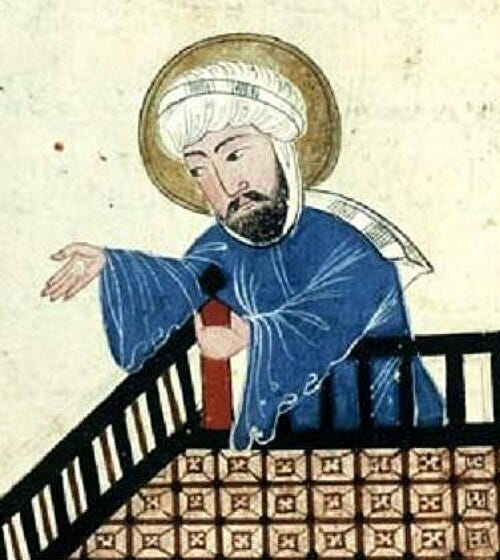
After reading and studying Belloc’s 10,000-word essay, The Enduring Heresy of Mohammed, published in 1938, I knew I had to share it with you guys because it is just that good.
I obviously cannot share the entire chapter, but I have been working like an animal for the past few days to cut it down to around two thousand words while preserving Belloc’s main arguments.
So here it is, a condensed version of Belloc’s brilliant essay:
By A.D. 630 all Gaul had long been Catholic. The last of the Arian generals and their garrisons in Italy and Spain had become orthodox. The Arian generals and garrisons of Northern Africa had been conquered by the orthodox armies of the Emperor.
It was just at this moment, a moment of apparently universal and permanent Catholicism, that there fell an unexpected blow of overwhelming magnitude and force. Islam arose ─ quite suddenly. It came out of the desert and overwhelmed half our civilization.
Islam ─ the teaching of Mohammed ─ conquered immediately in arms. Mohammed’s Arabian converts charged into Syria and won there two great battles, the first upon the Yarmuk to the east of Palestine in the highlands above the Jordan, the second in Mesopotamia. They went on to overrun Egypt; they pushed further and further into the heart of our Christian civilization with all its grandeur of Rome. They established themselves all over Northern Africa; they raided into Asia Minor, though they did not establish themselves there as yet. They could even occasionally threaten Constantinople itself. At last, a long lifetime after their first victories in Syria, they crossed the Straits of Gibraltar into Western Europe and began to flood Spain. They even got as far as the very heart of Northern France, between Poitiers and Tours, less than a hundred years after their first victories in Syria ─ in A.D. 732.
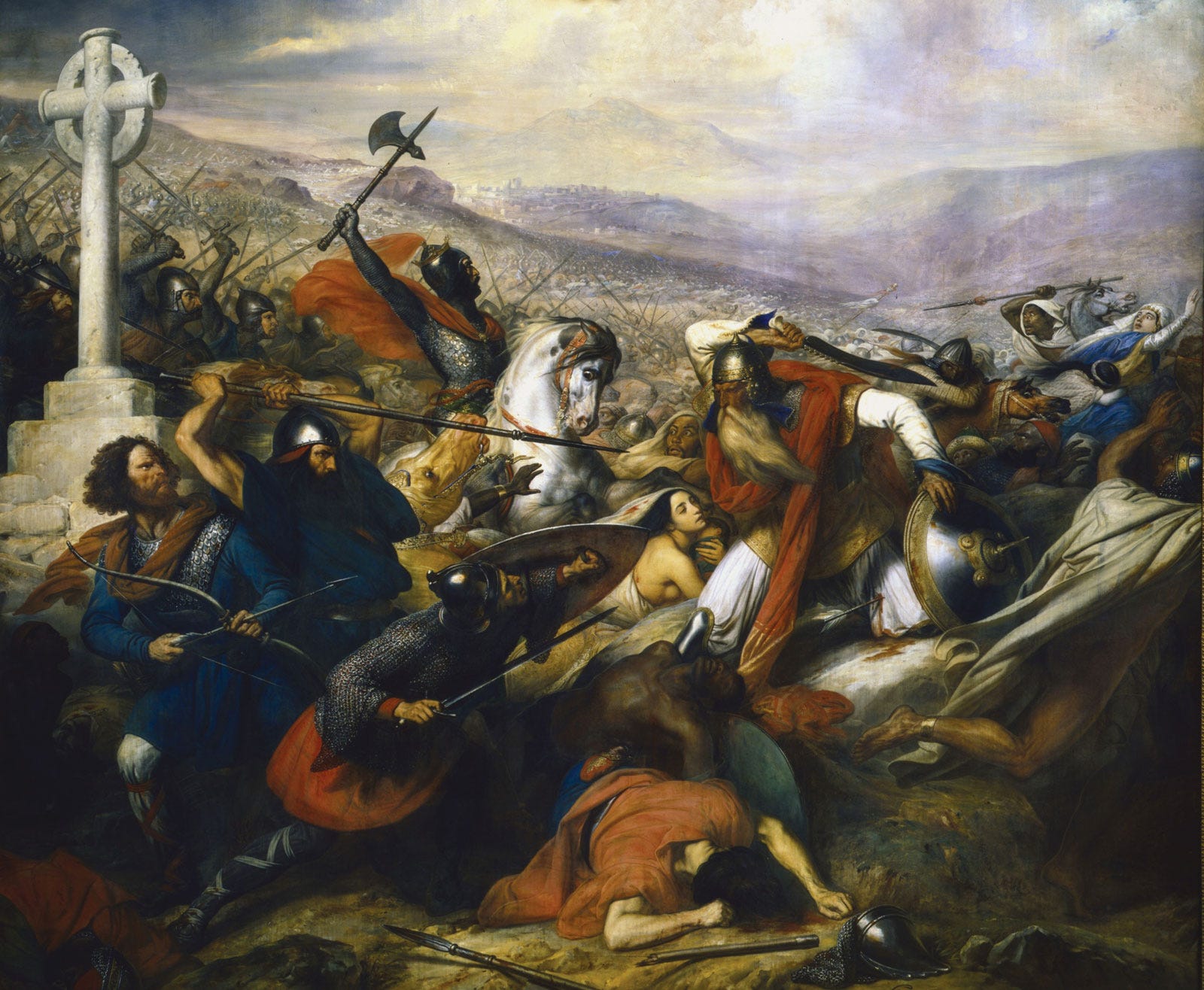
They were ultimately thrust back to the Pyrenees, but they continued to hold all Spain except the mountainous north-western corner. They held all Roman Africa, including Egypt, and all Syria. They dominated the whole Mediterranean west and east: held its islands, raided and left armed settlements even on the shores of Gaul and Italy. They spread mightily throughout Hither Asia, overwhelming the Persian realm. They were an increasing menace to Constantinople. Within a hundred years, a main part of the Roman world had fallen under the power of this new and strange force from the Desert.
Such a revolution had never been. No earlier attack had been so sudden, so violent or so permanently successful. Within a score of years from the first assault in 634 the Christian Levant had gone: Syria, the cradle of the Faith, and Egypt with Alexandria, the mighty Christian See. Within a lifetime half the wealth and nearly half the territory of the Christian Roman Empire was in the hands of Mohammedan masters and officials, and the mass of the population was becoming affected more and more by this new thing.
Mohammedan government and influence had taken the place of Christian government and influence, and were on the way to making the bulk of the Mediterranean on the east and the south Mohammedan.
We are about to follow the fortunes of this extraordinary thing which still calls itself Islam, that is, “The Acceptation” of the morals and simple doctrines which Mohammed had preached.
I shall later describe the historical origin of the thing, giving the dates of its progress and the stages of its original success. I shall describe the consolidation of it, its increasing power and the threat which it remained to our civilization. It very nearly destroyed us. It kept up the battle against Christendom actively for a thousand years, and the story is by no means over; the power of Islam may at any moment re-arise.
But before following that story we must grasp the two fundamental things ─ first, the nature of Mohammedanism; second, the essential cause of its sudden and, as it were, miraculous success over so many thousands of miles of territory and so many millions of human beings.
Mohammedanism was a heresy: that is the essential point to grasp before going any further. It began as a heresy, not as a new religion. It was not a pagan contrast with the Church; it was not an alien enemy. It was a perversion of Christian doctrine. Its vitality and endurance soon gave it the appearance of a new religion, but those who were contemporary with its rise saw it for what it was ─ not a denial, but an adaptation and a misuse, of the Christian thing. It differed from most (not from all) heresies in this, that it did not arise within the bounds of the Christian Church. The chief heresiarch, Mohammed himself, was not, like most heresiarchs, a man of Catholic birth and doctrine to begin with. He sprang from pagans. But that which he taught was in the main Catholic doctrine, oversimplified. It was the great Catholic world ─ on the frontiers of which he lived, whose influence was all around him and whose territories he had known by travel ─ which inspired his convictions. He came of, and mixed with, the degraded idolaters of the Arabian wilderness, the conquest of which had never seemed worth the Romans’ while.
He took over very few of those old pagan ideas which might have been native to him from his descent. On the contrary, he preached and insisted upon a whole group of ideas which were peculiar to the Catholic Church and distinguished it from the paganism which it had conquered in the Greek and Roman civilization. Thus the very foundation of his teaching was that prime Catholic doctrine, the unity and omnipotence of God. The attributes of God he also took over in the main from Catholic doctrine: the personal nature, the all-goodness, the timelessness, the providence of God, His creative power as the origin of all things, and His sustenance of all things by His power alone. The world of good spirits and angels and of evil spirits in rebellion against God was a part of the teaching, with a chief evil spirit, such as Christendom had recognized. Mohammed preached with insistence that prime Catholic doctrine, on the human side ─ the immortality of the soul and its responsibility for actions in this life, coupled with the consequent doctrine of punishment and reward after death.
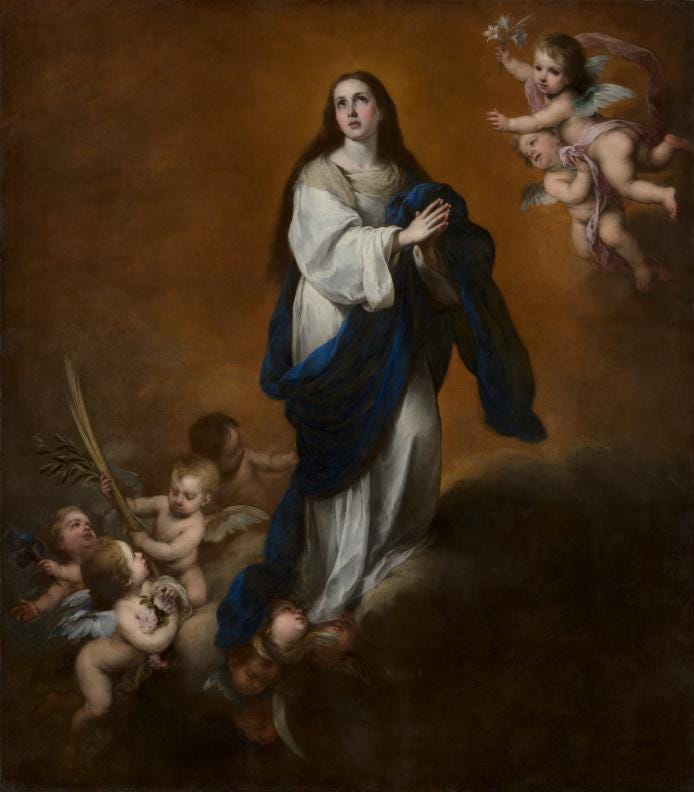
If anyone sets down those points that orthodox Catholicism has in common with Mohammedanism, and those points only, one might imagine if one went no further that there should have been no cause of quarrel. Mohammed would almost seem in this aspect to be a sort of missionary, preaching and spreading by the energy of his character the chief and fundamental doctrines of the Catholic Church among those who had hitherto been degraded pagans of the Desert. He gave to Our Lord the highest reverence, and to Our Lady also, for that matter. On the day of judgment (another Catholic idea which he taught) it was Our Lord, according to Mohammed, who would be the judge of mankind, not he, Mohammed. The Mother of Christ, Our Lady, “the Lady Miriam” was ever for him the first of womankind. His followers even got from the early fathers some vague hint of her Immaculate Conception.
But the central point where this new heresy struck home with a mortal blow against Catholic tradition was a full denial of the Incarnation.
Mohammed did not merely take the first steps toward that denial, as the Arians and their followers had done; he advanced a clear affirmation, full and complete, against the whole doctrine of an incarnate God. He taught that Our Lord was the greatest of all the prophets, but still only a prophet: a man like other men. He eliminated the Trinity altogether.
With that denial of the Incarnation went the whole sacramental structure. He refused to know anything of the Eucharist, with its Real Presence; he stopped the sacrifice of the Mass, and therefore the institution of a special priesthood. In other words, he, like so many other lesser heresiarchs, founded his heresy on simplification.
If you value well-researched stories about Western civilization that mainstream outlets ignore, consider becoming a paid subscriber.
Here’s what you get by upgrading:
In-depth essays on Christian men and great battles
Lessons from the past and what they can teach us today
Full access to the growing archive
Help keep The Western Spirit alive and independent by upgrading.
Catholic doctrine was true (he seemed to say), but it had become encumbered with false accretions; it had become complicated by needless man-made additions, including the idea that its founder was Divine, and the growth of a parasitical caste of priests who battened on a late, imagined, system of Sacraments which they alone could administer. All those corrupt accretions must be swept away.
There is thus a very great deal in common between the enthusiasm with which Mohammed’s teaching attacked the priesthood, the Mass and the sacraments, and the enthusiasm with which Calvinism, the central motive force of the Reformation, did the same. As we all know, the new teaching relaxed the marriage laws ─ but in practice this did not affect the mass of his followers who still remained monogamous. It made divorce as easy as possible, for the sacramental idea of marriage disappeared. It insisted upon the equality of men, and it necessarily had that further factor in which it resembled Calvinism ─ the sense of predestination, the sense of fate; of what the followers of John Knox were always calling “the immutable decrees of God.”
Mohammed’s teaching never developed among the mass of his followers, or in his own mind, a detailed theology. He was content to accept all that appealed to him in the Catholic scheme and to reject all that seemed to him, and to so many others of his time, too complicated or mysterious to be true. Simplicity was the note of the whole affair; and since all heresies draw their strength from some true doctrine, Mohammedanism drew its strength from the true Catholic doctrines which it retained: the equality of all men before God ─ “All true believers are brothers.” It zealously preached and throve on the paramount claims of justice, social and economic.
Now, why did this new, simple, energetic heresy have its sudden overwhelming success?
Continue reading below.