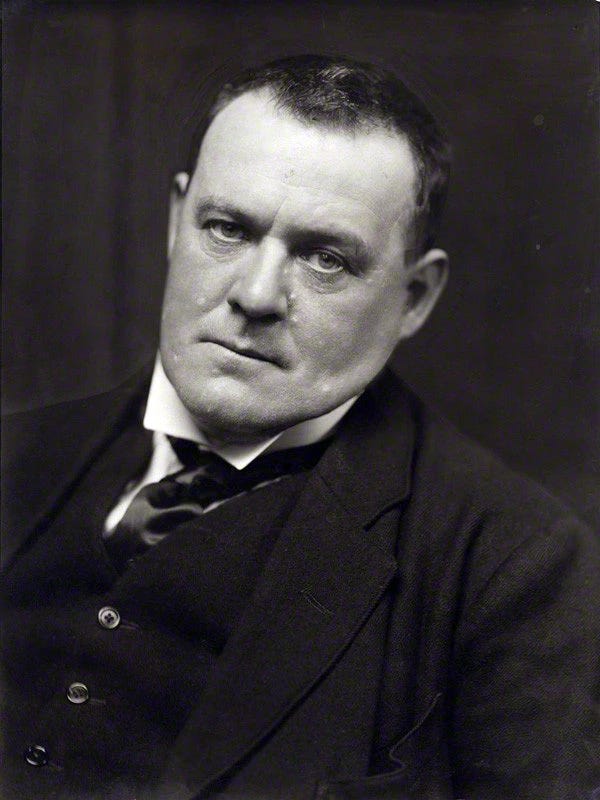
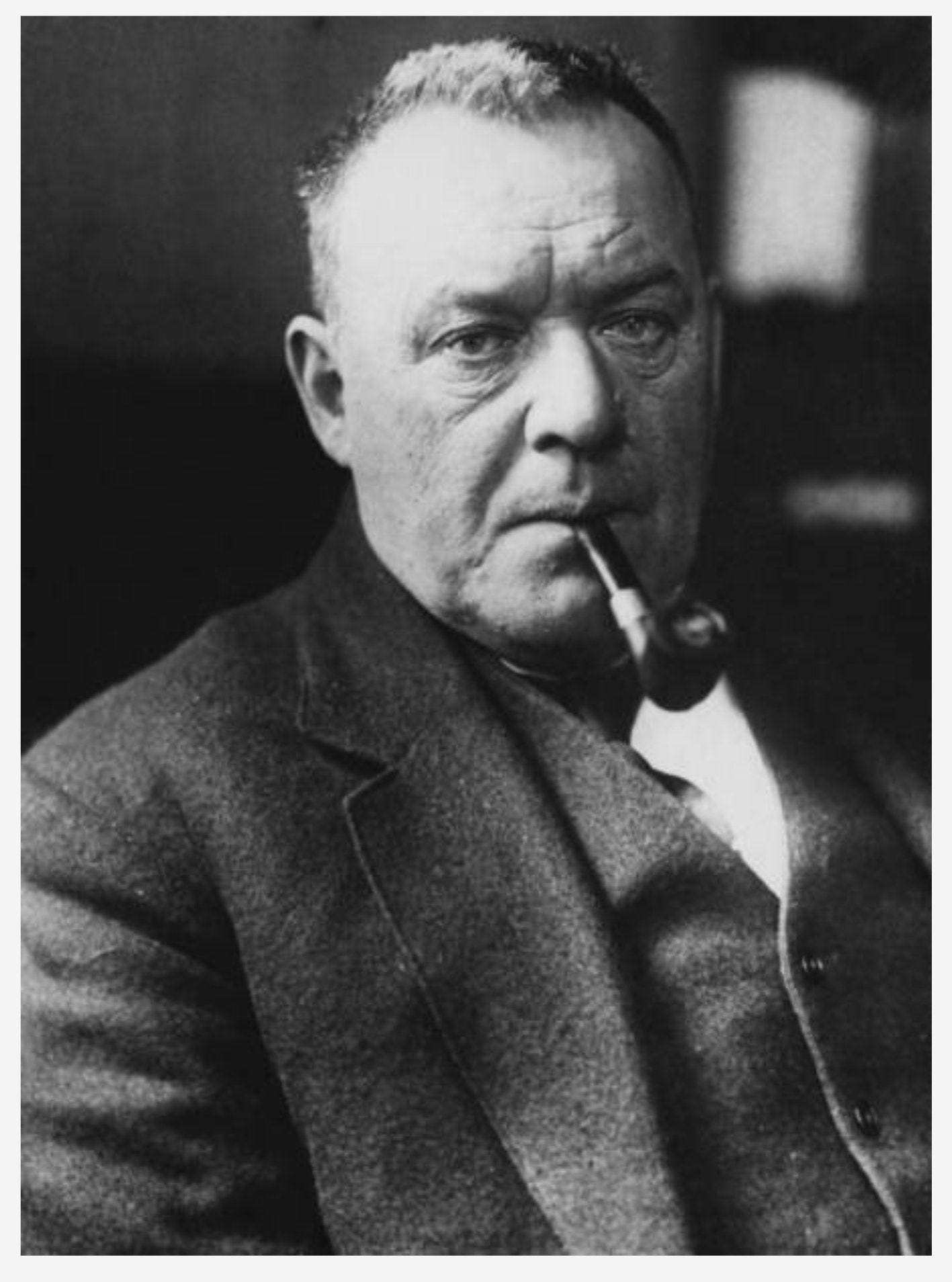
There are men who seem born into the wrong century. Hilaire Belloc was one of them. He lived in the modern age but spoke with the fire of the Middle Ages. While others praised progress, he defended tradition. While the twentieth century worshiped the machine, he sang of the land, the Church, and the soul. He was a poet, a historian, a sailor, and a fighter. Above all, he was a Catholic in an age that had forgotten what that meant.
He wrote in a time when the old world was collapsing… when Europe was turning its back on the faith that had built it. Belloc stood against this tide. He believed that the civilization we call the West was not an accident of geography or economics, but the direct creation of Christianity. To lose the Faith, he said, was to lose Europe itself.
His words were sharp, his tone fierce, his loyalty unbending. He loved truth, hated cant, and fought with pen and voice against everything that dulled or corrupted the human spirit. For that reason, even when his predictions were dark, they were written from love.
Reminder:The Western Spirit is a reader-supported publication. Help us reach 99/100 paid subscribers!
If you’ve been enjoying these essays, consider becoming a paid subscriber. For a few dollars a month, you’ll get:
In-depth pieces on forgotten battles, brave men, and turning points in Western history
Reflections on faith, order, tradition, and the deeper meaning behind culture
Full access to the growing archive — essays, book breakdowns, and historical deep dives
This project exists because readers like you make it possible.
The Beginning
Hilaire Belloc was born in 1870 in La Celle-Saint-Cloud, near Paris. His father was French, his mother English. His father died when Hilaire was only two, and his mother took him and his sister back to England, settling in Sussex.
He grew up between two worlds… the Catholic France of his birth and the Protestant England of his upbringing. That contrast marked him for life. He saw early that Europe was not one thing but a delicate balance of faiths, languages, and histories. Yet for him, beneath all differences, the foundation was the same: Christendom.
Belloc attended the Oratory School in Birmingham, founded by Cardinal Newman. There he absorbed the intellectual seriousness and moral courage of Catholic education. Later, he studied at Balliol College, Oxford, where he dazzled and infuriated his peers in equal measure. He was brilliant, combative, and unapologetically Catholic… a rarity in the Oxford of his time.
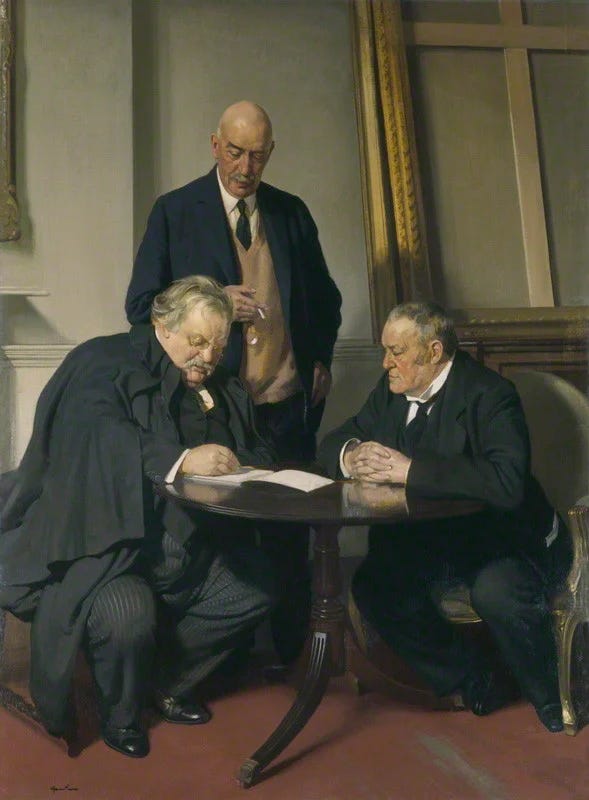
At Oxford he met his lifelong friend G. K. Chesterton. The two would later become known together as “the Chesterbelloc,” so closely did their minds and spirits align. Both loved argument, paradox, laughter, and truth.
The Soldier and the Wanderer
Before university, Belloc had returned to France to serve a year in the French army. He could have avoided it, but he wanted to prove his loyalty to his father’s country and to taste something of real discipline. It was a formative time. He learned endurance, precision, and camaraderie… virtues that would stay with him through life.
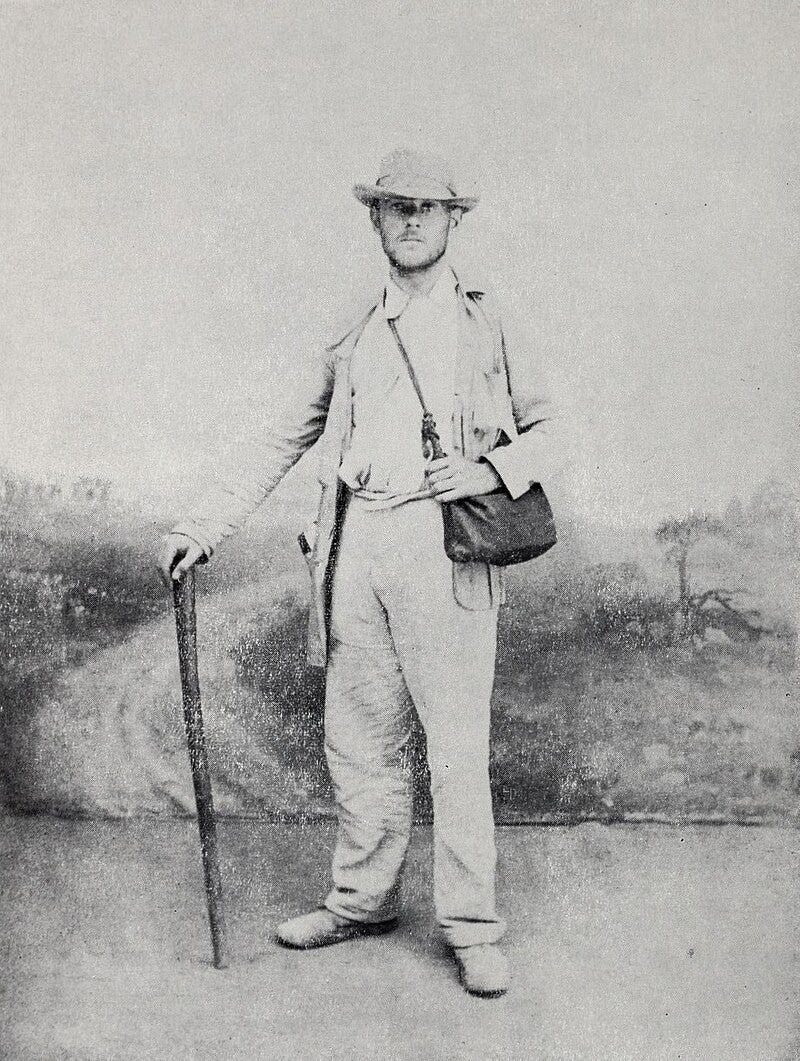
After his studies, Belloc traveled across Europe on foot, as he later described in The Path to Rome… his most beloved book. That journey, from Toul in Lorraine to Rome itself, was not just travel but pilgrimage. He walked through villages and valleys, met peasants and priests, slept under open skies, and reflected on the unity of Europe through its faith.
Belloc upon his arrival in Rome on 29 July 1901
The book is full of humor, landscapes, and sudden bursts of poetry. It is also full of longing… for a world that was already vanishing, where every village church still stood as the heart of its people. Belloc’s writing about that journey made him famous. It also revealed his central theme: the return to Rome, literal and spiritual.
The Writer and the Fighter
Belloc’s energy was astonishing. He wrote more than 150 books… essays, poetry, biographies, history, political theory, travel writing, satire. He could move from the Reformation to a children’s rhyme in a single morning.
But he was not just a writer; he was a combatant. He entered politics, serving as a Member of Parliament from 1906 to 1910. There, he championed Catholic education, working-class rights, and honest government. He also attacked the corruption of party politics. “The faith is Europe,” he declared, “and Europe is the faith.”
In public life he was relentless, often to his own cost. His independence made enemies, and his bluntness offended allies. He distrusted both capitalism and socialism, seeing in each a form of slavery. This led him to one of his most original and controversial ideas: Distributism.
The Distributist Vision
Distributism, developed with Chesterton, was Belloc’s answer to the economic evils of his age. Industrial capitalism, he said, concentrated property in the hands of a few. Socialism did the same, only in the hands of the state. Both left the ordinary man powerless.
Belloc’s alternative was simple: a society of widely distributed property… small farms, small shops, small guilds. He wanted families to own land, tools, and means of production. Only then could they be free.
He called the existing system the “Servile State,” where people were legally free but economically enslaved. His warnings came long before the modern debates about corporate power and consumerism. To him, economic dependence meant moral decline. Freedom required ownership and responsibility.
Though the Distributist movement never dominated politics, its spirit inspired later thinkers, from Catholic social theorists to localist and agrarian writers. Belloc’s insistence that economics is moral, not merely technical, remains a needed correction in every age.
The Historian
Belloc was not only an economist and polemicist but a historian of vast range. His histories of the Reformation, the Crusades, and early modern Europe aimed to restore a Catholic understanding of the past.
He believed that history had been rewritten by Protestant and secular historians to paint the Church as an obstacle to progress. He set out to correct that story. His prose could be fiery, but it was rooted in conviction. He wrote of the Reformation as the great wound of Europe… the moment when Christendom broke apart.
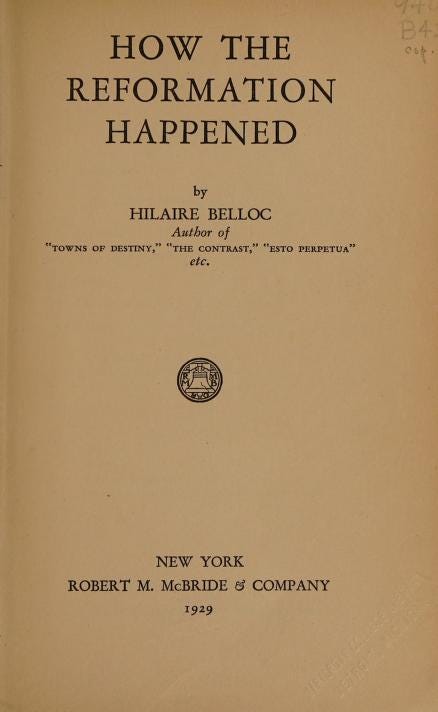
His book How the Reformation Happened argued that England’s break from Rome was not a popular movement but a political seizure of power by the ruling class. His portraits of figures like Cromwell, Wolsey, and Henry VIII are unsparing.
Belloc’s histories are not neutral. They are passionate. He did not believe the historian should pretend to have no convictions. Truth, he said, is not served by cold detachment but by honesty about one’s standpoint. His honesty sometimes made him wrong, but never dull.
The Poet
Though best known as an essayist and historian, Belloc saw himself first as a poet. His verse ranges from comic to lyrical, from satire to song. Some of his poems, like “Tarantella” and “Ha’nacker Mill,” capture a rhythm and melancholy that are unmistakably his.
His children’s verses… especially Cautionary Tales for Children… made generations laugh. “Matilda, who told lies and was burned to death” or “Jim, who ran away from his nurse and was eaten by a lion”… they were wickedly funny yet moral in the old sense, teaching that actions have consequences.
In his serious poetry, he could be deeply moving. The closing lines of “Ha’nacker Mill,” written after the mill near his Sussex home fell into ruin, carry the sadness of a civilization passing away:
Sally go round the sun, Sally go round the moon, Sally go round the chimney pots On a Sunday afternoon.
The mill is empty and still, The mill that stood on the hill, Never again to turn its wheel, Never again to fill.
The rhyme feels simple, but the grief is immense. The England Belloc loved… of mills, farms, and faith… was fading into a mechanized world.
The Man of Faith
At the core of Belloc’s life was his Catholic faith. It was not decorative or inherited; it was his anchor. He believed that without faith, man loses his center, and society loses its order. He saw in the Church not an institution but a living body… the continuation of truth through time.
His faith was not sentimental. He knew the failures of men and priests. He quarreled with bishops and mocked clerical stupidity. Yet he never wavered in belief. He wrote:
“The Catholic Church is an institution I am bound to hold divine — but for unbelievers a proof of its divinity might be found in the fact that no merely human institution conducted with such knavish imbecility would have lasted a fortnight.”
That blend of devotion and irony was typical of him. He could laugh at the Church because he loved it. He saw it as both holy and human… the ark carrying civilization through storms.
The Prophet
Belloc’s prophetic side is what makes him striking today. In the early twentieth century, he warned of the rise of bureaucratic tyranny and the decline of Christian Europe. He foresaw the moral emptiness that would follow when nations abandoned faith.
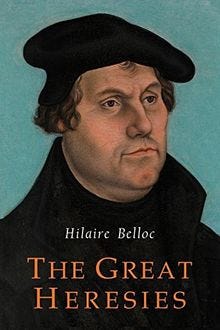
He wrote of Islam not as an ancient memory but as a living force that would one day reemerge. In his book The Great Heresies, he predicted that Islam would rise again to challenge the West, while the West would lose its will to believe. He was dismissed at the time, but his words now seem chillingly prescient.
Belloc saw the modern world as a civilization trying to live on the remnants of a faith it no longer understood. Without God, he said, reason loses foundation, and freedom becomes chaos. He believed that the West’s only hope was a return to its Christian roots… not as nostalgia, but as renewal.
The Friend and the Father
Behind the fierce polemicist was a deeply human man… passionate, affectionate, and sometimes melancholy. His friendship with Chesterton was one of the great intellectual bonds of the century. Together they laughed, argued, drank, and defended the Faith with words that could sing and sting.
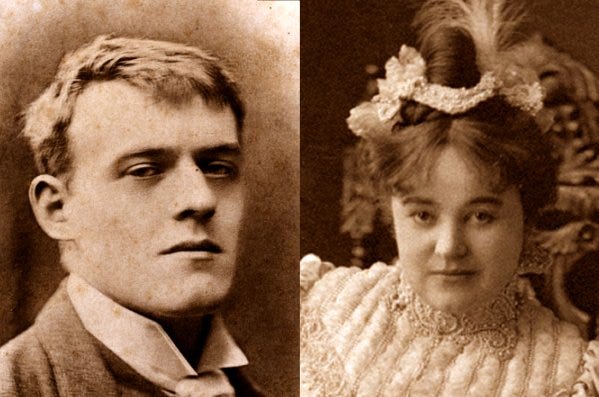
Belloc married Elodie Hogan, an American, in 1896. Their marriage was happy but brief. She died in 1914, leaving him desolate. He never recovered fully. The First World War soon followed, taking his eldest son, Louis. Later, in the Second World War, his youngest son, Peter, was killed as well. Belloc bore these losses with a faith that was wounded but unbroken.
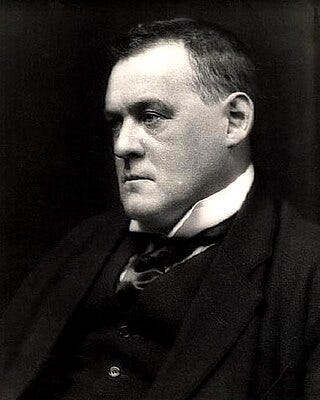
He aged surrounded by books and maps, writing and reworking manuscripts, walking the fields of Sussex. Those who visited him remembered a man of great presence… booming voice, piercing eyes, sudden laughter. He could be difficult, proud, even harsh. But underneath was a great tenderness for truth and for souls.
The End
In his later years, Belloc slowed but did not cease. He continued to write essays for newspapers, warning of the growing darkness in Europe. He watched the Second World War with sorrow, seeing in it the collapse of the Christian order he had tried to defend.
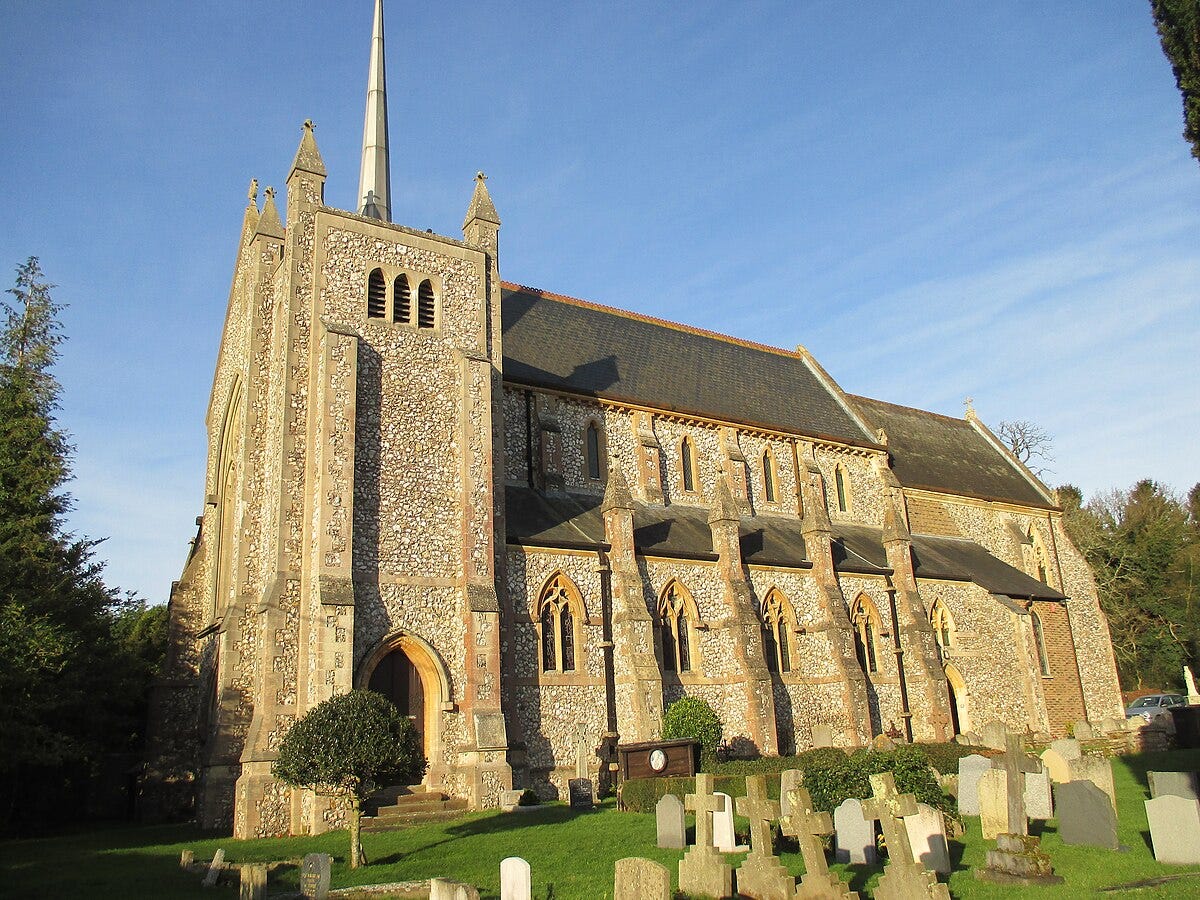
He suffered a stroke in 1942 and lived quietly until his death in 1953, at the age of eighty-two. He was buried in the churchyard of Our Lady of Consolation in West Grinstead, the small Catholic shrine near his home. His epitaph is simple:
“Pray for Hilaire Belloc, who died 16 July 1953. May he rest in peace.”
The Church he loved had survived the storms he foresaw, though wounded and smaller. The Europe he loved had changed almost beyond recognition. But his voice, even now, sounds like a call across time… a call to remember what built us.
The Legacy
Belloc’s legacy is immense and uneven. Some see him as a crank, a reactionary voice railing against modernity. Others see him as one of the last clear minds to grasp what modernity truly means.
His economic vision influenced Catholic social teaching. His defense of tradition inspired movements for localism and small ownership. His histories, though partisan, reminded scholars that faith had been the creative force of Europe.
Writers from Evelyn Waugh to J. R. R. Tolkien admired him. His prose, muscular and ironic, has a vitality missing from academic history. He wrote with conviction that truth is knowable and worth fighting for.
Even his fiercest critics admit his power of style. Every sentence bears the mark of a man who meant what he said. He had that rare combination of intellect and courage…he thought deeply and spoke plainly.
In a century of compromise, he refused to yield.
Lessons from Belloc
From Belloc’s life and work, a few enduring lessons stand out…
Keep reading with a 7-day free trial
Subscribe to The Western Spirit to keep reading this post and get 7 days of free access to the full post archives.