
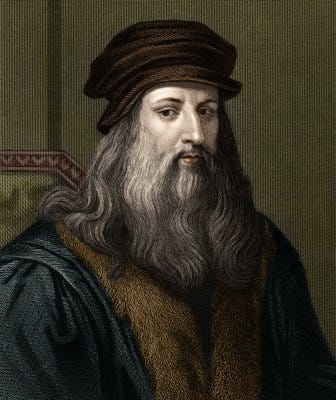
Most lives follow a pattern. People grow up, learn a trade, work, and leave behind some traces of their time. Leonardo da Vinci did all this, but he also did more. He became not just a man but a symbol of what human beings can be. His name now stands for genius itself. We use “a Leonardo” as shorthand for someone who sees farther and connects more widely than anyone else. He is remembered not just as a painter but as an inventor, engineer, anatomist, musician, philosopher, and dreamer.
He was not the only gifted man of the Renaissance. Michelangelo, Raphael, and others filled the same era with brilliance. But Leonardo was different. He crossed boundaries. He could not stay in one world. He painted the Mona Lisa but also designed helicopters. He dissected corpses to study muscles but also staged theatrical spectacles for courts. He was never satisfied with one field. He wanted to understand it all.
What makes Leonardo especially interesting is not only what he achieved but also what he left undone. He finished surprisingly few paintings. He drew designs that were never built. He wrote notes that were never published. In many ways his life is a series of fragments. Yet those fragments have inspired centuries. Sometimes an unfinished sketch can be as powerful as a completed masterpiece.
Let us walk through his life, from his beginnings in a small Tuscan town to his final years in France, and see what lessons we can learn…
Reminder: The Western Spirit is a reader-supported publication. We are very close to 99/100 paid subscribers!
If you’ve been enjoying these essays, consider becoming a paid subscriber. For a few dollars a month, you’ll get:
In-depth pieces on forgotten battles, brave men, and turning points in Western history
Reflections on faith, order, tradition, and the deeper meaning behind culture
Full access to the growing archive — essays, book breakdowns, and historical deep dives
This project exists because readers like you make it possible.
The Beginning in Vinci
Leonardo was born in 1452 in Vinci, a little town in the hills near Florence. His father, Ser Piero, was a notary. His mother, Caterina, was a peasant woman. Leonardo was illegitimate, which meant he could not follow his father into law. In some ways this was a disadvantage, but in other ways it freed him. He was not bound to the usual path of inheritance. He was free to become something unexpected.
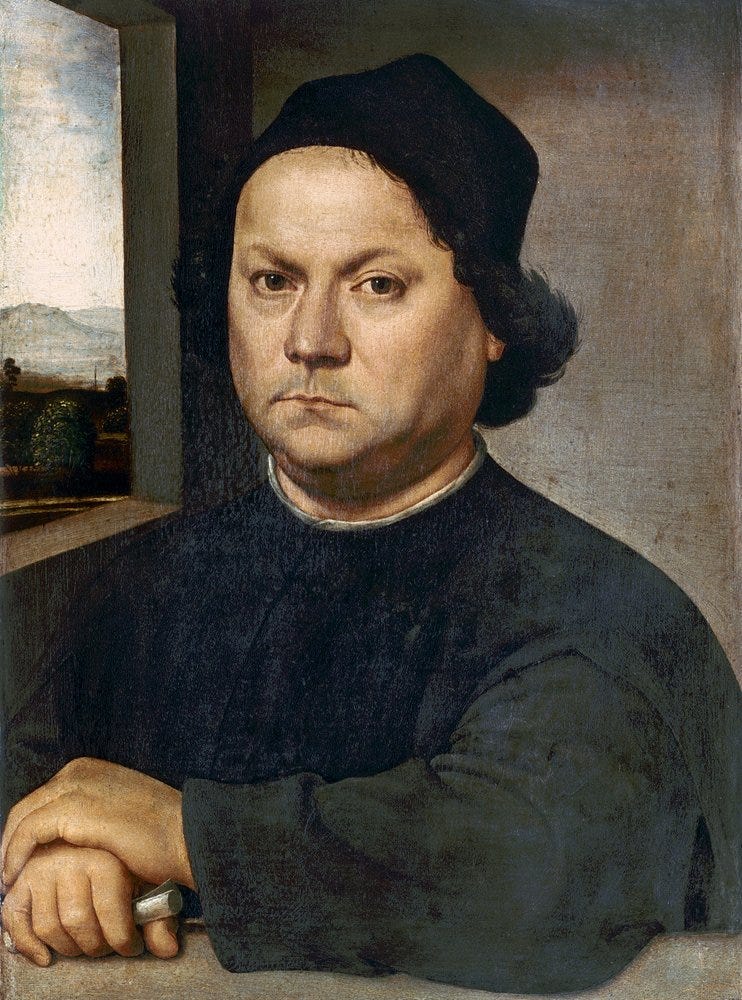
As a boy he showed signs of unusual talent. He drew constantly. He observed nature with a fascination that never left him. He loved animals, water, and the shapes of clouds. He was sent to Florence, the center of art and learning, to apprentice with Andrea del Verrocchio.
The Workshop
Verrocchio’s studio was one of the great schools of the Renaissance. There Leonardo learned painting, sculpture, metalwork, mechanics, and design. He learned how to grind pigments, prepare panels, cast bronze, and carve stone. In the Renaissance, an artist was also a craftsman, part scientist, part engineer.
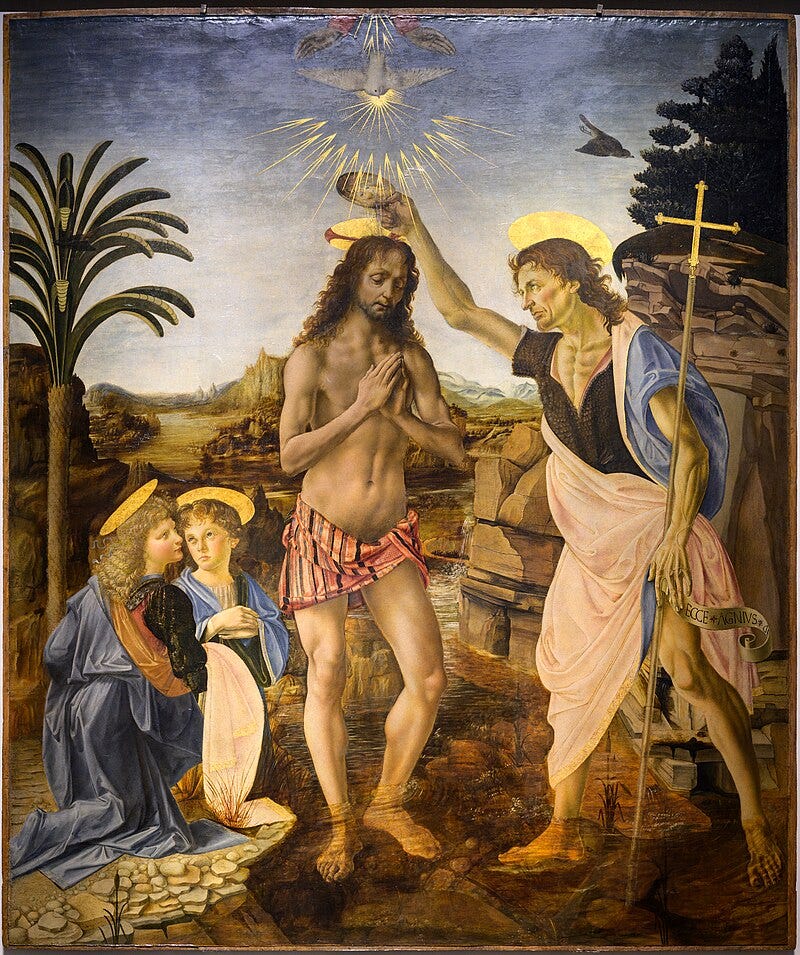
There is a famous story that Verrocchio was painting The Baptism of Christ and gave Leonardo the task of painting one of the angels. Leonardo’s angel was so beautiful and alive that Verrocchio never painted again. This story may be a legend, but it captures the truth that Leonardo’s gift was recognized early.
In this workshop Leonardo also absorbed the spirit of Florence, where art, science, and philosophy were flourishing. The city was ruled by the Medici family, patrons of the arts, and filled with thinkers. Leonardo’s mind was shaped by this environment.
The Early Paintings
Leonardo’s early works include the Annunciation, where the angel greets Mary. Already we see his attention to detail: the wings modeled after those of birds, the flowers carefully drawn, the perspective precise. Another early painting is The Adoration of the Magi, which he left unfinished but filled with swirling figures and architectural ruins.
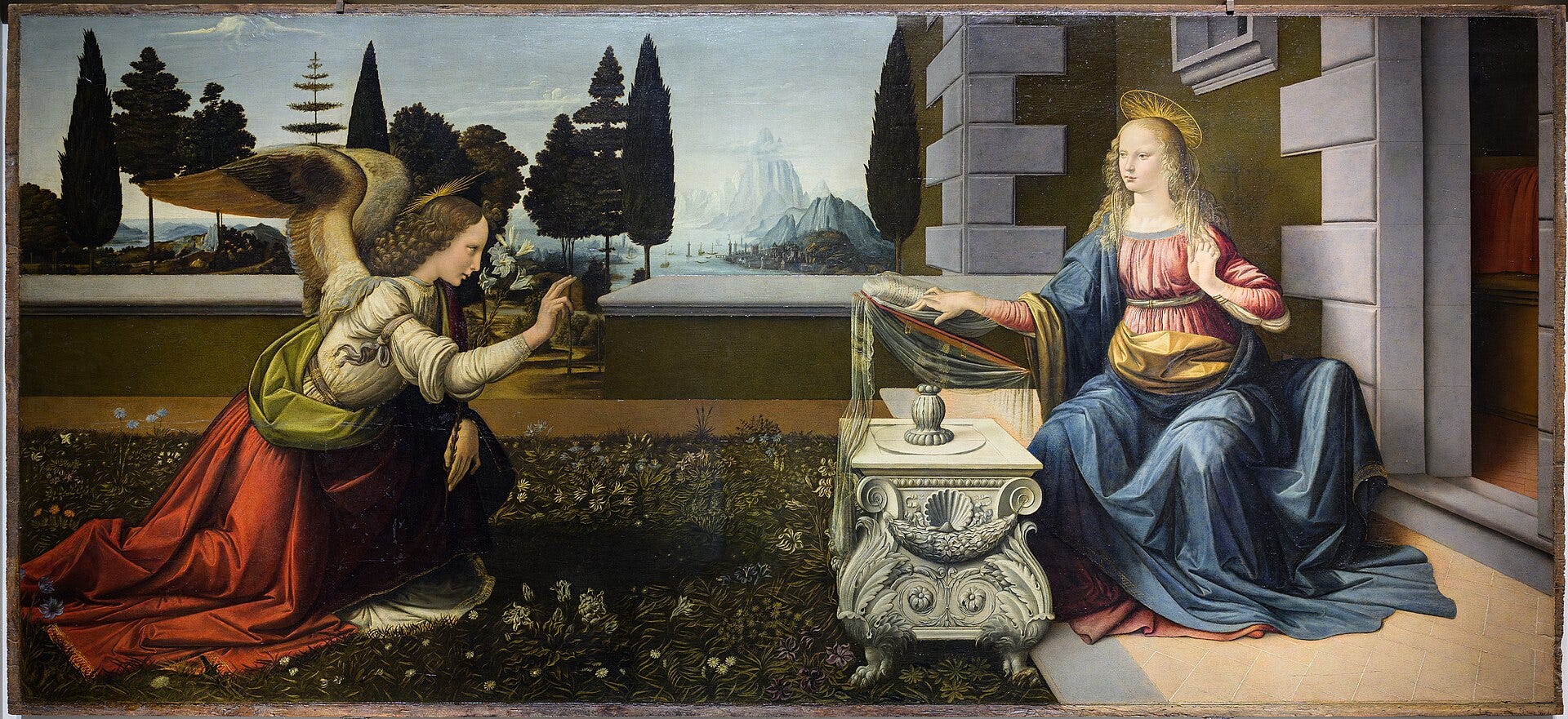
Even in these early works we see his style. He was not content with stiff figures. He wanted movement, emotion, and depth. He pioneered sfumato, the soft blending of tones that creates a smoky effect, as if forms are wrapped in atmosphere. His paintings seem to breathe.
But even as he painted, he was always distracted by other interests. He began filling notebooks with sketches and ideas.
The Notebooks
Leonardo carried notebooks everywhere. He wrote from right to left in mirror script, which some think was to keep his ideas private, though it may also have simply been easier for a left-handed writer. On these pages he drew anatomy, machines, landscapes, and designs. He wrote observations, calculations, and musings.
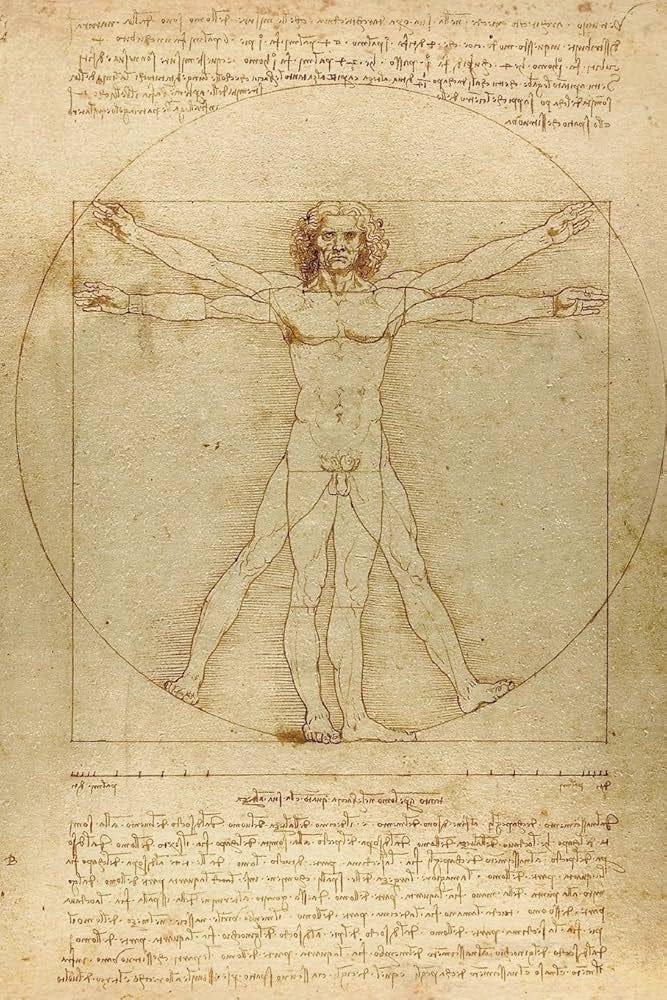
The range is staggering. One page might show the muscles of the arm, another a design for a flying machine, another the eddies of water in a stream. He was curious about everything. He once wrote, “I roamed the countryside searching for answers to things I did not understand. Why shells should be found on the tops of mountains. Why the thunder lasts a longer time than that which causes it. How circles of water form around the spot which has been struck.”
He asked questions like a child but answered them like a scientist. He wanted to see for himself, not just accept tradition.
Anatomy
Leonardo dissected corpses in hospitals and studied the human body with a precision unmatched in his time. He drew muscles, bones, organs, and the circulatory system. He made the first accurate drawing of the human spine. He studied the heart and valves, the brain and nerves. His anatomical sketches remain masterpieces of both science and art.
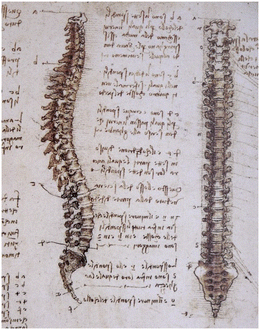
He wrote that the human foot was a marvel of engineering and that the human body was the measure of all things. For him, studying the body was not only useful for art but also a way of understanding nature itself…