
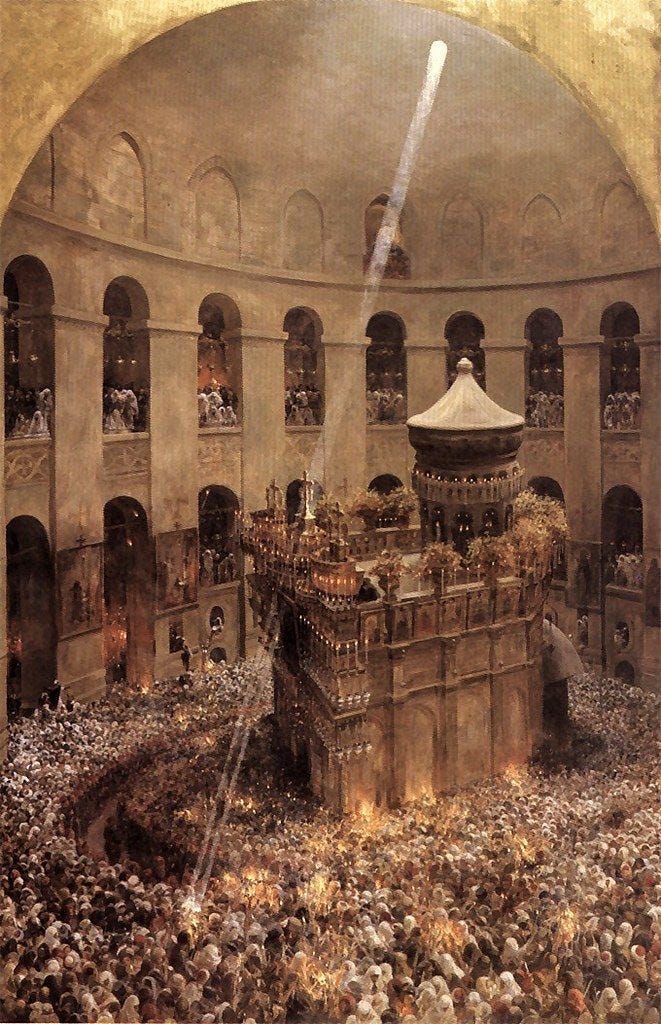
When it comes to churches, Islamic history is a testimony to Islamic doctrine: under Muslim rule, from the 7th century to the present, tens of thousands of churches that were once spread across thousands of miles of formerly Christian lands, were attacked, plundered, ransacked, destroyed and/or converted into mosques. Such a large number is consistent with the fact that, at the time of the Muslim conquests, half of the world’s entire Christian population lived in those lands invaded and subjugated by Islam.
According to one medieval Muslim historian, over the two-year-course of a particularly ruthless Christian persecution campaign, some 30,000 churches were burned or pillaged in Egypt and Syria alone. Major church attacks during Abbasid rule include when “the Muslims in Jerusalem made a rising [in 936] and burnt down the Church of the Resurrection [believed to be built atop the tomb of Christ] which they plundered, and destroyed all they could of it.” Nearly a century later, Caliph Hakim bi-Amr Allah (r. 996-1021) ordered that the already ravaged Church of the Resurrection be torn down “to its very foundations, apart from what could not be destroyed or pulled up, and they also destroyed the Golgotha and the Church of Saint Constantine and all that they contained, as well as all the sacred gravestones. They even tried to dig up the graves and wipe out all traces of their existence.”
— Raymond Ibrahim, originally published here
In the fourth century Constantine built the original Church of the Holy Sepulchre over the places associated with Golgotha and the empty tomb. For generations afterward, Christians traveled across great distances to pray at the sites where the central events of their faith had taken place, at a time when Islam did not yet exist.
After Muhammad’s death, Arab armies expanded beyond the Arabian Peninsula and conquered some of the oldest territories of the Christian world. Syria fell during the 630s, Jerusalem surrendered around 637, and Egypt soon followed, placing ancient centers of Christianity under Islamic rule more than four centuries before the beginning of the Crusades.
Patriarch Sophronius lived long enough to witness this transformation of Jerusalem, and he viewed the conquest as a disaster for the Christian East. When Caliph Umar entered the Holy City, Sophronius saw the conquest through biblical prophecy and described the destruction of churches, the killing of Christians, and the victories of the invading armies in deeply religious terms:
Why are the troops of the Saracens attacking us? Why has there been so much destruction and plunder? Why are there incessant outpourings of human blood? Why are the birds of the sky devouring human bodies? Why have churches been pulled down? Why is the cross mocked? Why is Christ … blasphemed by pagan mouths? … [T]he vengeful and God-hating Saracens, the abomination of desolation clearly foretold to us by the prophets, overrun the places which are not allowed to them, plunder cities, devastate fields, burn down villages, set on fire the holy churches, overturn the sacred monasteries, oppose the Byzantine armies arrayed against them, and in fighting raise up the trophies [of war] and add victory to victory.
The Church of the Holy Sepulchre remained in Christian hands for a time, and Christians were still able to worship at the site. Their ability to do so, however, depended on the permission of Muslim rulers, and that permission was not guaranteed to last.
Al-Hakim Ordered To Demolish The Tomb
Al-Hakim became Fatimid caliph in 996, and during his reign restrictions against Christian religious life became increasingly severe. Churches were confiscated or destroyed and Christian public life was restricted, while the Church of the Holy Sepulchre eventually became one of the most important targets of this wider campaign.
The tomb looks like this. It's inside a shrine called the Edicule.
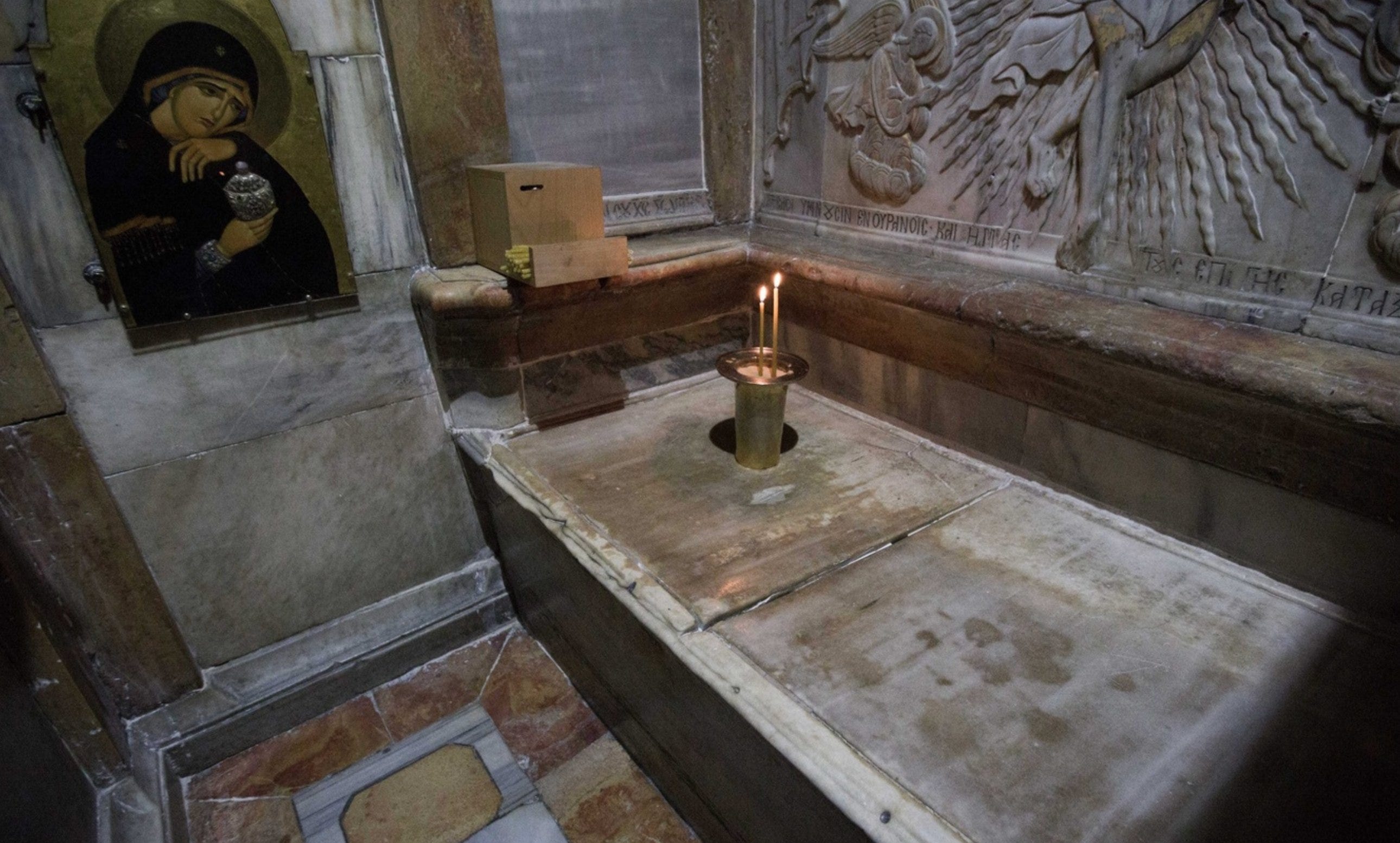
The Holy Sepulchre had already suffered an attack in 936, when Muslims in Jerusalem rose against the church, plundered it, and burned parts of the structure. Under al-Hakim, however, the destruction went much further, as the already damaged sanctuary was ordered to be torn down completely.
One of the closest accounts of the event comes from Yahya ibn Sa‘id of Antioch, a Christian historian writing in Arabic within living memory of the destruction. According to Yahya, the demolition began on 28 September 1009 and targeted not only the church itself, but also the sacred places and objects surrounding it:
And so Yarukh sent his son Yusuf and al-Husayn ibn Zahir al-Wazzan, in company with Abu’l-Fawaris al-Dayf, who seized all the movable goods that were there. After that, [the church itself] was cast down as far as the foundations, except for what it was impossible to destroy or difficult to uproot and carry away. Then the Skull (Golgotha), Calvary, the church of St Constantine, and all the other buildings enclosed within their walls were destroyed, and the sacred remains (holy relics) were completely annihilated. Ibn Abu Zahir attempted to remove the Holy Sepulchre and to cause all trace of it to disappear; he broke and demolished the major part of it. There was in the vicinity (of the Holy Sepulchre) a monastery of monks, known under the name of the monastery of al-Sari, which was also demolished.
He Was Not The Only Madman
Al-Hakim is sometimes presented as an erratic ruler whose personal behavior explains the destruction of the Holy Sepulchre, but the attack did not occur in isolation. During the same period, Christian churches and institutions across Fatimid territory were targeted, while their property and endowments were confiscated.
The Muslim historian al-Maqrizi later described the extent of these policies, recording both the destruction of churches and the seizure of Christian property:
And in his [al-Hakim’s] time, hardships such as one never saw befell the Christians…. He then laid his hands on all endowments of the churches and of the monasteries, which he confiscated to the public treasury, and wrote to that effect to all his provinces. He then burnt the wood of a great many crosses, and forbade the Christians to buy men or maid servants; he pulled down the churches that were in the street Rashida, outside the city of Misr [Old Cairo]. He then laid in ruins the churches of al-Maqs outside Cairo, and made over their contents to the people, who plundered them of more goods than can be told. He threw down the convent of al-Qosseir, and gave it to the people to sack…. He then set about demolishing all churches, and made over to the people, as prey and forfeit, all that was in them, and all that was settled on them. They were then all demolished, all their furniture and chattels were plundered, their endowments were forfeited to others, and mosques were built in their place…. The emir also wrote to the intendants of the provinces to support the Muslims in their destruction of the churches and of monasteries. And the work of demolition in Egypt was so general in the year 1012, that according to statements on which one can rely, as to what was demolished at the end of the year 1014, both in Egypt and in Syria and the provinces thereof, of temples built by the Greeks—it amounted to more than 3,000 churches [the original Arabic says 30,000]. All the gold and silver vessels in them were plundered, their endowments were forfeited; and those endowments were splendid and bestowed on wonderful edifices.
The pattern described in the sources remains clear. Churches and monasteries were destroyed, their property and endowments were confiscated, and these pressures contributed to some Christians converting to Islam.
The conflict affecting the Christian East had begun centuries before al-Hakim came to power, and it did not disappear with his death in 1021. Within a generation of the destruction of the Holy Sepulchre, Christian communities farther north would face another period of conquest and violence..
Friendly reminder:
The Western Spirit exists because of readers like you. Join us and help keep this project alive and independent.
If you’ve been enjoying these essays, consider becoming a paid subscriber. For a few dollars a month, you’ll get:
Essays on brave men, and turning points in Western history
Reflections on faith, tradition, and culture
Full access to the growing archive - essays, book breakdowns, and deep dives
This project exists because readers like you make it possible.
The Turks Came..
Continue reading below.