

For more than a thousand years, the city of Constantinople stood as the defender and capital of a Christian Roman Empire. For no good historical reason, we today call that empire “Byzantine.” But its people, its friends, and its enemies knew it only as Roman.
The world changed dramatically after Constantinople’s foundation in 330 A.D. In 476, the last remnants of the Roman Empire in the West collapsed. Although most of Europe, including the city of Rome, would slide into poverty and chaos, Constantinople remained vibrant, wealthy, and strong. With nearly a million people in the metropolitan area, Constantinople still enjoyed luxurious baths, rich markets, beautiful forums, and raucous chariot races well into the ninth century and beyond.
Yet time also brought historical amnesia.
Medieval Constantinople was filled to bursting with statues and monuments of antiquity. The medieval citizens had forgotten their original purposes, assigning to them new identities and, most intriguing of all, new mystical powers. The massive bronze statues and towering columns of such beauty were beyond the abilities of medieval people. They chalked them up to lost magic which could still be employed for the good of the city.
An entire book could be written about medieval Constantinople’s mystical protectors.¹ Here, I want to focus on the most visible one – the Column of Justinian.
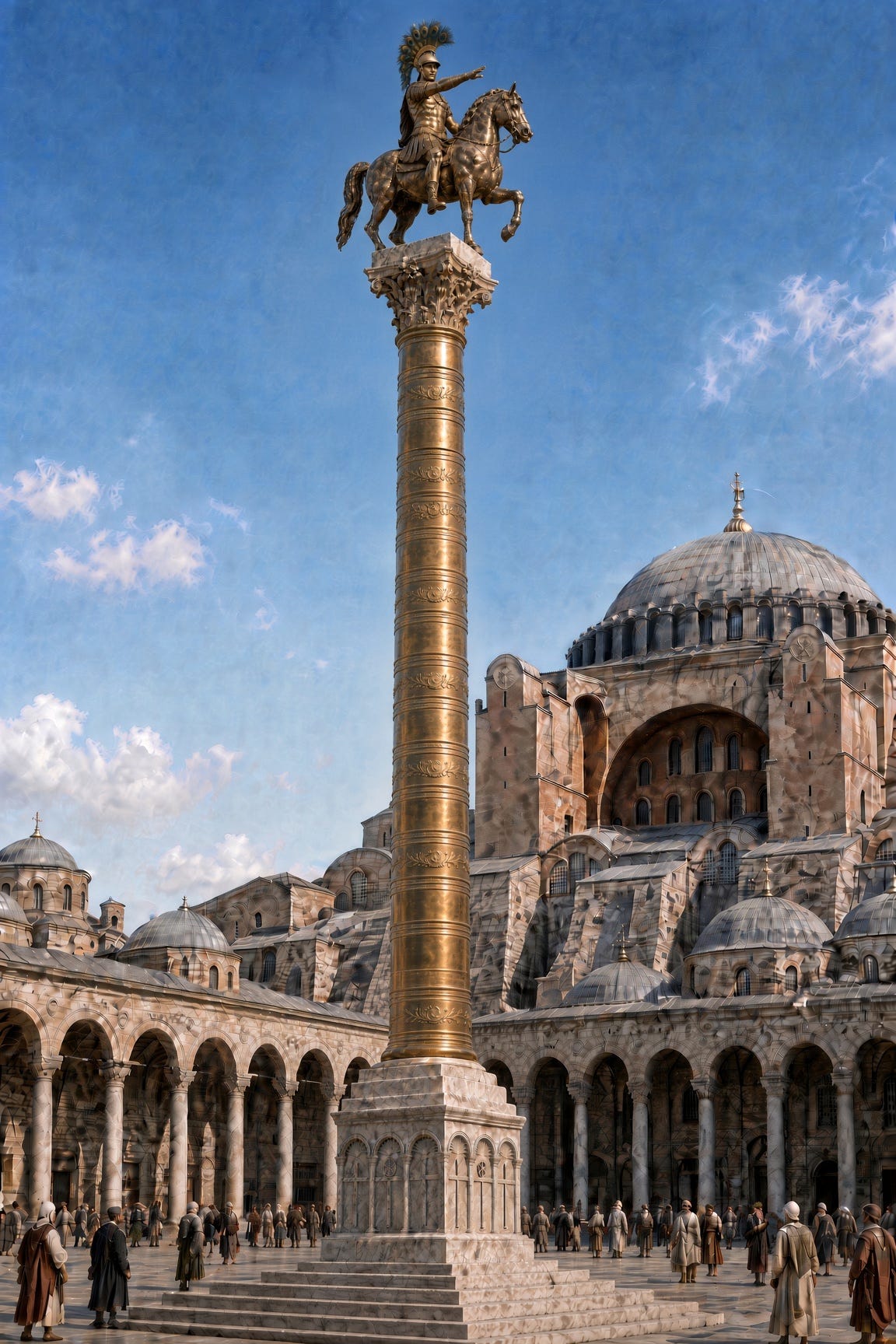
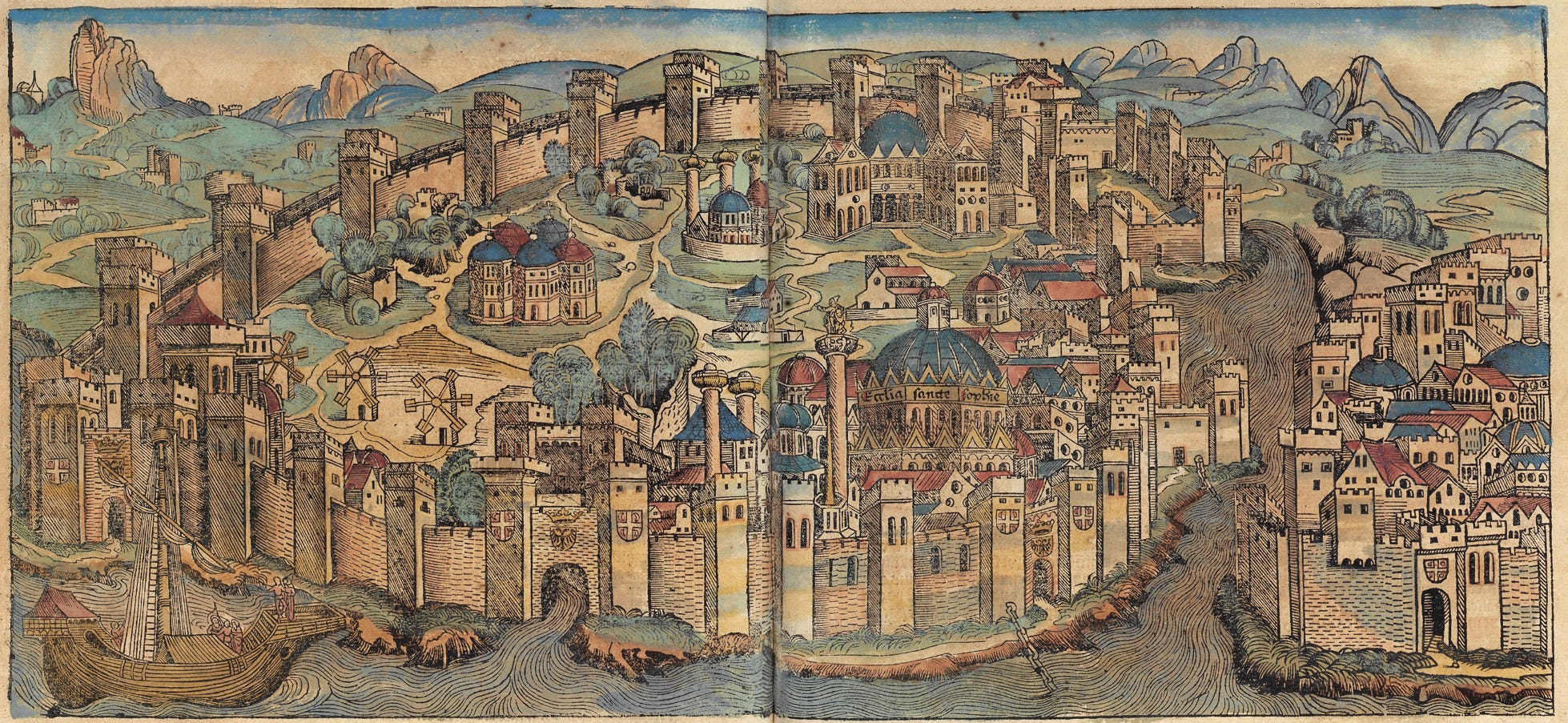
Every medieval drawing or map of Constantinople included this magnificent column. That is because it was simply unmissable. Set in downtown Constantinople between the largest Christian church in the world and the most opulent palace in Europe, the Column of Justinian rose more than one hundred fifty feet from the beautiful forum known as the Augusteion. It could be seen for miles in all directions.
At the top of the monument was a thrice life-size equestrian statue of Emperor Justinian (527–565). The horse was represented in a prancing motion with one forefoot in the air and the other three fastened to the capital. Justinian himself was dressed as Achilles, with half-boots, bare legs, and a Roman breastplate. On his head he wore a feathered toupha in the style of triumphant emperors. In his left hand he held an orb surmounted by a cross, signifying his dominion of the world and the divine means by which he has obtained it. His right arm was extended outward toward the east in a warding or commanding gesture. According to Procopius, who wrote shortly after the monument was erected in 543, with his right hand the emperor “commands the barbarians in that quarter to remain at home and to advance no further.”²
The monument was meant to commemorate Justinian’s victories over the Persians in the east and the Goths in the west. But as the centuries passed new legends and identities were ascribed to the famous column. For those interested, these are conveniently laid out in great detail in Elena N. Boeck’s book, The Bronze Horseman of Justinian in Constantinople (Cambridge).
When Justinian placed his statue atop the massive column there was no Islam. Mohammed had not yet been born. But over the centuries, the Muslim military powers, first Arab, then Turkish, became the enemy of Constantinople. Muslim armies took from the Byzantine Empire its territories in Egypt, the Holy Land, Syria, and Asia Minor. By 1100 the imperial city commanded little more than Greece and the shores of the Aegean. And the Muslim rulers made clear that they planned to capture Constantinople itself. In that extreme peril, the people enlisted the aid of the Column of Justinian (as well as thousands of Crusaders).
If you value well-researched stories about Western civilization that mainstream outlets ignore, consider becoming a paid subscriber. You’ll get:
In-depth essays on Christian men and great battles
Lessons from the past and what they can teach us today
Full access to the growing archive
Help keep The Western Spirit alive and independent by upgrading.
Given the eastward warding gesture of the statue, it is not surprising that medieval citizens of Constantinople began to view the monument as an anti-Muslim talisman that was preserving the city as a Christian citadel. In 1203, for example, the French crusader, Robert de Clari, wrote that letters engraved on the statue “said that he [Justinian] swore that the Saracens should never have truce from him.”³
And it seemed to work. Despite several attempts, Muslim armies had failed to capture the city. The statue had no apparent effect on the Crusaders from the West, however. They captured Constantinople in 1204 and ruled it until the Byzantines took it back in 1261.
By the fourteenth century Turkish power was expanding ever faster. By the fifteenth century virtually the entire Byzantine Empire had been conquered by the Ottomans. All that remained was Constantinople, the last Christian stronghold in the East.
Continue reading below.