
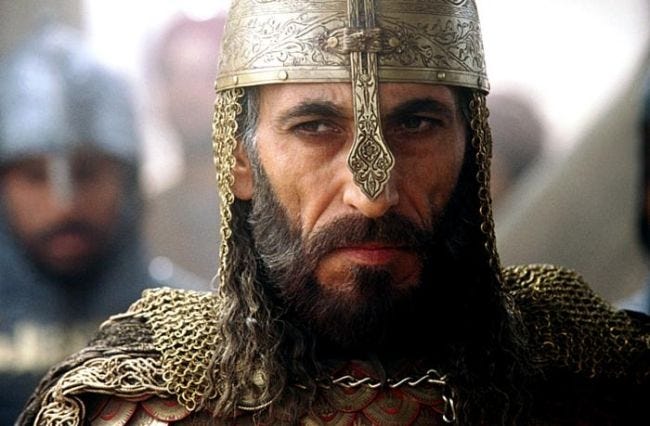
We have all seen the movie Kingdom of Heaven.
It presents Saladin as a kind and honorable ruler. He only fights when he has to, treats his Christian enemies with respect, and seems like the good guy compared to the fanatical Crusaders.
And it’s not just the movie. A lot of books/articles show Saladin in the same way: merciful, forgiving, tolerant, and almost too good to be living in such a violent time.
But how much of that is actually true?
Friendly reminder:
The Western Spirit exists because of readers like you. Join us and help keep this project alive and independent.
If you’ve been enjoying these essays, consider becoming a paid subscriber. For a few dollars a month, you’ll get:
Essays on brave men, and turning points in Western history
Reflections on faith, tradition, and culture
Full access to the growing archive - essays, book breakdowns, and deep dives
This project exists because readers like you make it possible.
Saladin is a child of fifteen when his father Ayyub (Job), Nurredin’s right-hand man and Zengi’s old captain, brings Nurredin into Damascus. He is a young man of twenty-five, still quite unknown, when the issue is joined on Egypt and Nurredin decides on the occupation of the Nile. He accompanies Nurredin’s army, led by his uncle, and begins for the first time to show his strange quiet talent, and the good fortune to which he is predestined. He is thirty-five years old when Nurredin dies. He is forty-seven when he has achieved complete rule, holding Mesopotamia with Syria and Egypt all in one hand. He is forty-eight when he wins his great victory over the last Christian army defending the Holy Places. Before he is fifty he has ridden in triumph through Jerusalem.
It behoves us, at the outset of that series, to understand what sort of man this was to whom such adventures happened.
Saladin was not of the type to which conform most great military leaders of history. Properly speaking, he did not achieve his results through the methods of a soldier so much as through the methods of a politician. He had in common with the great soldiers of history two things only: first, his ambition seems to have arisen late and accidentally, aroused by unexpected original success; second, he acted in any crisis immediately. He decided on what he had to do and, having decided, moved at once—that quality never fails in those who achieve such things. Baha’ al-Din ibn Shaddad, who served him closely, recorded that “he was sometimes deep in thought and forward planning, dealing with all departments and arranging what was required for each without any onset of bad temper or anger,” and that “I have never at all seen him consider the enemy too numerous nor exaggerate their strength.”
We must remember that, of a hundred decisions so taken and rapidly acted on, only a few bear fruit. The greater part lead to disaster or at any rate to nothingness. There was therefore a preponderant element of good luck in Saladin’s achievement; also he was very young. He was certainly quite indifferent to the sufferings of those whom he put to death; fanatically anti-Christian. Islam always seems roused to a special anger against the organised religion of Christendom, but Saladin exceeded on this point. For him the Incarnation, Priesthood, the sacraments, polluted the air. Ibn Shaddad testified to the intensity of this²:
“Saladin was very diligent in and zealous for the Jihad. If anyone were to swear that, since his embarking on the Jihad, he had not expended a single dinar or dirham on anything but the Jihad or his support for it, he would be telling the truth and true in his oath. The Jihad, his love and passion for it, had taken a mighty hold on his heart and all his being, so much so that he talked of nothing else.” To the same biographer he once confided, “I have it in mind that, when God Almighty has enabled me to conquer the rest of the coast, I shall divide up my lands, make my testament, take my leave and set sail on this sea to [the Franks’] islands to pursue them there until there no longer remain on the face of the earth any who deny God – or die [in the attempt].”
Like all other fighting men in that mixed world, the mounted leaders on either side of that twelfth century, whether Western or Oriental, he took a certain pleasure in the final practice of chivalry. Too much has been made of his supposed respect for opponents of equal valour or of equal power. He would, like his predecessor, destroy without mercy when they were within his grasp, and he would personally murder one against whom his personal passion was roused, as he murdered Reginald of Chatillon, his prisoner. After Hattin, according to Imad al-Din al-Isfahani, who was present, Saladin seated the captive king Guy and Reynald of Châtillon, then “upbraided him for his treachery and reminded him of his sins, saying, ‘How many times have you sworn oaths and violated them, agreed to treaties and infringed on them, made agreements and broken them, accepted covenants and rejected them?’” Reynald answered through a translator: “I have followed the custom of kings in that, and I have only acted according to the usual practices.” Guy, dying of thirst, was given iced water; he passed some to Reynald. Saladin said to the king: “You did not take it from me with my permission to give him a drink, so that does not oblige me to give him a guarantee of safety.” He later summoned Reynald into the tent, cut through his shoulder with his own sword, and ordered the head struck off. To the terrified Guy he said: “This one’s wickedness destroyed him, and his treachery betrayed him, as you see. He has perished from his sins and injustice.” Yet he was not a man whose common characteristics were odd violence. His devotion to all the details of his religion was that of a scholar..
He did not take Mosul, but he cowed it, and he exchanged with it the, to him, all-important fortress of Aleppo. He rode into that town on June 12, 1183. It was the crown of his long effort, and yet he had to wait somewhat before he could deliver the final blow.
Continue reading below.