When you hear about the Battle of Manzikert, you probably picture a single clash on an empty plain. But if you and I were standing in the 11th century, watching events unfold day by day, the battle would feel different. You would notice the pace of life along the frontier, the sound of hooves on dry earth, and the tension that came from seeing scouts ride in with news every morning. You would see soldiers repairing gear at night, officers arguing over maps, and villagers watching both armies move past their fields. The world around Manzikert was full of motion, noise, and worry.
The people who lived through this moment wrote about what they saw. They described the marches, the raids, the sudden appearances of enemy riders on distant hills. When you read them closely, you can almost follow the path of each army as it moved closer to the final encounter.
So in this story, I want you to picture the land, the armies, and the people moving through them..
The Western Spirit exists because of readers like you. Join us and help keep this project alive and independent.
If you’ve been enjoying these essays, consider becoming a paid subscriber. For a few dollars a month, you’ll get:
In-depth pieces on forgotten battles, brave men, and turning points in Western history
Reflections on faith, order, tradition, and the deeper meaning behind culture
Full access to the growing archive — essays, book breakdowns, and historical deep dives
This project exists because readers like you make it possible.
The Frontier Before the Battle
Eastern Anatolia in the mid-11th century was a zone of constant movement. Byzantine soldiers, Armenian lords, and Turkmen raiders moved through valleys and across mountain passes. Fortresses like Manzikert, Chliat, and Ahlat stood on high ridges above plains where herds grazed and armies camped. The Seljuk raids of the 1060s damaged fields and displaced villagers. Michael Attaleiates noted that “the east groaned under continuous incursions.” Roads between settlements became dangerous, and traders often traveled in guarded caravans.
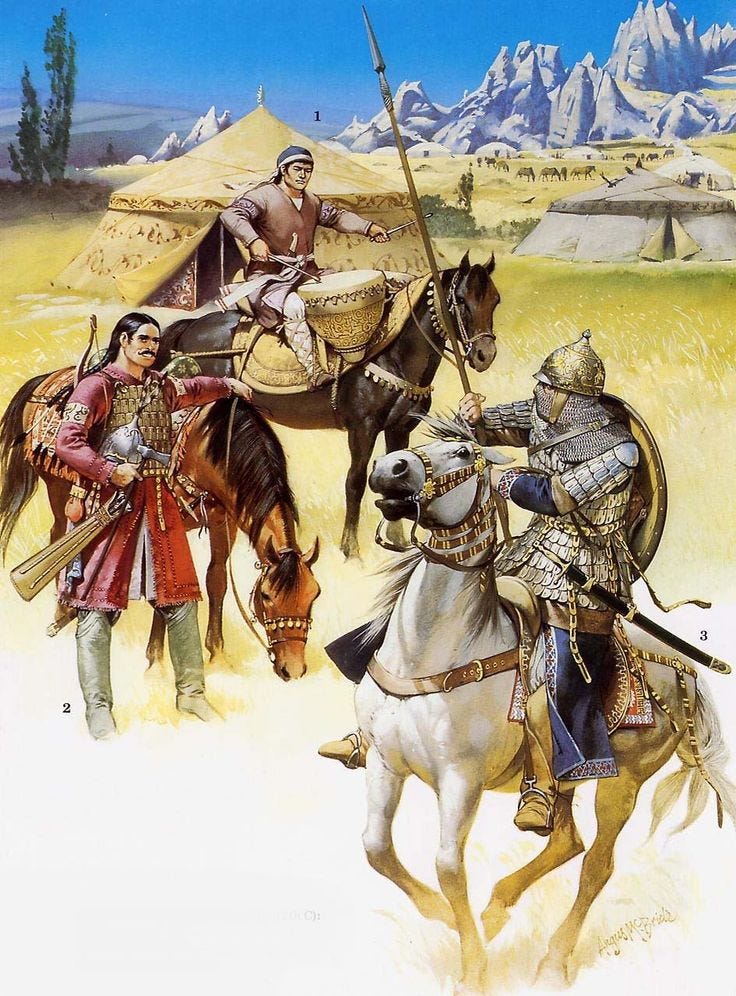
The Byzantine frontier garrisons tried to respond. Commanders wrote letters to Constantinople requesting reinforcements. Patrols chased raiders who vanished into the hills. Turkmen cavalry preferred to fight in loose formation, firing arrows at long range and avoiding direct clashes. Their movements created pressure across the frontier, and their presence forced the Byzantines to send more armies east each year.
In 1068, Romanos Diogenes became emperor and focused his attention on these frontier issues. He marched east several times before 1071. Attaleiates accompanied him and recorded details of the marches: “the emperor rode ahead with the tagmata, crossing the plains swiftly,” and “the army moved in great heat, the dust rising as if from fire.” These early campaigns involved sieges, skirmishes, and long supply trains that stretched across miles.
By 1071, Romanos planned a campaign that aimed at securing the entire region around Lake Van. His intention was to capture key fortresses, place garrisons inside them, and create a stable line of defense. This meant marching deep into territory that the Seljuks also considered important. Alp Arslan, the Seljuk sultan, moved north at the same time after completing a campaign in Syria. He traveled rapidly with cavalry forces that depended on horses more than supply wagons.
The armies moved toward each other without knowing exactly where the encounter would occur.
The March Toward the Lake Van Region
Romanos gathered his forces in the spring and advanced through Cappadocia and the Armenian highlands. The march involved infantry, cavalry, mercenaries, and auxiliaries. The Varangian Guard, composed largely of axe-wielding northern soldiers, moved near the emperor. Local Armenian units joined along the route, supplying knowledge of the terrain. Pecheneg cavalry and Norman mercenaries traveled with the army as well. Each group had its own command structure.
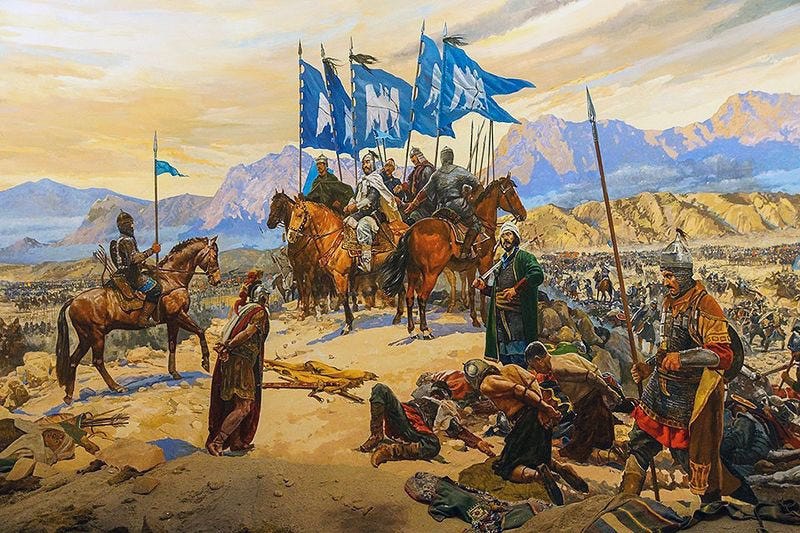
Attaleiates wrote that “the multitude of banners stretched far across the plain,” and that the emperor “reviewed the soldiers at every stop.” Supply carts carried provisions, and herds of animals accompanied the army. The march progressed through rough ground, where narrow passes slowed movement.
As the Byzantines approached the region around Lake Van, Romanos made a significant decision. He divided the army. He sent General Joseph Tarchaneiotes with a large detachment toward Chliat, a fortress southwest of Manzikert. Romanos expected Tarchaneiotes to take the city and rejoin the main force. Nhưng the terrain around Chliat was complex, with mountains, lakes, and narrow valleys. Tarchaneiotes continued his march but did not return.
Aristakes of Lastivert wrote that the detachment “became lost in fear of the advancing Turks.” Other sources say Seljuk forces blocked his approach. Whatever happened, the main Byzantine army faced the coming battle without this contingent.
Romanos continued toward Manzikert and reached its walls without opposition. Matthew of Edessa wrote, “The emperor entered Manzikert and raised his banners upon its towers.” The Seljuks had abandoned the fortress, leaving it empty. Romanos ordered repairs, reorganized the garrison, and sent scouts in all directions. These scouts returned with reports of Seljuk cavalry moving across distant ridges.
The Byzantines spent two days searching for the Seljuk army. Skirmishes occurred as Byzantine patrols encountered Turkish horse archers. The Seljuks struck quickly and retreated each time. Attaleiates described these encounters: “Our men chased them across the fields but could not catch them.”
These movements signaled that Alp Arslan’s forces were approaching.
The Seljuks Arrive
Alp Arslan moved fast. When he heard that the Byzantine emperor led a large army into Armenia, he marched north from Aleppo. His cavalry traveled lightly and covered long distances each day. Seljuk chroniclers describe the sultan praying before beginning the march and speaking to his commanders about their goal. Their army included many horse archers, lancers, and tribal auxiliaries familiar with the terrain.
As the Seljuks neared the plains around Manzikert, their scouts observed the Byzantine movements. They noted that the Byzantine army was divided. They also saw the large camp and the garrison inside the fortress. The Seljuks tried to lure Byzantine units into traps during the initial skirmishes. They used feigned retreats and small detachments that struck quickly.
The countryside filled with noise. Horses galloped across the plains, horns sounded from both armies, and messengers rode between commanders with reports. Romanos tried to draw Alp Arslan into direct battle. Alp Arslan maneuvered to control the timing of the clash.
Contemporary sources recorded gestures the sultan made in the hours before the battle. One account describes him placing a white cloth over his shoulders in the manner of a warrior ready for death. Another says he addressed his soldiers, telling them, “If I should fall, let my son succeed me.” These details come from Muslim chroniclers writing soon after the event, and they reflect how the Seljuks viewed the coming battle as significant.
Romanos made his own preparations. He organized the army into divisions. He sent out patrols to measure the Seljuk positions. He arranged the supply train and ensured the standards were visible to all units. Attaleiates noted that the troops felt confident, having taken Manzikert and seen no large Seljuk force yet.
All of this changed on August 26, when both armies faced each other in the open field.
The Opening Movements of Battle
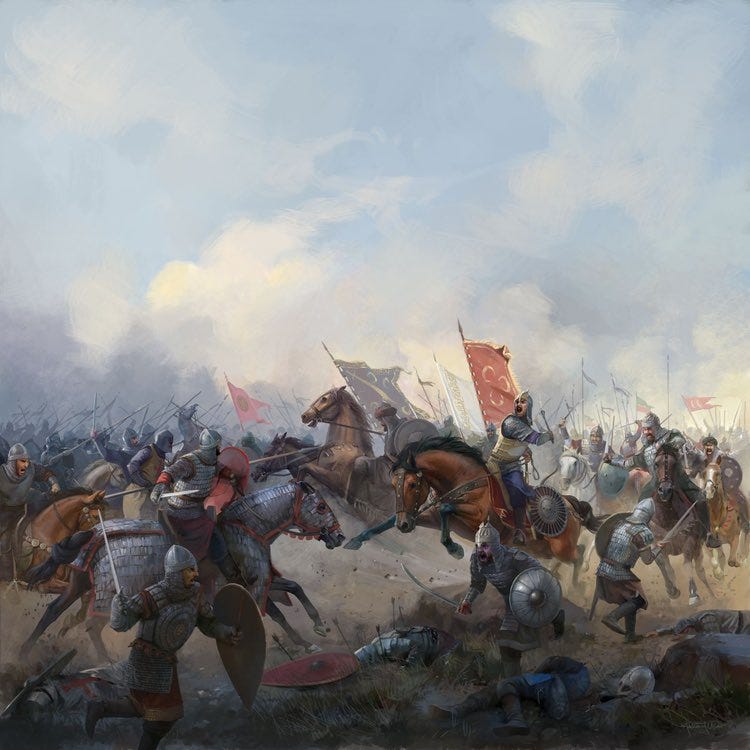
The Byzantines formed three main divisions. Romanos commanded the center. The right wing was under Theodore Alyates. The left wing was under Nikephoros Bryennios. Reserve units stood behind them. The Varangian Guard protected the emperor. The field stretched wide, with dry soil and patches of grass. Small hills surrounded the plain.
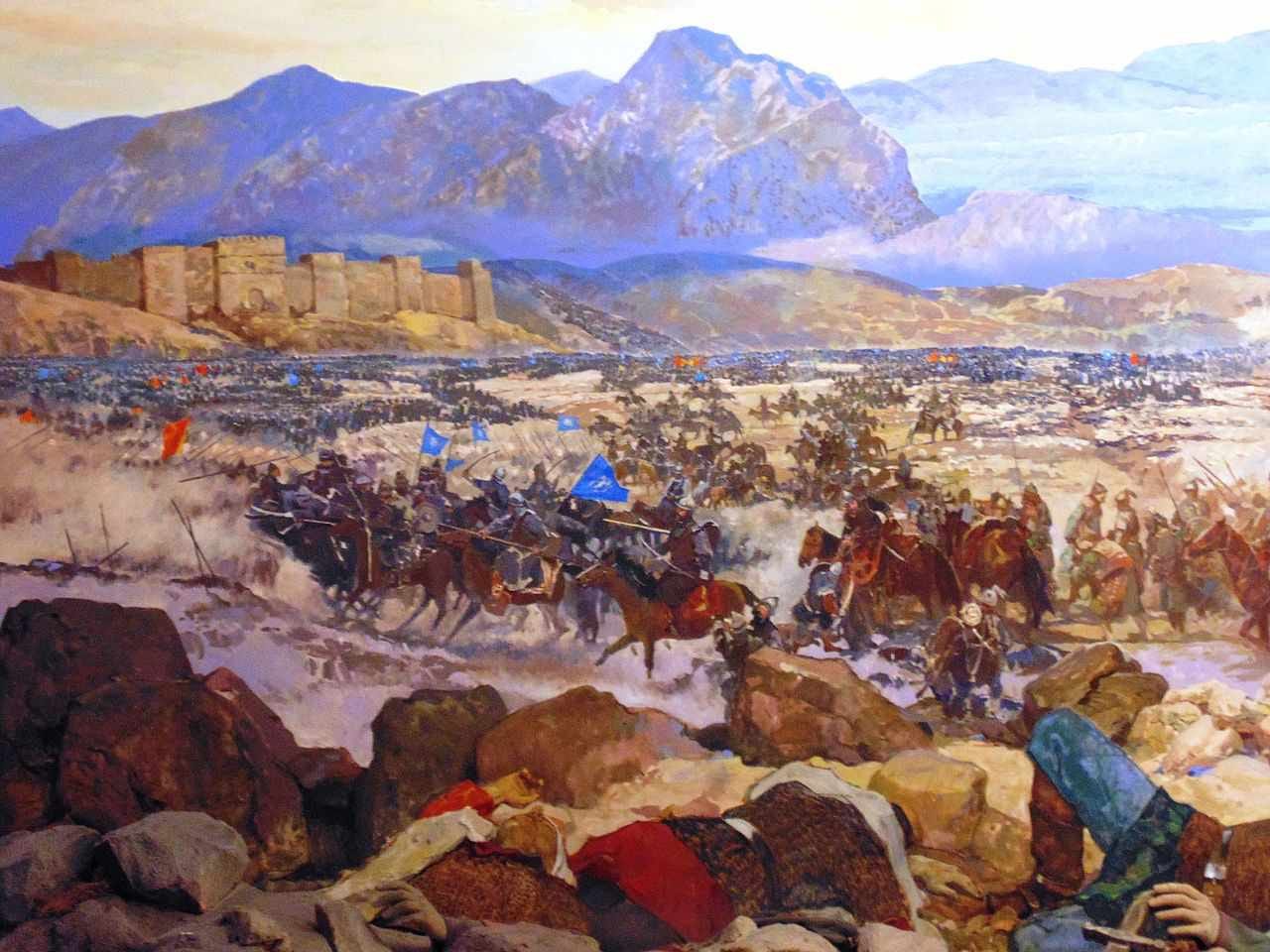
The Seljuks arranged themselves in a crescent formation. Their horse archers formed the outward curve. Their lancers stood ready behind them. This formation allowed them to surround their enemy or withdraw quickly while maintaining pressure with arrows. The Seljuks relied on mobility, while the Byzantines relied on heavy infantry and disciplined formations.
The battle began with a wave of Seljuk arrows. Riders approached, released volleys, and retreated before the Byzantine infantry could close in. The Byzantines advanced methodically. When they reached the point where a clash seemed possible, the Seljuks withdrew again, firing while turning their horses. Dust rose from their movements.
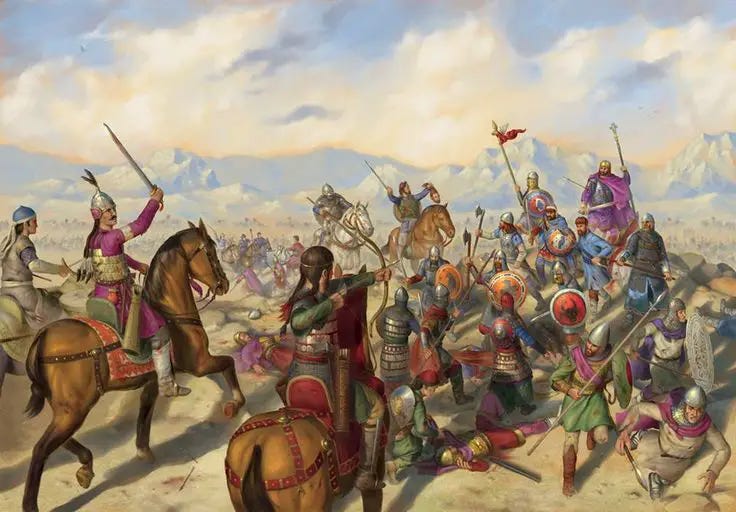
Attaleiates described the first hours of fighting: “The Turks rode like birds across the plain, shooting arrows and circling our lines.” He recorded that the Byzantines tried to hold formation while advancing.
The Seljuks continued these patterns through the afternoon. They attacked the wings, then retreated. They struck the center and moved away. Each movement consumed time and strained the Byzantine lines. Some Byzantine units advanced farther than others, creating small gaps. The Seljuks aimed at these gaps with new volleys.
The battle developed through movement rather than direct collision.
The Critical Hours Before Sunset
By late afternoon, Romanos realized that the Seljuks were drawing the battle out. He wanted to pull his forces back to restore cohesion. He signaled a controlled withdrawal. This required the rear guard, commanded by Andronikos Doukas, to cover the movement.
At this point, the crisis unfolded. Andronikos Doukas withdrew prematurely. Attaleiates described this moment plainly: “The rear guard turned away, leaving the emperor exposed.” The chronicler believed this was intentional. Others say Doukas misunderstood the signal. Whatever the cause, the rear guard abandoned its position.
Confusion spread through the Byzantine ranks. Units on the wings saw the withdrawal and believed the army was retreating. Shouts traveled through the lines. Dust clouds from the Seljuk cavalry made it difficult to see clearly.
Alp Arslan saw the opening. He ordered a full encirclement. Seljuk cavalry surged forward, tightening the crescent formation around the Byzantines. Arrows struck from multiple directions. The Byzantines attempted to reform their lines, but the speed of the Seljuk advance overwhelmed them.
Michael Attaleiates wrote, “The Turks enclosed us like a net.” Matthew of Edessa said, “The Greek army fell into disorder as if struck by lightning.”
The Varangian Guard tried to protect the emperor. They formed a defensive ring and held off repeated cavalry charges. They swung their axes at riders who approached too closely. Other Byzantine units collapsed under pressure. Horses panicked, infantry fled, and standards fell.
The sun began to set. The Seljuks pushed harder. The Byzantine camp in the rear broke apart as retreating units collided with supply wagons. Tents collapsed. Fires were knocked over. The noise carried across the plain.
Romanos continued to fight at the center. He tried to gather troops around him. Seljuk riders approached in waves. At some point during this final phase, Romanos was unhorsed and taken captive.
The battle ended in darkness.
6. The Capture of the Emperor
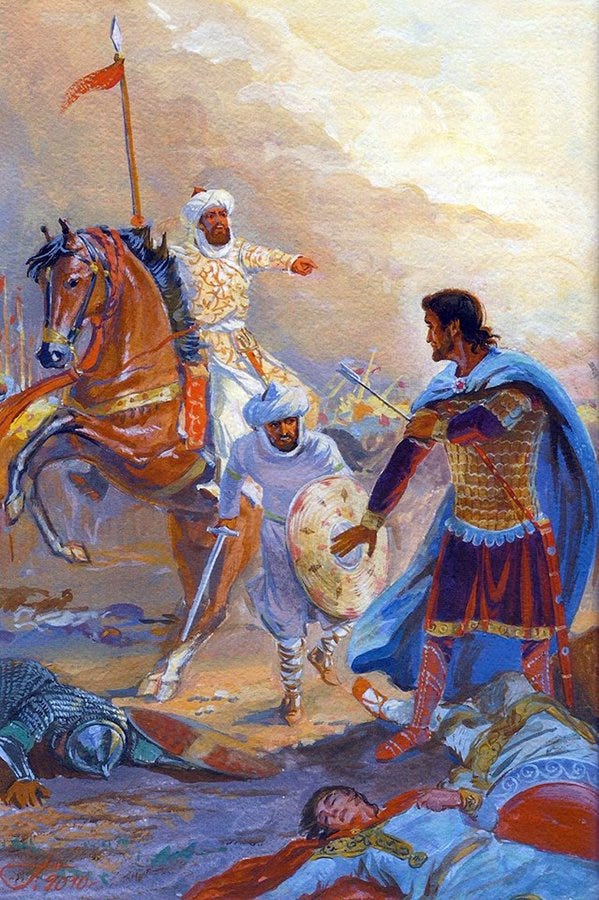
Seljuk chroniclers describe Romanos’s capture as a decisive moment. They say he fought until surrounded. They say a Seljuk soldier seized him and brought him to Alp Arslan. Byzantine sources confirm the capture but focus on the chaos of the final moments.
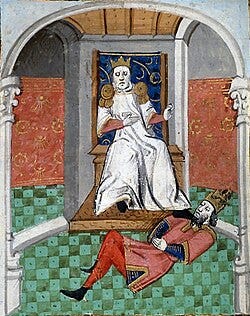
Alp Arslan received Romanos in his tent and placed his foot on Romanos’ neck… a symbolic domination gesture common in medieval Turkic and Islamic victory rituals.
Several sources record a brief exchange. One Arabic account says the sultan asked, “What would you have done to me if I had been taken?” Romanos answered, “Perhaps I would have killed you.” The sultan replied, “My punishment is far heavier.” This story circulated widely in medieval writings. Whether true or false… it reflects how contemporaries viewed the meeting.
The sultan negotiated terms: fortresses, tribute, and a temporary peace. The Byzantines agreed. Romanos was released.
The battle was over, but its consequences continued to unfold..