
After the death of El Cid, the Christians of Spain faced another serious threat from North Africa. Ali ibn Yusuf, the new ruler of the Almoravids and successor to Yusuf ibn Tashfin, saw an opportunity to expand his power in the Iberian Peninsula. He assembled a large army of horsemen, crossbowmen, and infantry and sent them north to attack Christian territories, destroying towns, killing inhabitants, and taking prisoners. According to the Chronicle of Alfonso the Emperor, Ali even ordered his commanders to send back to Africa “any of the Christian warriors, boys, virtuous women and girls whom you capture.”
The timing could hardly have been worse for the Christians, who were already struggling with divisions among their own rulers. Before his death, King Alfonso VI of León-Castile had attempted to strengthen the Christian position by arranging a marriage between his daughter Urraca and Alfonso I of Aragon, hoping that the union would bring their kingdoms together and create a stronger front against the advancing Almoravids. But instead of uniting the Christian kingdoms, the marriage turned into a disaster, with the two rulers developing such a bitter hatred for each other that they eventually went to war.
In 1110, the Pope attempted to annul their marriage on the grounds of consanguinity, but despite their mutual hostility and the threat of excommunication, the couple remained married for several more years. During this period, Christian territories were being attacked by Muslim armies from the south while their own rulers were fighting each other, leaving northern Spain in an increasingly difficult position. It was not until 1114 that Alfonso finally agreed to the separation and turned his attention back to fighting the Almoravids, launching campaigns against the Muslim forces that had taken advantage of the Christian divisions.
Meanwhile, another major development was taking place in Muslim Spain, where the Almoravids were beginning to lose the support of the very people they had originally come to defend. When they first crossed into Spain from North Africa, they had presented themselves as defenders of Islam against the advancing Christian kingdoms, replacing Muslim rulers whom they accused of corruption, religious laxity, and excessive luxury. But now the same accusations were being directed against the Almoravids themselves, as many Muslims in al-Andalus began to believe that their North African rulers had abandoned the strict religious principles that had originally brought them to power.
And history was about to repeat itself. Just as the Almoravids had once been invited into Spain to replace supposedly corrupt Muslim rulers, another religious movement was emerging in North Africa that accused the Almoravids of having strayed from true Islam. These were the Almohads, whose name came from the Arabic al-muwahhidun, meaning those who profess the oneness of God. Unlike the Almoravids, whose name was associated with frontier warfare and religious military service, the Almohads defined themselves primarily through their strict theological beliefs and their determination to restore what they considered authentic Islam.
By 1146, the Almohads had overthrown the Almoravid power base in North Africa and soon began expanding into Muslim Spain, where their arrival brought another period of religious persecution. Christians who had lived under Muslim rule for generations now faced enormous pressure, including forced conversions, confiscation of property, and violence. According to one chronicle cited in the account, the Almohads killed Christians known as Mozarabs, persecuted Jewish communities, and seized the possessions of those who resisted them. Many Jews converted outwardly to Islam in order to survive, while others fled to territories where they could continue practicing their religion.
The historian al-Marrakushi described how some Jews publicly professed Islam, attended mosques, and taught their children the Quran, although he questioned whether their outward conversion reflected their private beliefs. This was a particularly difficult period for the remaining Christian and Jewish communities of al-Andalus, many of whom had already experienced generations of changing rulers, religious restrictions, and political instability.
If you value well-researched stories about Western civilization that mainstream outlets ignore, consider becoming a paid subscriber. You’ll get:
In-depth essays on Christian men and great battles
Lessons from the past and what they can teach us today
Full access to the growing archive
Help keep The Western Spirit alive and independent by upgrading.
But the Almohads would eventually encounter the same problems that had weakened their predecessors. In 1212, the Christian kingdoms won a major victory against them at the Battle of Las Navas de Tolosa, which seriously damaged Almohad military power in Spain. Although the Christians were unable to take full advantage of their victory immediately, the situation changed dramatically in 1224, when the Almohad caliph Yusuf II died and rival Muslim leaders began fighting among themselves. According to a contemporary Christian chronicler, so much discord broke out among the powerful men of the Muslim territories that he could not resist adding, with obvious satisfaction, that he hoped it would continue forever.
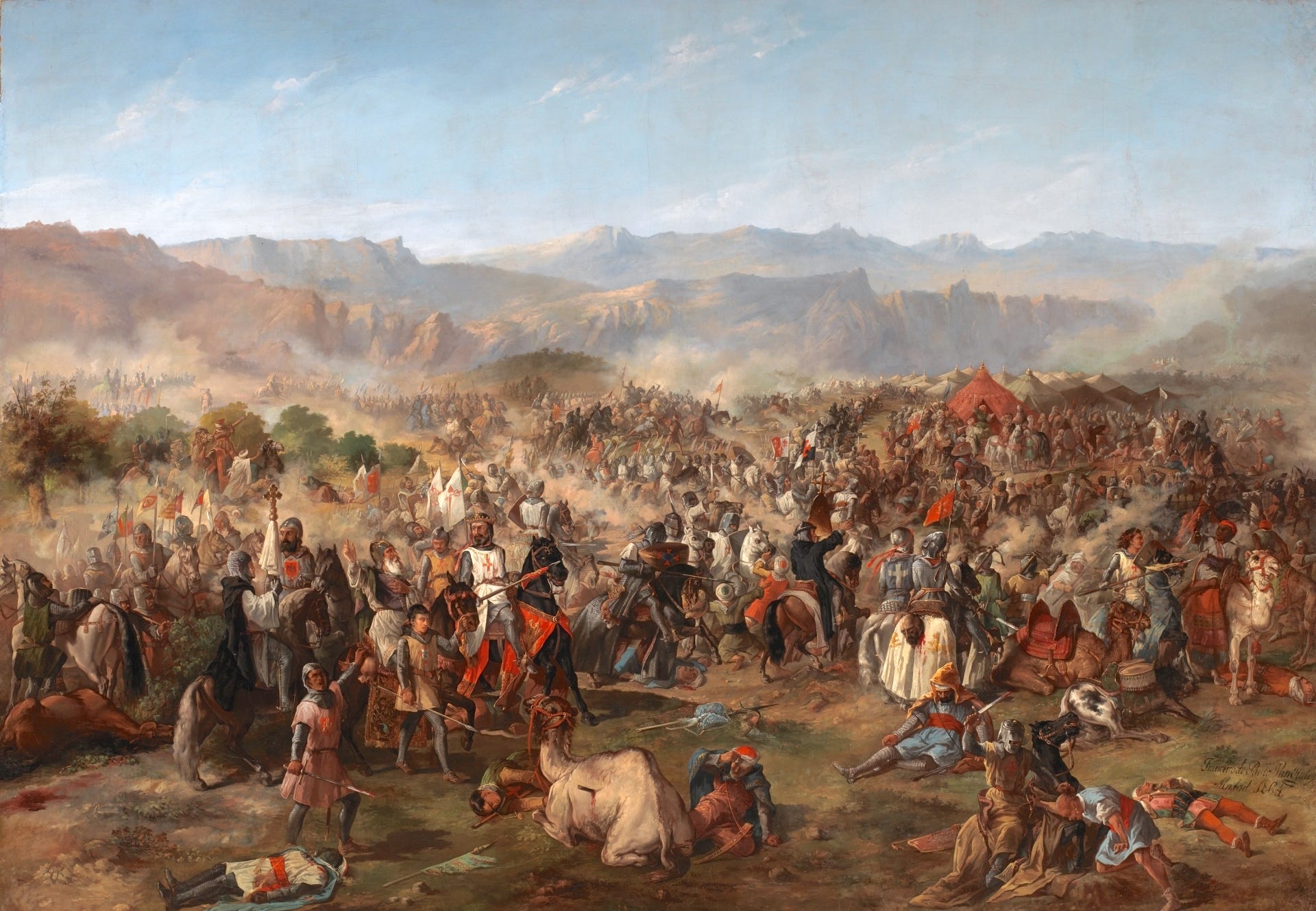
It was at this moment that a young Christian king named Ferdinand III of Castile decided to take advantage of the situation.
Continue reading below.