If you read Part 1 of my series - 8 Western Classics Every Educated Person Should Read - thanks for sticking around.
Look, The Western Spirit isn’t just about the long conflict between Islam and the West (even though that’s what im most interested in). It’s also about the books that shaped our civilization. So expect more of these kinds of essays.
Here are 8 more works that helped shape the mind of the West.
Let’s get into them..
1. Virgil’s Aeneid
Rome’s national epic and the greatest poem of Latin literature. Virgil tells the story of Aeneas, the Trojan hero who flees the burning ruins of Troy to found the Roman people. Written under Augustus, it became the central school text of the Roman Empire and later of medieval and Renaissance Europe.
“Easy is the descent to Avernus: night and day the door of gloomy Dis stands open; but to recall thy steps and pass out to the upper air, this is the task, this the toil! … Some few, whom equal Jove has loved, or shining worth has raised to heaven, the sons of the gods, have achieved it.”
(Aeneid VI.126–131, trans. H. Rushton Fairclough)“Forsan et haec olim meminisse juvabit.”
“Perhaps one day it will be a joy to remember even these things.”
(Aeneid I.203)
2. Plato’s Republic
The most influential work of political philosophy in the Western tradition. Through Socrates, Plato asks what justice actually is, whether the just man is happier than the unjust, and what kind of city - and soul - is truly ordered. The allegory of the cave, the philosopher-king, the discussion of the forms… these ideas never stopped poking at people.
From the Academy to the medieval universities to the modern classroom, the Republic is still the book every other political theory has to measure itself against.
“The just man does not permit the several elements within him to interfere with one another, or any of them to do the work of others. He sets in order his own inner life, and is his own master and his own law, and is at peace with himself.”
(Republic 443d–e, trans. Benjamin Jowett)“Until philosophers are kings, or the kings and princes of this world have the spirit and power of philosophy, and political greatness and wisdom meet in one, and those commoner natures who pursue either to the exclusion of the other are compelled to stand aside, cities will never have rest from their evils—no, nor the human race, as I believe—and then only will this our State have a possibility of life and behold the light of day.”
(Republic 473c–d)
3. Augustine’s Confessions
The first great spiritual autobiography of the West. Written at the end of the fourth century, Augustine lays out his restless search for truth - through rhetoric, Manichaeism, Neoplatonism, and finally Christian faith. That famous garden conversion scene and his meditations on memory, time, and the restless heart have shaped Christian writing ever since.
No later writer on the inner life - from Dante to Pascal to Newman - really escaped his influence.
“You have made us for yourself, O Lord, and our heart is restless until it rests in you.”
(Confessions I.1, trans. Henry Chadwick)“Late have I loved you, beauty so old and so new: late have I loved you. And see, you were within and I was in the external world and sought you there, and in my unlovely state I plunged into those lovely created things which you made. You were with me, and I was not with you. The lovely things kept me far from you, though if they did not have their existence in you they would have no existence at all. You called and cried out loud and shattered my deafness. You were radiant and resplendent, you put to flight my blindness. You were fragrant, and I drew in my breath and now pant after you. I tasted you, and I feel but hunger and thirst for you. You touched me, and I am set on fire to attain the peace which is yours.”
(Confessions X.27)
4. Boethius’ The Consolation of Philosophy
Written in prison while he waited to be executed under Theodoric the Ostrogoth. This dialogue between Boethius and Lady Philosophy became one of the most widely read books of the Middle Ages. Kings, monks, and scholars kept turning to it for comfort and clarity. Dante put Boethius among the great teachers in Paradise.
It asks the hardest question: how can a just God allow the innocent to suffer?
“Nothing is miserable unless you think it so; and on the other hand, nothing brings happiness unless you are content with it.”
(Consolation II.4, trans. V.E. Watts)“All fortune is good fortune; for it either rewards or disciplines the good, and either punishes or corrects the bad. Therefore all fortune is good, since it is either just or useful.”
(Consolation IV.7)
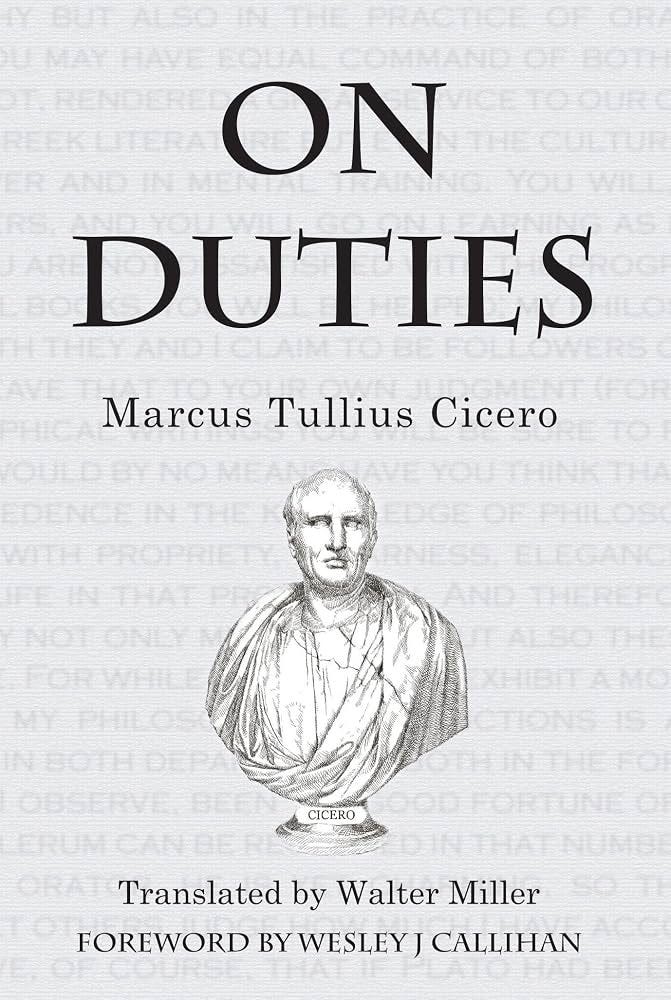
5. Cicero’s On Duties (De Officiis)
Written in the last months of his life after Caesar’s assassination. Cicero’s handbook of moral and political duty became the most influential Latin prose work of antiquity. Medieval and Renaissance schoolboys learned their Latin from it.
Friendly reminder: The Western Spirit exists because of readers like you. Join us and help keep this project alive and independent.
If you’ve been enjoying these essays, consider becoming a paid subscriber. For a few dollars a month, you’ll get:
Essays on brave men, and turning points in Western history
Reflections on faith, tradition, and culture
Full access to the growing archive - essays, book breakdowns, and deep dives
This project exists because readers like you make it possible.
It’s a practical philosophy of honour, justice, and what you actually owe in public life.
“We are not born for ourselves alone, but our country claims a share of our being, and our friends a share.”
(On Duties I.22, trans. Walter Miller)“The foundation of justice is good faith—that is, constancy and truth in promises and agreements.”
(On Duties I.23)“There are two kinds of injustice: the first is found in those who do an injury, the second in those who fail to protect another from injury when they can.”
(On Duties I.23)
6. Thucydides’ History of the Peloponnesian War
The first truly scientific history of the West. Thucydides was an Athenian general who lived through the war between Athens and Sparta. He refused myth and flattery. He recorded speeches, analysed power, and laid bare the realities of fear, honour, and interest.
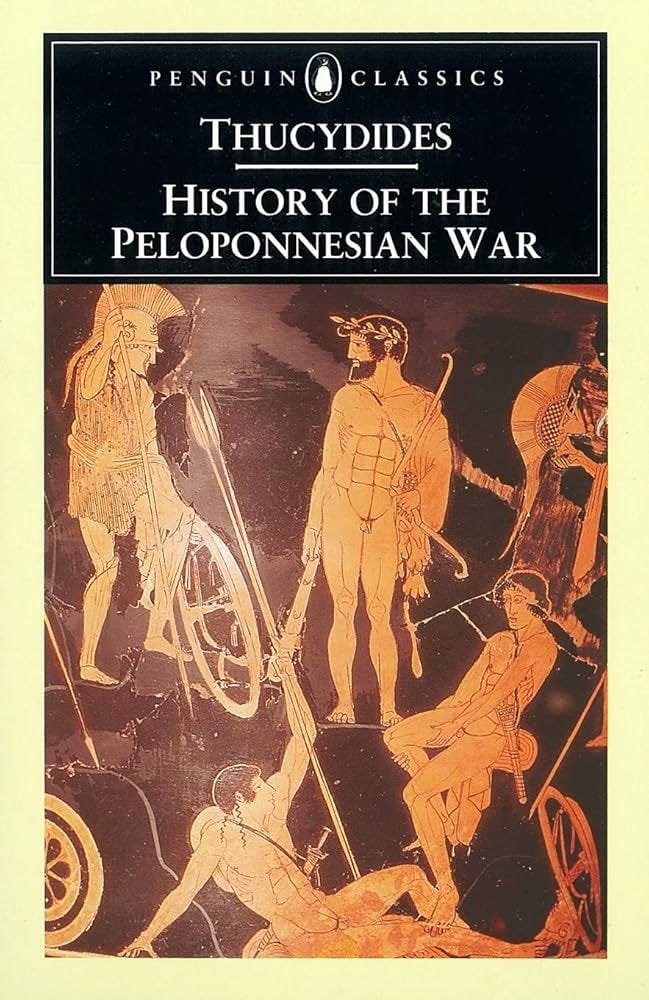
Hobbes translated him. The American Founders studied him. Statesmen still go back to the Melian Dialogue and Pericles’ Funeral Oration.
“The strong do what they can and the weak suffer what they must.”
(Melian Dialogue, V.89, trans. Rex Warner)“In peace and prosperity both states and individuals are actuated by higher motives, because they do not fall under the dominion of imperious necessities; but war, which takes away the comfortable provision of daily life, is a hard master and tends to assimilate men’s characters to their conditions.”
(III.82)
7. Marcus Aurelius’ Meditations
The private notebook of a Roman emperor ruling at the height of the empire while fighting on the northern frontiers. Written in Greek for his own use, the Meditations offer a stoic philosophy of duty, mortality, and self-command that still hits hard.
From medieval monks to modern soldiers and statesmen, people have found in these pages a model of the philosophical life under pressure.
“You have power over your mind—not outside events. Realize this, and you will find strength.”
(Meditations IV.3)“When you arise in the morning, think of what a precious privilege it is to be alive—to breathe, to think, to enjoy, to love.”
(Meditations II.1)“Waste no more time arguing about what a good man should be. Be one.”
(Meditations X.16)
8. Beowulf
The earliest major work of English literature and the greatest surviving epic of the northern Germanic world. Composed in Old English sometime between the seventh and tenth centuries, it tells of Beowulf’s battles against Grendel, Grendel’s mother, and a dragon.
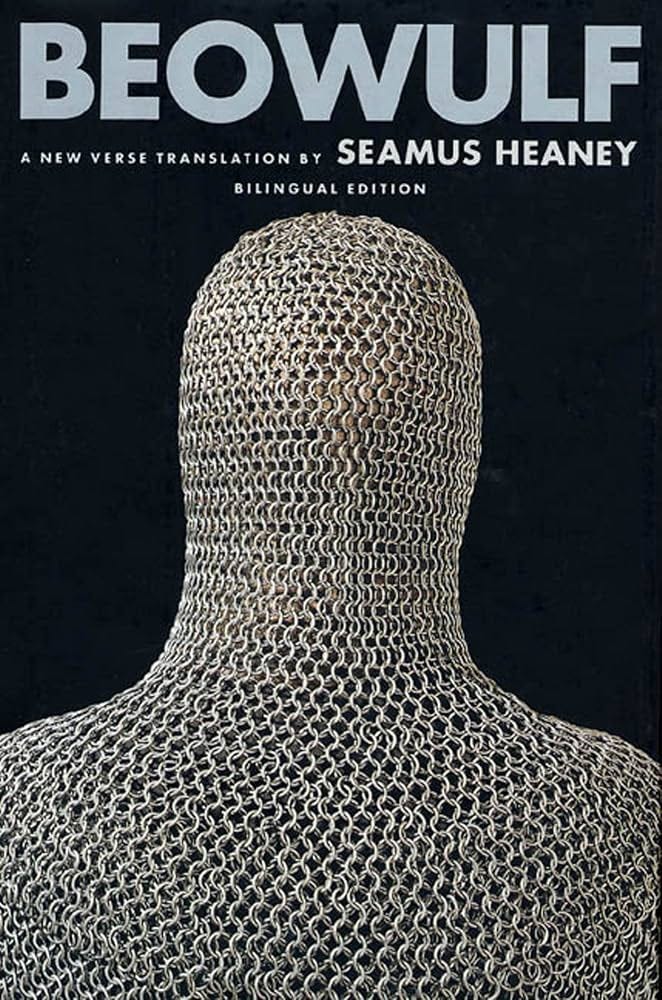
Preserved by Christian monks, the poem fuses pagan heroic values with a Christian sense of fate, courage, and how fleeting earthly glory really is. Tolkien’s scholarship and modern translations finally put it back where it belongs among the classics.
“Behaviour that’s admired is the path to power among people everywhere.”
(Beowulf lines 24–25, trans. Seamus Heaney)“It is always better to avenge dear ones than to indulge in mourning. For every one of us, living in this world means waiting for our end. Let whoever can win glory before death. When a warrior is gone, that will be his best and only bulwark.”
(Beowulf lines 1384–1389, Heaney)
By the way - we are about to start our most exciting read-along yet inside our book club.
The Brothers Karamazov.
If you've been on the fence about joining the Athenaeum Book Club, now's the time. You do not want to miss this.
We are reading it over the next 6 weeks, and now is the last call to join. First discussion is on August 4 (today), covering Books 1-4 (you don't have to have read all of that by then, just a few chapters is enough).
Our group read Crime and Punishment in May, and followed the harrowing yet illuminating journey of Raskolnikov. But The Brothers Karamazov, Dostoevsky's final and greatest work, takes his moral and spiritual ideas to their utmost height. Many consider it the greatest psychological novel ever written.
Take out a paid subscription if you want to join our "inner circle" and participate in the discussions directly. You'll get:
- Live book club discussions (biweekly)
- Access to our incredible community chat
- Essays to guide you through the Great Books
- All past recordings, essays, and podcasts
- Ability to vote on what we read next
Of course, you may also read along for free and tune into the live broadcasts. Let's make this our biggest read-along ever!
See you inside