
A few days ago, while writing about the Battle of Yarmouk and the Muslim conquest of the Christian Middle East, I came across a story I had never heard before, and it takes us to Gaza, only a few years after the death of Muhammad.
Today we think of Gaza entirely through modern politics, but seventh-century Gaza belonged to a completely different world, because it was a predominantly Christian city within the Eastern Roman Empire, surrounded by monasteries and home to a flourishing Christian intellectual tradition.
Then the armies of the new Islamic caliphate arrived.
And among the Christians caught in the conquest were sixty Byzantine soldiers whose story survived in an early Christian martyrdom account known as the Passion of the Sixty Martyrs of Gaza. The surviving version is a Latin translation deriving from a lost Greek original, and although, like other hagiographical texts, some of its details require caution, historians value it as an early Christian account of the Arab conquest of Palestine.
A Few Years After Muhammad’s Death
Muhammad died in 632, and what followed happened incredibly quickly, because Muslim armies poured out of Arabia and began attacking the two great powers surrounding them, the Christian Byzantine Empire to the north and the Sassanid Persian Empire to the east.
Then came Yarmouk in 636, where the main Byzantine field army in Syria suffered a catastrophic defeat.
Palestine was now exposed.
Jerusalem surrendered shortly afterward, while Gaza also passed from Byzantine into Muslim hands during this first wave of conquest.
According to the Passion, when Gaza negotiated its surrender, terms were granted to the city but did not include the Byzantine soldiers defending it, and the sixty members of the garrison were consequently seized and imprisoned:
“It happened in that time with regard to the atheist Saracens that they besieged Gaza, that city beloved of Christ, and the city, forced by necessity, asked for terms. This was done. The Saracens granted terms to [the city], but without [including] the soldiers who were captured in the city. Entering the city and seizing these most Christian soldiers, they confined them to prison. The following day Ambrus ordered the holy Christian soldiers to be summoned. When they were brought to him, he [tried to] compel them to recede from the confession of Christ and from the precious, life-giving cross of our Lord Jesus Christ. When they would not agree to do this, Ambrus ordered their wives and children and arms to be separated from them and sent them again to prison.”
And this is where their story really begins.
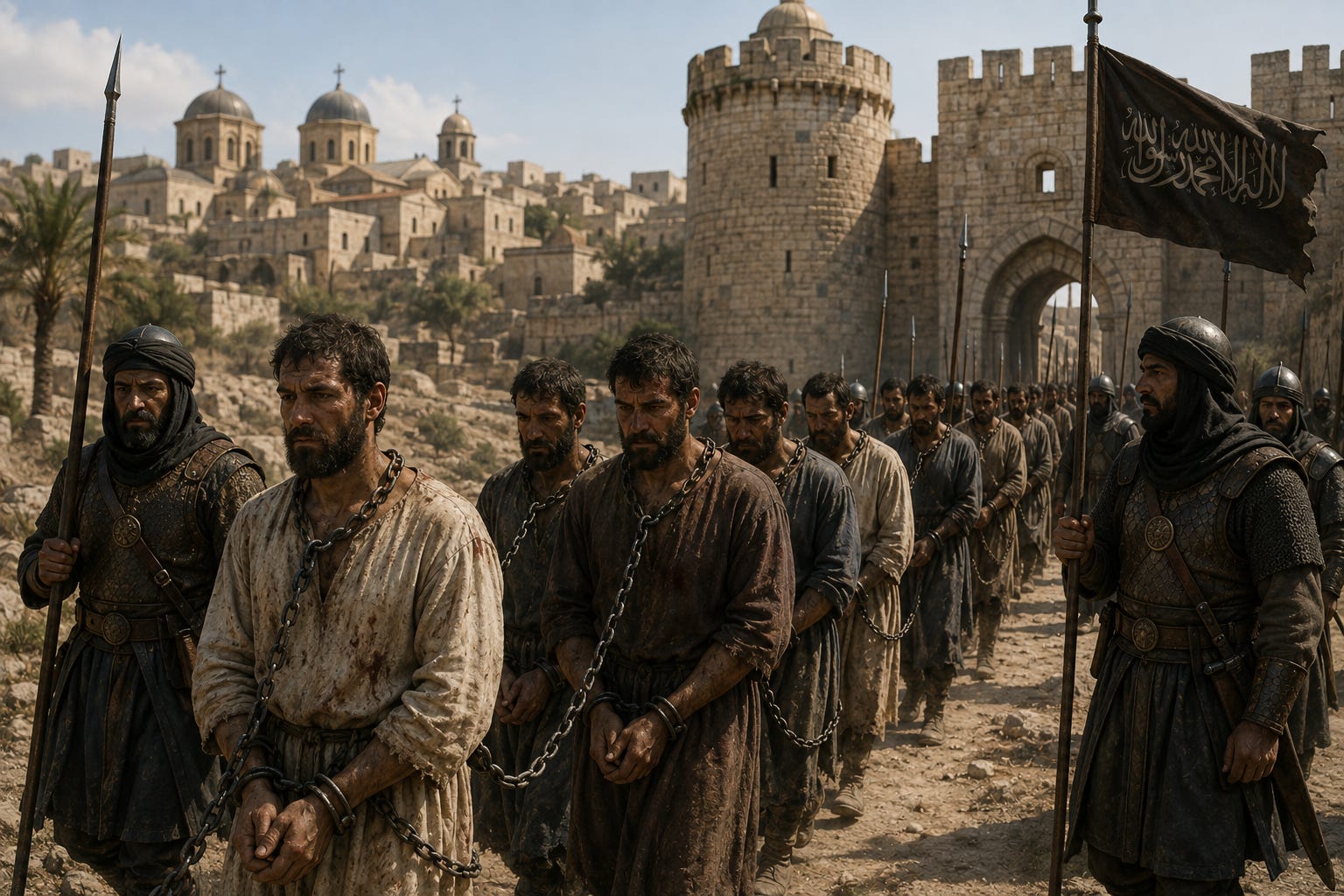
The Sixty Soldiers Are Given a Choice
According to the Christian account, the prisoners were brought before a Muslim commander whom the surviving Latin text calls Ambrus, possibly a corrupted reference to the famous Arab commander ʿAmr ibn al-ʿAs.
The soldiers were pressured to abandon their confession of Christ and the Cross.
They refused.
Their weapons were taken from them, they were separated from their wives and children, and rather than being released with the rest of the city they were returned to prison.
And they stayed there.
The account describes them being moved from Gaza to Eleutheropolis, the ancient city near modern Beit Guvrin, where they remained imprisoned for months before eventually being transported in chains to Jerusalem.
Then the Patriarch of Jerusalem Came to Them
One of the most interesting figures to appear in the story is Sophronius, Patriarch of Jerusalem, the same Christian patriarch traditionally associated with Jerusalem’s surrender during the Muslim conquest.
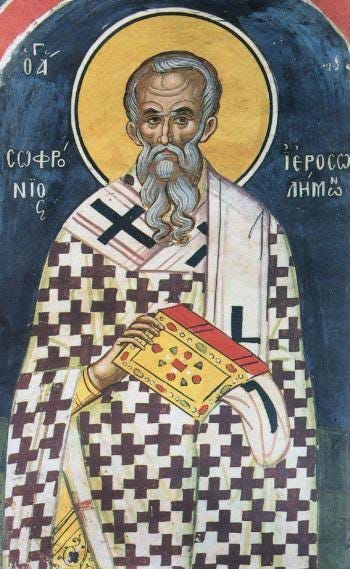
According to the Passion, Sophronius learned that the soldiers were imprisoned in Jerusalem and visited them during the night, encouraging them to remain faithful to Christ regardless of what happened next:
“Being held there for another three months, the aforementioned impious Ambrus, sending Saracens, brought them from prison and led them into the Holy City to be sent again to prison. Learning of this, the most holy patriarch Sophronius went to them at night, admonishing and begging that they not recede from the confession of Christ, who died for us; and that not one of them be separated with regard to the faith of our Lord Christ. In a similar manner, the first of the holy martyrs of Christ by the name of Callinicus, admonished and begged them every day that they be imitators of the forty holy martyrs. … Hearing this, the most holy patriarch Sophronius did not rest that night, begging with tears and admonishing each one concerning the faith of Christ.”
Continue reading below…
Friendly reminder: The Western Spirit exists because of readers like you. Join us and help keep this project alive and independent.
If you’ve been enjoying these essays, consider becoming a paid subscriber. For a few dollars a month, you’ll get:
Essays on brave men, and turning points in Western history
Reflections on faith, tradition, and culture
Full access to the growing archive - essays, book breakdowns, and deep dives
This project exists because readers like you make it possible.